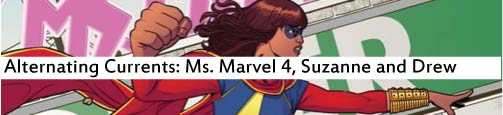
Ms. Marvel 4

ms marvel 4Today, Suzanne and Drew are discussing Ms. Marvel 4, originally released May 28th, 2014.

slim-banner

“What’s Ms. Marvel supposed to look like?”

Kamala Khan

Suzanne: It’s easy to get wrapped into other people’s expectations of you. Subtle messages and feedback from friends and strangers can inadvertently contribute to your sense of self. I’m reminded of this every time I walk into a comic book shop with my husband. The (male) store clerks start up a conversation with him and barely acknowledge my presence. Little do they know that he’s just keeping me company and doesn’t even read comics. So what is a comic book nerd supposed to look like? Would most people even consider women a part of the general readership? Stereotypes like the balding, Caucasian comic shop owner and socially awkward fans like Sheldon from The Big Bang Theory are still common in pop culture. Continue reading

Ms. Marvel 3

ms marvel 3

Today, Suzanne and Shelby are discussing Ms. Marvel 3, originally released April 16th, 2014.

slim-bannerSuzanne: Let me just come out and say it — as a Muslim, I’m equal parts thrilled and reluctant to embrace a comic that represents someone from my faith. Overall, I like when writers incorporate details like ethnicity or religion as part of a whole character. This goes across the board — from Kitty Pryde being Jewish to Daredevil being Catholic. I’m signed on as long as the writing doesn’t divert into tokenism or pandering to a specific group.

Continue reading

Serious Issues: The Janelle Asselin Controversy pt. 2 – Representation

Serious Issues: The Janelle Asselin Controversy pt. 1 - Context

Interviewer: So, why do you write these strong female characters?
Joss Whedon: Because you’re still asking me that question.

This exact change may be a tad apocryphal. The rhetoric is too biting, too effective, even for a wordsmith like Whedon to toss out on the fly. The quote comes from a speech Whedon gave on gender equality, and it’s the well-scripted button on the top of an extremely well-crafted, well-reasoned argument for normalizing equality. The reason his response cuts so deep is because it is an intuitive truth. I can’t tell you how many times we’ve patted artists on the back for not being lecherous fuckers, or how frequently we need to sing the praises of a writer that creates female characters with real agency. We are so used to the imbalance between quality female characters and quality male characters that simply resisting this trend is often greeted as progress. This needs to change. Continue reading

Inhuman 1

inhuman 1

Today, Shelby and Patrick are discussing Inhuman 1, originally released April 2nd, 2014

Shelby: I have always been somewhat baffled by racism. I can’t understand the reasoning behind looking at another human being and deciding that they are inferior because of the color of their skin. I understand that racism exists, I’m certainly not trying to deny it, I just don’t understand the logic (such as it is) behind it. How can any one human be inherently better than another? And what could skin color possibly have to do with it? As Charles Soule kicks off Inhuman 1, he presents us with a situation where there IS a branch of humanity which is measurably superior. The Inhumans are stronger and more powerful than the rest of us mere mortals, and some are not afraid to show it. The real question is, once these inferior humans start instantly transforming into superior beings, what are all those racist Inhumans going to do about it?

Continue reading

Ms. Marvel 1

ms  marvel 1

Today, Drew and Spencer are discussing Ms. Marvel 1, originally released February 5th, 2014. 

slim-banner

But what did he see in the clear stream below? His own image; no longer a dark, gray bird, ugly and disagreeable to look at, but a graceful and beautiful swan.

Hans Christian Andersen, The Ugly Duckling

Drew: We all know the story, but have you ever actually read Hans Christian Andersen’s original The Ugly Ducking? It’s beyond dark. Before he realizes he’s actually a swan, the ugly duckling has embraced suicide as his only escape from a life as an outcast. Even without that particular detail, the ending has always struck me as grim. The happy ending stems from the ugly duckling actually being classically beautiful, after all, not from any kind of acknowledgement that looks aren’t everything. This particular duckling happened to be a swan, but what of ducklings that are actually ugly? I guess those end up actually committing suicide. In spite of this straight-up “difference is awful (unless it happens to make you the same as someone else)” message, this story is treated as though it empowers different-looking children. Its contradiction is almost tragic. As I read through the letters column of Ms. Marvel 1, which praised the notion of a non-white heroine, I couldn’t help but feel that same tragic disconnect, as the heroine herself turns out to be, well, you can see for yourself after the jump. Continue reading