Paper Girls 2

paper girls 2

Today, Drew and Ryan M. are discussing Paper Girls 2, originally released November 4th, 2015.

Drew: How early in a narrative can you usually predict the ending? Usually, when we describe a narrative as “predictable” we mean that derisively, but most stories have prescribed endings — oftentimes, the genre of the story is enough to hint at the ending: how does a romantic comedy end? How about a murder mystery? What about a sports movie? There are obviously countless examples that subvert those expectations, but those play by the same rules — the ending can be flipped, sure, but the potential endings are still reduced down to a small handful of options. Unless, of course, that story “defies genre,” evading any of the pigeonholes that would dictate its ending (or at least evading them long enough for you to get sucked in). That’s exactly the case with Paper Girls 2, where the deepening mystery thwarts any expectations about what might happen next. Continue reading

Black Magick 1

Alternating Currents: Black Magick 1, Drew and Michael

Today, Drew and Michael are discussing Black Magick 1, originally released October 28th, 2015.

Drew: Police stories tend to be more about cases than about characters. Law and Order is a prime example — the detectives and ADAs mostly serve as charismatic cogs in a machine, only hinting at “character” insofar as they have different manners of speech and dress. Sure, every once in a while you’d be asked to care about someone’s home life, but the fact that it always felt awkward and forced illustrates my point — we only cared that they got the bad guy, not that they were driven into police work by an overbearing father or whatever.

But then there are police stories that manage to make their characters’ psychology a key element of the narrative — The Wire springs immediately to mind, making the wants and habits and vices of its detectives as important to understanding the story as any piece of evidence they might find. Greg Rucka and Ed Brubaker struck a similar balance in their Gotham Central, where the romantic and familial relationships of the characters played key roles. It’s no surprise, then, that Black Magick 1, Rucka’s latest police story, features a detective who is every bit as intriguing as the case she’s called to. Of course, as was often the case with Gotham Central, it may be difficult to separate the character from a case that seems so personal. Continue reading

Tokyo Ghost 2


tokyo ghost 2

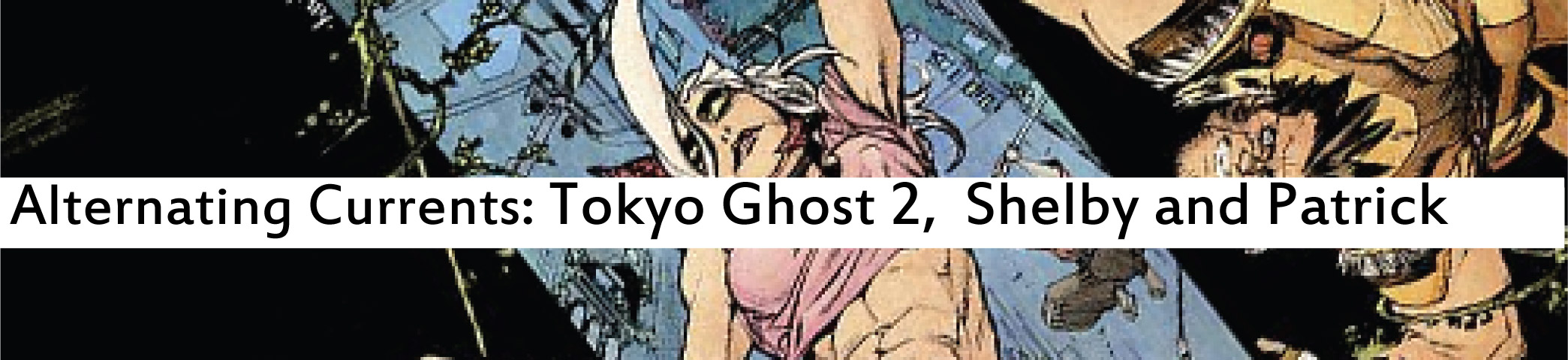
Today, Shelby and Patrick are discussing Tokyo Ghost 2, originally released October 21st, 2015.

Shelby: We got Internet at my house when I was in high school. I had experienced it before then, of course, but I was old enough to remember that moment my farm in rural northern Wisconsin was plugged in and online. Those of us in our late 20s/early 30s are probably the last generation to remember life before the internet, when life and plans had to be scheduled ahead of time instead of on the fly, when the thought of connecting to someone a world away was unheard of, when there was just some information you didn’t have constant access to. As someone who feels too old be a Millenial and too young to be a Gen-Xer (or whatever came before the current generation), I feel of two minds about our near constant plugged in state, but Rick Remender, Sean Murphy, and Matt Hollingsworth sure don’t. The future they’ve envisioned in Tokyo Ghost is a world where the worst parts of the Internet have taken over, and it is somehow grimmer and more fascinating than you’d imagine. Continue reading

I Hate Fairyland 1

Alternating Currents: I Hate Fairyland 1, Drew and RyanToday, Drew and Ryan M. are discussing I Hate Fairyland 1, originally released October 14th, 2015.

Drew: When I was in high school, I used to annoy a friend of mine by insisting that all ska music sounds the same. I suspect the vast majority of people might agree that ska has a pretty specific sound, but that’s true of virtually any artistic style, from country music to cubism — if you aren’t placing it in the appropriate context, you’ll only notice the most superficial elements, which necessarily define the genre. I’d argue that certain artists are so unique that they present a genre unto themselves, which is why sophomore efforts from those artists, say Spike Jonze’s Adaptation or Weezer’s Pinkerton, are chronically under-valued: we notice only the superficial similarities to their previous work, failing to appreciate what makes this one different. History tends to right those wrongs, but it can be hard to correct in the moment. So please, don’t hold it against me when I suggest that Skottie Young’s I Hate Fairyland presents a cuter, cruder take on his Rocket Raccoon. Continue reading

East of West 21

east of west 21

Today, Taylor and Patrick are discussing East of West 21, originally released October 14th, 2015.

Taylor: The stories that keep me on the edge of my seat are the stories that reveal just enough, but never the whole thing. While this is true of any story, it is especially true of any story that is syndicated; you need to keep my attention sustained not just over a short amount of time, but possibly years. The TV shows Lost and Battlestar Galatica were able to do this simply by withholding information from me. While that was maddening at times, I openly enjoyed it because it let me engage the world in ways other stories didn’t. Instead of passively watching events unfold, I was always guessing what would happen next. While East of West may not possess the same level of intrigue, it does keep me guessing where it’s going next each issue. It’s wildly unpredictable in the best way possible.

Continue reading

Paper Girls 1

paper girls 1Today, Patrick and Spencer are discussing Paper Girls 1, originally released October 7th, 2015.

We all see what we want to see. Coffey looks and he sees Russians. He sees hate and fear. You have to look with better eyes than that.

Lindsey Brigman, The Abyss (1989)

Patrick: When The Abyss came out in 1989, the Cold War was still very much a part of the American Zeitgeist. So much so, that a James Cameron movie about underwater aliens necessarily had to address political tensions between the US and the Soviets and the fear of nuclear annihilation. Those themes are more clearly expressed in the lumpier director’s cut of the film, but even the theatrical release is colored with assumptions and anxieties specific to that period in time. I love The Abyss, but I probably didn’t see it until I was 11 or 12 (1994 sounds right), which means I was able to take it in from the other side of the Berlin Wall, and none of those relics of Cold War paranoia rang true to my personal experience. But rather than being alienating, those details tap into an existing international psychology, and create a world that is instantly recognizable as real, honest, and not so far outside the world we know. Paper Girls pulls a similar trick, filling the pages with 1988 details that don’t so much tell a story as set the scene for a story. Continue reading

Nameless 5

Alternating Currents: Nameless 5, Drew and Patrick

Today, Drew and Patrick are discussing Nameless 5, originally released September 23rd, 2015.

I’m an insect who dreamt he was a man…

Seth Brundle, The Fly

Drew: When I was first searching for that quote, I was convinced it was actually from Franz Kafka’s Metamorphosis. Or, at least, I thought there was a line in Metamorphosis questioning whether Gregor Samsa was a man who dreamt he was an insect, or an insect who dreamt he was a man. I suppose it’s fitting that, while trying to find a quote about the elusive line between fantasy and reality, I ended up looking for a quote that didn’t actually exist. Of course, because Metamorphosis is a real text that exists outside of my head, I can verify what quotes it does or does not contain — it’s a reasonably straightforward binary, translation errors notwithstanding. The events of Nameless, on the other hand, are fictional, so there is no “real.” How, then, do we distinguish its dream sequences from the rest? The answer might just be that we can’t, which could be what this series is all about. Continue reading

Sex Criminals 12

Alternating Currents: Sex Criminals 12, Drew and Michael

Today, Drew and Michael are discussing Sex Criminals 12, originally released September 16th, 2015.

Drew: Human beings find meaning in things. It makes sense as a survival mechanism — recognizing patterns or hypothesizing causal links can lead us towards food or away from danger — but it’s also not something we can turn off. A friend of mine once pointed out that you can fill one of those logical analogies (you know, “puppy is to dog as kitten is to cat”) with four totally random words and it will still make some kind of sense — that is, we can find meaning in connections that are literally drawn out of a hat. To me, that means that “meaning” doesn’t necessarily have objective basis in reality — it’s a thing that we construct because that’s what our brains do. This has some rather profound existential consequences, but for the purposes of our discussion of Sex Criminals 12, I want to focus on what it means for the characters, as this issue finds them each extrapolating meaning that might not be there. Continue reading

The Fade Out 9

fade out 9

Today, Spencer and Drew are discussing The Fade Out 9, originally released September 16th, 2015.

Spencer: Those in power always prey upon those they consider “beneath” them. This is true in pretty much every aspect of life, but especially in the Hollywood depicted in Ed Brubaker and Sean Phillips’ The Fade Out. Almost every character in this title is a victim in one way or another, and issue 9 takes a special interest in the damage those with power inflict upon those less fortunate than themselves.  Continue reading

Phonogram: The Immaterial Girl 2

phonogram 2Today, Spencer and Shane are discussing Phonogram: The Immaterial Girl 2, originally released September 9th, 2015.

Spencer: Quite a few people who know me in real life think that I’m very quiet and shy. I suppose that’s closer to the truth than I’d like to admit, but the reality is that if you get me talking about the right subject, I’ll never shut up. Sometimes, it actually scares me how I can only seem to relate to people if we can chat about comics or music or pop culture — especially as I grow older and my friends and family turn their attention more and more to falling in love and raising families. I have to wonder if there’s something wrong with me, if my hyper-intense focus on my hobbies makes me a lesser, “two-dimensional” person. The cast of Kieron Gillen and Jamie McKelvie’s Phonogram: The Immaterial Girl seem to be dealing with the same kind of worries in issue 2, even if they’re not quite self-aware enough to articulate them yet. Continue reading