Zero 14

zero 14 Today, Drew and Taylor are discussing Zero 14, originally released January 28th, 2015. Art and Social Function

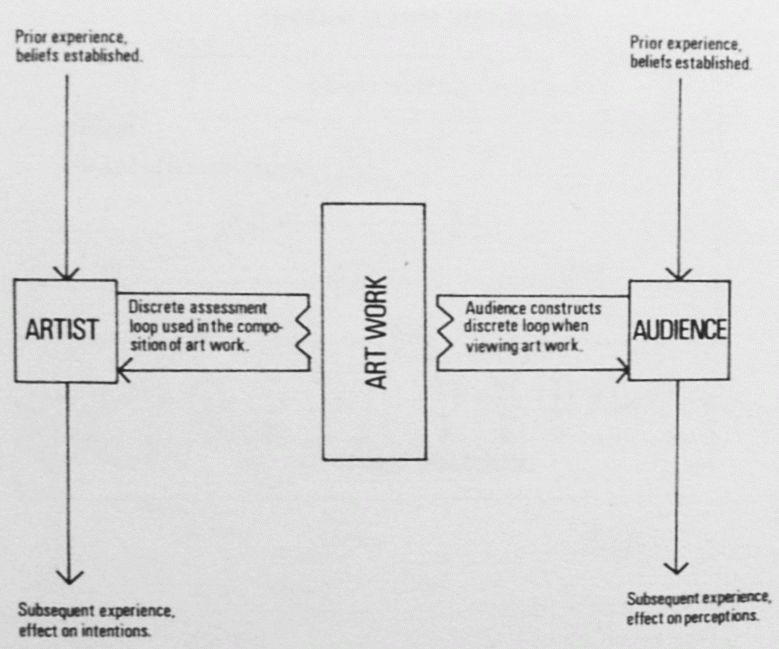
Two fundamental discrete cognate loops are shown, which are isolated from each other by the artwork. There is no form of interaction between the two which could generate mutual understanding as would be the case in a successful conversation. In the absence of such a procedure both the audience and the artists become locked in their own perceptual biases.

Stephen Willats, Art and Social Function

Drew: Where does meaning happen? I was brought up on the postmodern ideals outlined in the epigraph, but it seems that a great deal of modern society still clings to romantic notions of artistic intention. We celebrate and scorn artists based on their intentions, forgetting that the value of their art may not have anything to do with the artist. Indeed, we’re so obsessed with intention that we conflate it with meaning, minimizing the audience’s role — a role I might argue is the whole point of art in the first place. It’s because of this climate that I enjoy art that obscures its artist’s intentions. It’s easy to assume the moral is the “point” of one of Aesop’s fables, but it’s decidedly harder to draw such a clean line in something like Zero 14, where ambiguity and sheer density of ideas makes any meaning we can parse decidedly our own. Continue reading

The Wicked + The Divine 7

Alternating Currents: The Wicked and The Divine 7, Drew and Spencer

Today, Drew and Spencer are discussing The Wicked + The Divine 7, originally released January 21st, 2015.

Drew: Religion is such a weird thing in comics. Both of the Big Two feature actual gods in their publishing line, which opens up a whole host of ontological questions — Did these gods play a role in the creation of the universe? How did they come to exist? — but these characters largely aren’t designed to answer religious questions. Just like Superman isn’t really about the existential questions raised by alien societies, the likes of Thor and Wonder Woman aren’t really about mythology — goddom is just another avenue to explain why your characters would have superpowers. It was easy for me to confuse The Wicked + The Divine with this type of story — neither is ultimately interested in the religious implications of having gods up and walking around — but as the series’ themes continue to solidify, it’s become ever more apparent that the powers don’t matter, either. “God” is just an exaggerated stand-in for “teen idol,” and given the way our society treats celebrities, it’s not that much of an exaggeration. Continue reading

The Wicked + The Divine 4

wicked and divine 4Today, Spencer and Suzanne are discussing The Wicked + The Divine 4, originally released September 17th, 2014.

Spencer: Last year I had the privilege of spending a day working as a roadie for my favorite band, Saves the Day. I was extremely fortunate that the guys in Saves lived up to my expectations; they’re probably the nicest, most genuine guys I know and went out of their way to make me feel comfortable, but even so, spending time backstage with them and their crew felt like entering a strange new world, with culture and customs all their own. I couldn’t help but think about this while reading Kieron Gillen and Jamie McKelvie’s The Wicked + The Divine 4, as Laura gets to spend time in the private world of her idols. But while I had the best day of my life, Laura seems to walk away from the experience in much deeper trouble than when she started. Continue reading

The Wicked + The Divine 3

wicked and divine 3Today, Spencer and (guest writer) Shane are discussing The Wicked + The Divine 3, originally released August 20th, 2014.

Spencer: When Patrick and I would discuss Young Avengers, our articles would often turn into debates about whether the dialogue was “too clever” or not (I’m thinking of this article in particular). I’ve personally always thought that something being “too clever” wasn’t possible — I love distinctive, clever dialogue and prefer that to dialogue that tries to be realistic and instead comes across as bland or boring — but I admit I caught myself thinking “man, this might be too clever for it’s own good” once or twice as I read The Wicked + The Divine 3. Fortunately, I think there’s some sound, character-based reasons for the “cleverness” of the cast (specifically Morrigan and Baphomet) that helps to inform how the title’s pantheon view themselves compared to the world at large — and how the world at large views them. Continue reading

The Wicked + The Divine 1

wicked and divine 1Today, Spencer and Patrick are discussing The Wicked + The Divine 1, originally released June 18th, 2014.

Spencer: There’s a reason they call pop stars “idols.” I’ve been to concerts that were essentially religious experiences to many in the crowd; whether it’s their larger than life style or the way they can connect with their listeners, pop stars (as well as many other musicians and celebrities) have, unintentionally or not, set themselves up as a new pantheon of modern-day deities. Kieron Gillen and Jamie McKelvie have hit plot beats similar to this before with Phonogram — where music is magic — but in The Wicked + The Divine 1, they literally turn gods into pop stars, complete with concerts-as-masses and a snazzy 1-2-3-4 whenever they display their gifts. It seems to be a pretty apt look into modern-day spirituality. Continue reading