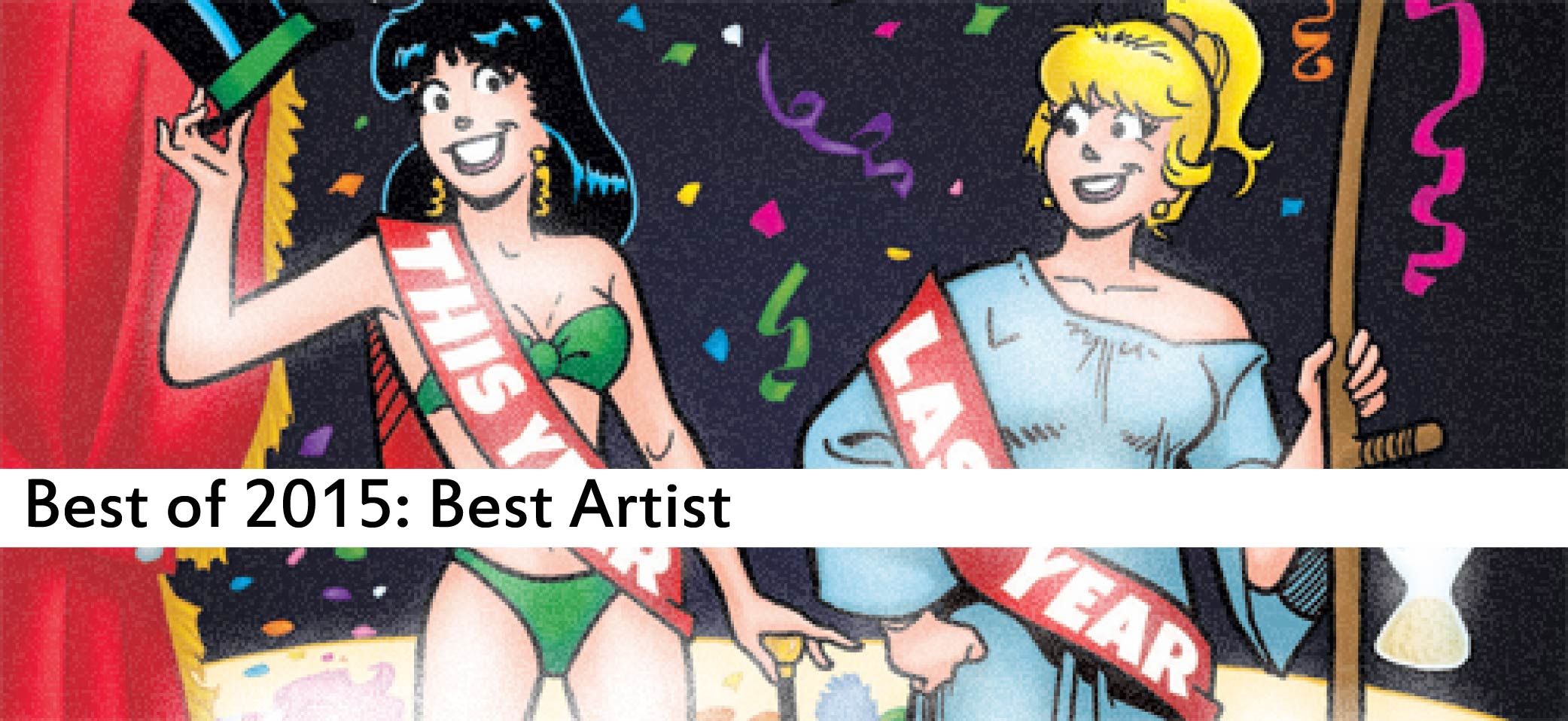
Without artists, all of your favorite characters, scenes, costumes, and locations would just be words on a page. In short, they’re the ones that make comics comics. That’s a lot of responsibility, yet the best artists manage to juggle all of those tasks and inject some meaningful art and style into the proceedings. Whether its a subtle expression or a jaw-dropping action sequence, our favorite artists add the requisite magic to make their worlds and characters real. These are our top 10 artists of 2015.
Continue reading
Tag Archives: Fiona Staples
Saga 31

Today, Ryan D. and Drew are discussing Saga 31, originally released November 25 2015.

Ryan D: The hiatus is over! Superstar creative team Brian K. Vaughn and Fiona Staples have been keeping themselves rather busy since issue 30 released a million years ago in July, hitting Comic Cons and embarking upon new series. Though Vaughn’s mini-series We Stand on Guard outsold Saga in the month of it’s debut, the Eisner-winning space opera returns with a new chapter which promises to keep returning readers satiated with its signature bend of absurdly imaginative and developed characters in an ever-expanding universe. Continue reading
Archie 3

Today, Patrick and Ryan M. are discussing Archie 3, originally released September 30th, 2015.
Patrick: David Fincher’s adaptation of Fight Club surpasses the original Chuck Palahniuk novel in a lot of ways — chief among them is Fincher’s stylish filmmaking. Fincher is so cool behind the camera, and the gulf between the drudgery of the narrator’s everyday existence and the idyllic (if chaotic) world that Tyler Durden offers is wide enough to made Durden’s obviously bad ideas sound like great ones. That’s a tool that Palahniuk didn’t really have at his disposal — Tyler’s ideas seem much more ridiculous on the page without that veneer of cool to legitimize them. My favorite way that Fincher improves on Palahniuk’s story is in the meeting between the narrator and Tyler — up until this point, the audience is inundated with Edward Norton’s voice over, and an almost oppressive score from the Chemical Brothers. The film is also largely an extended montage until we meet Tyler, and the pacing of the scenes quicken right up to the point that they wind up next to each other on a plane. But the action, the narration, and the score all come to a screeching halt the second Tyler opens his mouth. He represents freedom from all the neurosis the narrator has been filling our head with since the moment the movie started. Tyler — both in the life of the narrator and in the film — is the ultimate disruptor. Archie 3 pulls a very similar trick, but who has the force of personality to be Archie’s Tyler Durden? Why, Veronica Lodge, of course. Continue reading
Archie 2

Today, Spencer and (Guest Writer) Ryan Mogge are discussing Archie 2, originally released August 19th, 2015.
Spencer: First issues are meant to sell a title to new readers. The creative team is putting their finest foot forward, introducing their characters, world, and the conflicts and themes they wish to explore, but the one thing first issues aren’t great at is showing how the creative team is going to tell their story from month to month. It often takes a few issues for readers to start to get a handle on a series’ format, and that’s very much the case with Archie. Mark Waid and Fiona Staples’ first issue wow-ed readers with its gorgeous, modern reinterpretation of Riverdale, but it’s issue 2 that gives us a clearer picture of just what kind of stories we can expect each month. Continue reading
Archie 1

Today, Drew and Spencer are discussing Archie 1, originally released July 9th, 2015.
Drew: Ah, the reboot. Comics have a long history of restarting characters from the beginning (or something resembling it), but new artists reimagining familiar characters can be seen everywhere, from Peter Pan to Macbeth. The recent popularity of rebooting movie franchises, however, has often smacked of a dearth of ideas. Reboots have all of the familiarity of sequels, but without any of the risk of putting characters in new situations. Or, at least, that’s the cynical attitude I tend to bring to reboots. Archie 1 proves to be surprisingly daring, even as it riffs on characters and situations that have been around for decades. Continue reading
Saga 29
Today, Drew and Spencer are discussing Saga 29, originally released June 10th, 2015.
Turning and turning in the widening gyre
The falcon cannot hear the falconer;
Things fall apart; the centre cannot hold;
Mere anarchy is loosed upon the world,
The blood-dimmed tide is loosed, and everywhere
The ceremony of innocence is drowned;
The best lack all conviction, while the worst
Are full of passionate intensity.William Butler Yeats, “The Second Coming”
Drew: Written in the wake of the first World War, “The Second Coming” features some of the most vivid images in modernist poetry. The second stanza takes on a more biblical tone, name-dropping the titular second coming, but the first stanza, quoted above, features no hint of the divine — this is pure horror of war stuff. Of all the concepts Yeats evokes, the notion that “the best lack all conviction” might actually be the scariest to me. If war can change our values and convictions, what are we actually fighting for? Curiously, we talk about becoming a parent in similar ways: our values and priorities shift around when we have a child to care for. Saga has always existed at the weird intersection between war and parenthood, but issue 29 makes its exploration of the values we sacrifice in the name of either a bit more explicit. Continue reading
Saga 28
Today, Drew and Patrick are discussing Saga 28, originally released May 13th, 2015.
Drew: There are few things more depressing than studying altruism at a biological level. In a world driven by survival, what could possibly compel an individual to risk life and limb (or, more modestly, share food and shelter) with another? For sexually mature individuals, the most obvious answer is reproduction — helping your mate or your offspring survive increases the chance of your genes, and thus, the behavior of protecting your mate and offspring, will be carried on to future generations. But what about other relationships? Well, in 1964, W.D. Hamilton proposed that we help others for basically the same reason we protect our offspring: because we share genes with them. Importantly, we only share genes with those that are actually related to us, and a key part of Hamilton’s formula was the “relatedness coefficient” — essentially, you’re more likely to help your sibling than your cousin because you’re more related to them, or, more precisely, because you’re more likely to share genes with them. Which is to say, we don’t help people at all, we help their genes, and only because their genes are our genes. From that perspective, “altruism” doesn’t exist at all — we’re all just working in service of totally self-interested genes.
Of course, we’re not entirely driven by our genes. If genes give us our hardware, culture gives us our software, allowing us to do all kinds of things our genes wouldn’t dream of, from taking vows of celibacy to covering a live grenade to protect our platoon. Those are some extreme examples, but I think they become more relatable when we think of those acts as protecting family. Sure, a religious congregation or military unit aren’t technically families, but they can act as families for those who need it. It’s exactly these types of makeshift families — and the sacrifices they elicit — that Saga 28 is all about. Continue reading
Saga 27

Today, Patrick and Drew are discussing Saga 27, originally released April 8th, 2015.
Grace comes home drunk some times / and beats on the doorway to my guts. / I fumble with the locks / ’til the wound opens up. / She falls in, laughing: “Honey, I’m home.”
I wince as she stumbles up my spine / leaves a trail of bruises on my ribs. / I choke on her dancing on my tongue / she kicks out a tooth. / “Honey, I’m home.”
She lights a cigarette inside my head / blows all the smoke into my eyes / until she sees a tear. / Then she sighs: “just what I thought — another fragile Buddha”
Stuart Davis, “Grace”
Patrick: The language of love and the language of violence are uncomfortably similar. I’d also argue that they are two cultural constants we never really understand. The impulses to nurture and destroy are down deep in the human subconsciousness, ungoverned by rationality. Bryan K. Vaughan and Fiona Staples explore this through Marko’s bad fadeaway trip in Saga 27, suggesting that pacifism may mute more than Marko’s passion for violence, but all of his passions. He wakes up with a clarity, but is that a clarity to be celebrated or to be reviled? Continue reading
Saga 25

Today, Ryan and Patrick are discussing Saga 25, originally released February 4th, 2015.
Ryan: Pop culture loves rebels. We hang posters of them in our dorm rooms, whether they have a cause or not. We wear red graphic t-shirts emblazoned with their likeness, not very concerned about some of the more morally ambiguous acts this person committed. Luke Skywalker played figurehead for the Rebel Alliance and may be the most popular and beloved rebel of all time, despite the fact that the blood of 322,951 Death Star personnel (not to mention the oil of 400 thousand plus droids) stains his non-synthetic hand. Saga 25 adds another variable into the mix with the introduction of a third side to the outstanding war between Landfall and Wreath, while also providing another complication to the Dengo child-heist. Continue reading
Best of 2014: Best Series Part 2
 We all love a good one-off or anthology, but it’s the thrill of a series that keeps us coming back to our comic shop week-in, week-out. Whether it’s a decades-spanning ongoing or a short-run miniseries, serialized storytelling allows for bigger casts, bigger worlds, and bigger adventures. Indeed, we’re so enamored of serialization that we decided to split our favorite series list into two installments. Here’s part 2 our top 14 series of 2014 (click here for part 1).
Continue reading
 Retcon Punch