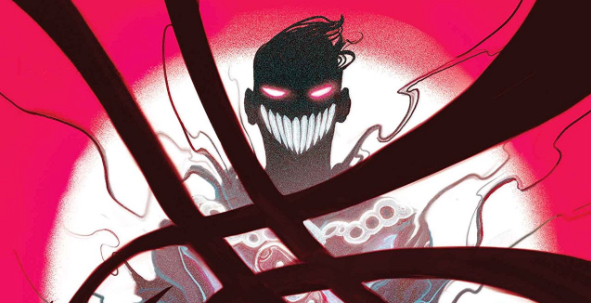
Doctor Strange 384: Discussion

by Michael DeLaney and Spencer Irwin

This article contains SPOILERS. If you haven’t read the issue yet, proceed at your own risk!

Michael: This is the second week in a row that I get to name-drop the Sentry! I think I may be in the minority when I say that I like the Sentry, the Dr. Jekyll Superman analogue with a Mr. Hyde counterpart called The Void. I don’t think that he should be headlining his own book, but I do like him as a co-star or part of an ensemble. Donny Cates makes excellent use out of the Sentry in Doctor Strange 384. Continue reading

Amazing Spider-Man & Venom: Venom Inc. Omega Spoils Itself

by Drew Baumgartner

Venom Inc Omega

This article contains SPOILERS. If you haven’t read the issue yet, proceed at your own risk!

How do we feel about Marvel’s “alpha” and “omega” strategy to crossovers? That is, mostly embedding the crossover in already-running monthlies, reducing the event series to just the first and last chapters of the story. They’re harder to skip by design — where you might be able to simply ignore an entire event series, you might be pulled into a crossover if a book you’re following is participating — but that can be frustrating to otherwise disinterested readers. Another downside that I hadn’t considered is that the stakes of an omega issue are kind of necessarily neutered — their inessential nature means they lack the ballast to make any changes that would be too earth-shattering to its participating series. Any big changes must have already happened in the series it would most effect, leaving the omega to tie up the loose ends with as little disruption to the status quo as possible. I don’t love to lead with these kind of meta-critiques of an issue (honestly, most superhero story arcs wrap up with the same kind of predictable return-to-normal), but Amazing Spider-Man & Venom: Venom Inc. Omega seems determined to keep it at the forefront of my mind, stymying any tension at every chance it gets. Continue reading

America’s Joy Defines America 11

by Spencer Irwin

This article will contain SPOILERS. If you haven’t read the issue yet, proceed at your own risk!

America‘s often breathless pace works to its favor in issue 11, a transition issue that manages to serve as an epilogue to the previous storyline while also diving head-first into the next, mixing heartfelt character moments with genuine thrills and actions, with none feeling out of place or poorly paced. For the moment, America Chavez is in a good place, and her joy shines through in this issue loud and clear. Continue reading

A Different Set of Stakes in Old Man Hawkeye 1

by Drew Baumgartner

Old Man Hawkeye 1

This article contains SPOILERS. If you haven’t read the issue yet, proceed at your own risk!

There are plenty of valid critiques of individual prequels, but I’ll never understand the argument that prequels are robbed of stakes because we know who survives the story. This ties into my wariness of spoiler concerns that privilege plot over all other aspects of consuming a story, but with the added twist of fetishizing death as the only stakes a story could possibly have. It falls apart under even the slightest scrutiny — the protagonist’s survival can be assumed for the vast majority of stories, and I reject the notion that this fact inherently makes those stories inferior. We know Vito must survive the flashback story in The Godfather Part II, but it is also regarded as one of the greatest movies of all time — held in higher esteem than virtually all movies where the protagonist might maybe die in the third act. Not all stories are life-and-death stories, and not all life-and-death stories require us to actually believe that the character might die. Such is the case with Old Man Hawkeye, which tells the story of Clint Barton before he went on that fateful road trip in Old Man Logan. (So, you know, heads up about spoilers for that series after the jump.)  Continue reading

Inspiring Vulnerable Populations in Ms. Marvel 26

By Patrick Ehlers

This article contains SPOILERS. If you haven’t read the issue yet, proceed at your own risk!

Kamala Khan is such a good kid. She get’s these stretchy-growy-shrinky superpowers and the very first thing she does is try to protect the vulnerable people in her community. Of course, that doesn’t mean helping impoverished families navigate the SNAP program or helping people with job placement or anything like that — it means punchin’ bad dudes with her temporarily over-sized fists. It’s an inspiring thing, both to read and for the characters within Kamala’s orbit. Issue 26 continues the ‘Teenage Wasteland” story arc by showing us just how thoroughly Kamala has inspired her friends to act as nobly and selflessly as she did when faced with roughly the same threat. Continue reading

Different Kinds of Strength in She-Hulk 161

by Spencer Irwin

This article contains SPOILERS. If you haven’t read the issue yet, proceed at your own risk!

Mariko Tamaki’s been taking Jennifer Walters on a long, singular journey towards recovery ever since taking over Hulk/She-Hulk, and the antagonists Jen has faced along the way have been specifically chosen to reflect different challenges of that journey, often by turning them into mirror images of Jen’s greatest fears. What does it mean, then, that She-Hulk 161 has two villains for Jen to face down? And what do these two foes have to say about where Jen’s head is right now? Continue reading

Found Family is an Attractive Force in Runaways 5

by Ryan Mogge

This article contains SPOILERS! If you haven’t read the issue, proceed at your own risk.

The band is finally getting back together in Runaways 5. After a few issues that establish the new normal, make sure all the characters are alive and show us what has and hasn’t changed in their personalities, Rainbow Rowell is ready to give the former Runaways a common goal. There is no better person to have at the center than Molly, the character who is simultaneously the most and least vulnerable. Continue reading

The Unbeatable Squirrel Girl 28 Piles on the Grifts

by Drew Baumgartner

Unbeatable Squirrel Girl 28

This article contains SPOILERS. If you haven’t read the issue yet, proceed at your own risk!

Loki stories are fun — and have been for literal millennia — because of the dynamic way storytellers let us in on his tricks. Sometimes, we’re only tipped off to the trick after the fact, allowing us to be fooled along with his audience. In other cases, we get to be “in” on the trick, effectively seeing it from his perspective. Or our perspective can shift at any point, allowing us to be fooled for a time before revealing the trick to us halfway through, introducing that bit of dramatic irony that makes trickster stories so fun. Ryan North and Erica Henderson understand the fun of all of those approaches, and mix and match them to glorious effect in Squirrel Girl 28. Continue reading

Gwen Faces the End in The Unbelievable Gwenpool 24

by Spencer Irwin

This article contains SPOILERS! If you haven’t read the issue, proceed at your own risk.

The first monthly comic book I ever followed was Geoff Johns’ Teen Titans in the early 2000s — it was the book that got me into comic shops every week, buying single issues and learning and following creative teams. Johns’ eventual departure from the title was also the first time I ever dealt with the end of a beloved run, and I didn’t handle it well; it felt like a friend had died. I should note that the series wasn’t even cancelled — it went on for over 50 more issues with several different creative teams — but the end of that particular take on the property that I loved so dearly was devastating nonetheless. The Unbelievable Gwenpool 24 finds Christopher Hastings and Gurihiru digging into a similar kind of loss as Gwen mourns the cancellation of her own comic book, only for her, the loss is far more real. Continue reading

Fisk Keeps His Enemies Closer in Daredevil 597

by Drew Baumgartner

Daredevil 597

This article contains SPOILERS. If you haven’t read the issue yet, proceed at your own risk!

What rock did these morally pure creatures crawl out from under and, more important, how do you go from innocent millipede to White House staffer without becoming soiled or disillusioned by the dirty realities of politics along the way?

Heather Havrilesky, “Will The West Wing go south?”

There are a lot of things to nitpick about The West Wing, between its heavy-handed Sorkin-isms and its penchant for too-saccharine resolutions, but the one criticism that I can’t stand is that it isn’t realistic enough. Of course it isn’t — it’s fiction. No, these aren’t how actual White House staffers would talk about issues, because how they actually talk would be totally impenetrable to the audience the show is actually made for. Tone-deaf critics would dismiss this as dumbing-down, but the alternative is a highly accurate but totally unwatchable bore. Policy wonks may lament that there’s no television truly tailored to their niche interests, but the rest of us want something, you know, entertaining. Moreover, we understand that in order to generate drama, characters in fiction may need to speak and act in ways that real people wouldn’t (hint: real people don’t only sit on one half of a dining room table or speak in iambic pentameter). Which means the hero sometimes has to be naive in their hopes and dreams — if they know they’re going to crash on the rocks, they might just call the whole adventure off, which doesn’t leave us with much of a story. Such is the case with Matt’s attempt to keep a watchful eye on Fisk. Continue reading