The Woods 2

woods 2Today, Spencer and Patrick are discussing The Woods 2, originally released June 4th, 2014.

Spencer: In narratives focused on teenaged characters, it’s common to pit the adults against the children in one way or another. Young Avengers recently took that conflict to extreme levels by making it so that the two groups literally couldn’t understand each other, but James Tynion IV and Michael Dialynas’ The Woods 2 plays things with a bit more subtlety; there is a major conflict between the faculty and the students of Bay Point Preparatory Academy, but the motivations of members of both sides seem to vary greatly. Continue reading

Batman ’66 Meets The Green Hornet 1

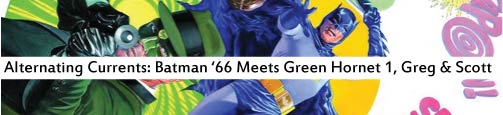
batman 66 green hornetToday, Greg and Scott are discussing Batman ’66 Meets The Green Hornet 1, originally released June 4, 2014.

Greg: Christopher Nolan’s Dark Knight Trilogy are both some of my favorite and least favorite things to happen to contemporary pop culture. I love them because the movies, particularly that second one, are smashingly good entertainments, with towering performances, consistent style, and an attitude of taking the world seriously that feels naturally extended from the best Batman comics and ‘90s animated series episodes. I hate them because now it feels like every single big budget blockbuster that comes out (even the new Captain America, for goodness’ sake) is dark, gritty, oppressively somber, po-faced, and muted. It’s a conflicting feeling because as much as I love the shock and awe that comes from treating these extraordinary scenarios with verisimilitude, I similarly love the fun and joy that comes from treating them as, well, fun and joyful. Batman ‘66 Meets The Green Hornet is a strikingly contagious example of what happens when you have affectionate fun in your larger-than-life storytelling, and I’d like writers Kevin Smith and Ralph Garman to get their own big budget trilogy, please.

Continue reading

Black Widow 7

black widow 7Today, Shelby and Drew are discussing Black Widow 7, originally released June 4th, 2014. 

slim-bannerShelby: Sometimes it takes other people to really see something about a character.  Seeing a character’s actions and internal monologue when it’s separate from others can almost numb you towards that character’s actions. It’s with the inclusion of another point of view that you suddenly realize the character is not all right, or that they need more help than even they realize. If there’s any character out there who needs more help than they realize, it’s gotta be Nathan Edmondson’s Black Widow.

Continue reading

Action Comics 32

action comics 32 Today, Drew and Patrick are discussing Action Comics 32, originally released June 4th, 2014.

Drew: How do you beat the unbeatable man? Normally, Superman writers struggle with this question in trying to create any real tension — the conventions of comics dictate that Superman is the most powerful being on Earth and that the good guy always wins, so how do you manage to wring a compelling story out of that? “Doomed” solves this problem by turning it on its head: what if Superman was the bad guy? Then the fact that he’s the most powerful being on Earth lies in direct conflict with the fact that the good guys always win, making the question of how to beat Superman no longer a trivial detail, but a key to the resolution of the conflict. Of course, years of the other kind of conflict have given writers an arsenal of weapons to use against Superman — they’ve never quite worked on their own, but maybe they can get the job done together. Action Comics 32 explores this idea in earnest, but reminds us that for all the ways we have to beat Superman, he was always our only solution to beating Doomsday. Continue reading

Moon Knight 4

Alternating Currents: Moon Knight 4, Drew and SpencerToday, Drew and Spencer are discussing Moon Knight 4, originally released June 4th, 2014.

Drew: The etymology of the verb “to haunt” isn’t entirely clear, but it likely stems from the Old Norse heimta “bring home”, which is itself derived from the Proto-Germanic  khaim- or “home”. That is to say, while we commonly refer to people being haunted by thoughts and ideas, “haunting” originally referred rather specifically to spirits being brought to or trapped in ones home. But are those actually different things? I tend to think of the idea of ghosts as vengeance-seeking beings as a manifestation of guilt, whether that guilt be the killer’s, or just of those lucky enough to still be alive. That is to say, I don’t think the spirit of Banquo actually visits MacBeth — he’s more powerful to me as a representation of MacBeth’s guilty conscience than of any supernatural power. Ghosts are our tell-tale heart, figments of our imagination that drive us mad. Unless, of course, you don’t have a conscience. Then Moon Knight might need to be driven mad on your behalf. Continue reading

The New 52: Futures End 5

futures end 5Today, Patrick leads a discussion on The New 52: Futures End 5, originally released June 4th, 2014.

Patrick: In the first and second season finales of LOST, our heroes encounter a gigantic green bird that screeches “HURLEY” as it soars over them. Fans, because they are so damn clever, starting calling this thing the Hurley Bird. The thing was introduced as one of those “maybe we’ll pay this off later” sort of things, but they never really had any idea what they were doing with it. In retrospect, the creature’s second appearance served as an admission of this fact, and a cheeky way to dismiss the entire concept. What happens is that Jack, Sawyer, Kate, Hurley and Michael are making their way across the island, when the Hurley Bird divebombs them (naturally howling “HURLEY” at the top of its bird lungs). Michael tries to shoot it, but Jack never loaded his weapon — that was the point of the scene: now Michael knows the others don’t trust him. But the notable part of the scene is that Hurley asks the audience surrogate question: “Did that bird just say my name?” Sawyer, acting as the voice of the creative team, sarcastically responds “Yeah, right before it crapped gold.” That translates to “who fucking cares?” And you know what? Fair play to LOST — I wouldn’t have wanted to halfheartedly explore some bullshit bird. Futures End 5 has that same dismissive attitude toward all of its real story points, making me believe that the writers care just as much about this bullshit as I do. It’s not a comforting feeling. Continue reading

Teenage Mutant Ninja Turtles 34

tmnt 34Today, Patrick and Taylor are discussing the Teenage Mutant Ninja Turtles 34, originally released June 4, 2014. Patrick: Are you ever at a party and meeting someone new and they ask what you do? Conventional wisdom says that you should just tell the person what your day job is — “I work in an office;” “I’m a teacher;” “I work in fundraising” — but we all know that’s a woefully inaccurate representation of what you do. We’re all hobbies and clubs and jobs and passions and interests. Prioritizing those identities is hard, so we tend to just slide back to describing ourselves by where we’re employed. But maybe we should all be introducing ourselves by saying “I read comics and foster daily online conversations about them” or “I’m an improviser” or whatever. Our priorities say more about who we are than where we burn eight hours in the middle of the day, right? The Teenage Mutant Ninja Turtles are currently having their unified identity challenged by this very idea, as the looming threats of Krang and Shredder vie for the top of their priorities list. Continue reading

The Wake 9

wake 9 Today, Shelby and Drew are discussing The Wake 9 originally released June 4th, 2014. Shelby: Death is a pretty easy way to end a story. In most mediums, you wouldn’t be wrong to say it’s the ultimate end of a story; dead is dead, right? We’ve learned time and time again, however, that comic books play by their own, messier set of rules when it comes to the death of a character. Usually it’s an eye-rolling sort of resurrection we all begrudgingly saw coming a mile away. Sometimes, like in Charles Soule’s last issue of Thunderbolts, we love the “just kidding, not dead!” moment despite knowing with complete certainty it was coming. Sometimes, though, the death/not death of a character catches us so off guard we don’t know where to go next. That shock is exactly what I got at the end of Scott Snyder and Sean Murphy’s penultimate issue of The Wake. In case you didn’t catch my drift (ocean puns!): here be spoilers. Continue reading

Deadpool 29

Deadpool 29Today, Spencer and Greg are discussing Deadpool 29, originally released May 28th, 2014.

“…I’m happy, too.”

“Hey, don’t use the ‘h’ word around me. It ends the fun quickly.”

–Shiklah and Deadpool, Deadpool 29

Spencer: As a medium, comics seem to have a problem with happiness — and quite often, as DC especially has proven, they specifically have a problem with characters being happily married. The above quote comes from the very first panel of Deadpool 29, and is spoken as Wade and his new wife lie together in bed. It’s a remarkably prescient statement from Deadpool; life itself seems to go out of its way to make sure Wade can’t ever be genuinely happy, at least not for long. Wade and his new bride have been disarmingly happy together so far, but with the honeymoon over and real life (aka the larger Marvel universe) reasserting itself, it seems like only a matter of time until the “fun ends quickly.” Continue reading

Mind MGMT 22

mind mgmt 22

Today, Drew and Patrick are discussing Mind MGMT 22, originally released May 28th, 2014.

Drew: It would be foolish to attempt to define Art in a write-up of a single issue of a comic book (even if that issue happens to dance on the edge of that definition), but I do think we can easily define “art,” the colloquial term we use to describe any care put into the effect of something that could otherwise be “artless.” It’s what makes a story compelling, a building inviting, a meal delicious. With that definition, I’d like to posit magic as the purest form of “art” — it’s all about the effect. We’d never walk away from a magic act questioning it’s meaning, but we’re often impressed by the execution. Intriguingly, those effects are controlled in much the same way they are in other artforms — by setting up and defying our expectations — the only difference being that other art uses these effects as means to an end — a way of eliciting specific responses from the audience — whereas magic views those effects as an end unto themselves. It’s an intriguing duality, and as usual for Mind MGMT, Matt Kindt pitches this issue along the continuum between the two. Continue reading