Subjective Martyrdom in All-New Wolverine 21

by Drew Baumgartner

All-New Wolverine 21

This article contains SPOILERS. If you haven’t read the issue yet, read on at your own risk!

And Jesus put forth his hand, and touched him, saying, I will; be thou clean. And immediately his leprosy was cleansed.

Matthew 8:3

While I’ve often marveled at the depth of Tom Taylor’s allusions on All-New Wolverine, it doesn’t exactly take a biblical scholar to catch the parallels to Jesus in this issue. Laura practices peace, heals the sick, and ultimately dies (maybe), but it’s that middle point that Taylor really sinks his teeth into, detailing not only the pitiful masses in need of help, but the suffering Laura endures in order to cure them. She’s Jesus, just without the religious conviction (I opted not to open this essay with Luke’s account, which finds Jesus getting downright snippy when recently-cured lepers fail to praise God to his satisfaction). Continue reading

Deadpool 25

deadpool-25

Today, Patrick and Taylor are discussing Deadpool 25, originally released January 25, 2017. As always, this article contains SPOILERS.

slim-banner

Patrick: Do you ever worry about what kind of legacy you’re going to leave behind? If you have kids, will they carry on values? Or maybe just your faults? If you don’t have kids — as I do not — how do you hope to leave a lasting impact on the generations to follow? Is that even a priority for you? Or can the opposite be true, and we wish to slide into and out of your time on Earth without effecting anything? It’s all impossible to control, each human being a tributary fed by thousands of influential rivers. In Deadpool 25, Gerry Duggan and Scott Koblish plumb the depths of Deadpool’s legacy through a dueling pair of inheritors – his daughters. It’s a hard look downstream, hoping for the best, but ultimately resigned to the fact that betterment is slow, painful and costly.

Continue reading

Deadpool 24

deadpool-24

Today, Spencer and Patrick are discussing Deadpool 24, originally released January 11th, 2017. As always, this article contains SPOILERS.

slim-banner

Spencer: What lengths would you go to to save your family? What sacrifices and compromises would you be willing to make? That’s a question we quite often ask of our heroes (comic book or otherwise), but that question usually implies that a character has some sort of ethics, values, or morals they’d have to struggle about breaking or abandoning in the first place. Deadpool doesn’t really have any of those things, though; what he has to give up to save his family is something far different, but just as important to him. Continue reading

Deadpool 21

deadpool-21

Today, Taylor and Patrick are discussing Deadpool 21, originally released October 26th, 2016. As always, this article contains SPOILERS.

slim-banner

Taylor: The Music Box Theater in Chicago has an ongoing series of film showings called “Is It Still Funny?” The premise of the event is that viewers go and watch an older comedy film and then listen to a discussion that begs the questions “is this film even funny anymore?” It’s an interesting idea and I think it works because unlike other genres, comedy tends to not age well. There’s a slew of reasons for that and here is not really the place to get into it, but the question is interesting when applied to a character like Deadpool. At what point do all of his antics fail to amuse and humor? More importantly, at what point do they begin to put innocent lives in danger?

Continue reading

Deadpool Annual 1

deadpool-annual-1

Today, Taylor and Drew are discussing Deadpool Annual 1, originally released September 28th, 2016. As always, this article contains SPOILERS.

slim-banner

Taylor: As a kid, I was a cartoon addict. I would wake up at 6:00 am every day for the sole purpose of watching cartoons for an hour before school. Needless to say, Saturday morning cartoons were like manna from heaven for me. Being young, I watched these cartoon shows for hours on end indiscriminately. In retrospect, much of the shows I watched were truly awful, sporting low production values and shoddy writing at the best of times. Still, I fondly remember these cartoons, and I’m willing to bet most children of the ’80s look back on these cartoons through a rosy lens like myself. In the Deadpool Annual, writers Gerry Duggan and Brian Posehn take a look back at these shows and wonder what would happen if the Merc with the Mouth had gotten his own crack at Saturday morning.

Continue reading

Spider-Man/Deadpool 6

Today, Ryan and Patrick are discussing Spider-Man/Deadpool 6, originally released June 29, 2016 

slim-banner

Ryan: Meta-narratives come in varying levels of sophistication. On one end of the spectrum is the simple cultural reference. With the tact of a name-drop, a creator can acknowledge that she is aware of and potentially influenced by other pieces of art. The next step up in complexity involves a character being aware of art and having opinions that directly reflect back upon the source work. This character can directly address the form of his own story or invite the audience to have a relationship with the work that mirrors a character’s. When the fourth wall has begun to break down, a creator can be even more explicit with commentary. A character like Deadpool can act as a mouthpiece because his self-awareness lends itself toward dark humor at the expense of the tropes of his world. In Spider-Man Deadpool 6, Scott Aukerman exploits Deadpool’s meta tendencies and ends up with more meta than narrative.

Continue reading

Deadpool 13

deadpool 13

Today, Patrick and Drew are discussing Deadpool 13, originally released June 1, 2016 

slim-banner

Patrick: Hey, do you think we’re too comfortable with Deadpool? We know he’s a bastard that plays fast and loose with the value of human life, but there’s a jeu de vivre to the character that makes him immanently lovable. But what do readers and fans stand to gain from looking past Wade’s uglier qualities? He’s supposed to be chaotic, he’s supposed to be subversive — those are the Deadpool qualities that we celebrate. But readers sorta need to employ their own fan-canon in order to reconcile that chaos, with the often-adorable, infinitely accepting, ultimately heroic Deadpool we have in our minds. It’s that second version of Deadpool that writer Gerry Duggan has tapped for the better part of the last three years to build up Deadpool’s cast of friends, employees and even family. Recent issues have seen those relationships strained, or even destroyed, leaving Wade Wilson to be reflected upon and defined by people outside his inner circle in issue 13. Cleverly, issue 13 is also kind of an issue of Daredevil and kind of an issue of Power Man & Iron Fist, meaning the opinions we’re getting aren’t just from characters outside of Deadpool, but creators outside of Deadpool. The consensus? Wade Wilson kinda sucks.

Continue reading

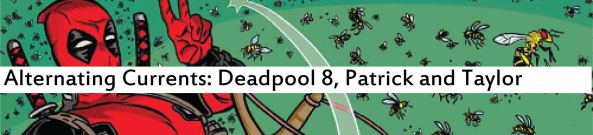
Deadpool 8

deadpool 8

Today, Patrick and Taylor are discussing Deadpool 8, originally released March 2, 2016 

slim-banner

Patrick: Every couple years, Drew and I end up having a conversation about the “death of irony” or the “death of sincerity” and every time we have it, we’re basically blowing smoke out our asses. Concepts like “irony” and “sincerity” need not be mutually exclusive – in fact that’s where most genre fiction rest: comfortably in both camps. A superhero comic in 2016 wears the trappings of a superhero comic because its creators and its audience simultaneously love and are bored by those trappings. That puts a character like Deadpool in a tricky spot, when it seems like his mission statement is to subvert what is gradually becoming the insubvertible. Deadpool’s popularity almost works against him in this regard – how can you continue to classify him as a misfit underdog if everyone loves him? And then there’s the wildly successful Deadpool film, catapulting audiences acceptance of the Merc with the Mouth to meteoric heights. Writer Gerry Duggan and editor Jordan D. White act as Deadpool’s tonal shepherds in this series, keeping the character’s aims purely subversive, the key difference is that the subject they’re subverting is no longer as broad as “comics” or “superheroes” or “the 90s” – the subject is Deadpool.

Continue reading

Deadpool 3

deadpool 3

Today, Patrick and Spencer are discussing Deadpool 3, originally released December 9th, 2015. 

slim-banner

Patrick: The book responsible for shaping most modern improvised comedy is titled, simply Truth in Comedy. The title comes from the idea that the most honest reactions to unusual stimulus are going to be the funniest – essentially espousing that the truth is the ultimate punchline. That’s surprisingly poignant in a medium that could so easily be — and so frequently is — desperate performers mugging for a laugh. Real, sustainably funny scenes can only come from emotionally honest performances. But the title of the book actually implies something else: that the greatest truths can be found through the vehicle of comedy. I have yet to really come to a meaningful conclusion about why that is, but laughing with a character for long enough makes me sympathetic to them, and forges a connection between them and the audience. Deadpool is a fine case study of this phenomenon – through thousands of gags, and a handful of vulnerable turns, the audience is trained to trust and love him in a way we simply cannot extend to his facsimiles in the Mercs for Money. Continue reading

Mrs. Deadpool and the Howling Commandos 2

mrs deadpool sw 2

Today, Spencer and Michael are discussing Mrs. Deadpool and the Howling Commandos 2, originally released July 8th, 2015. This issue is a Secret Wars tie-in. For more Secret Wars coverage from the week, click here.

secret wars div

Spencer: One of my best friends and I quite often find ourselves arguing about how “realistic” a story should be. He loves stories that could take place in our “real” world, while they sometimes rub me the wrong way. Don’t get me wrong, there’s quite a few stories that benefit from a sense of gritty realism (The Black Hood is an excellent, recent example), but I resent the idea that all stories need to be realistic. Our world is quite often an awful place, and fiction is my way of escaping it — I get a lot of joy out of stories that can break the restrictive rules of our reality. Gerry Duggan and Salva Espin’s Mrs. Deadpool and the Howling Commandos 2 is just such a story, one which takes great pleasure in transcending the limits of both reality and traditional narrative structures. It’s a hoot. Continue reading