A New Path Emerges in Generation Gone 5

by Drew Baumgartner

Generation Gone 5

This article contains SPOILERS. If you haven’t read the issue yet, proceed at your own risk!

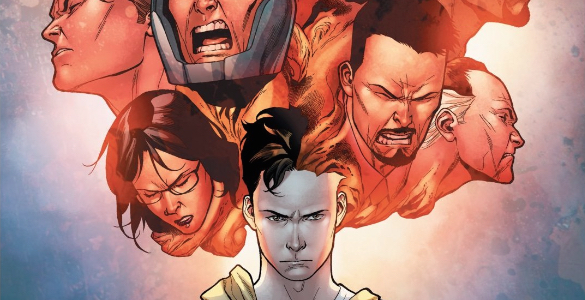
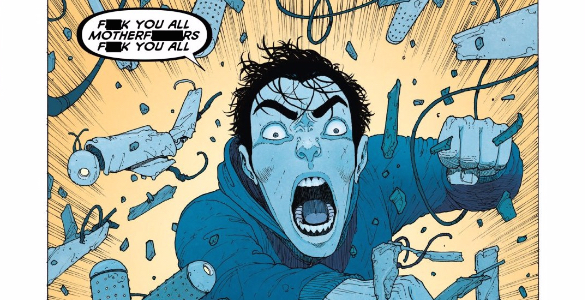
Generation Gone, Aleš Kot and André Lima Araújo have consistently set up competing ideologies — Akio vs. General West, People vs. Government, Idealism vs. Realism, Generation vs. Generation — but the most important (and most nuanced) has probably been those of Elena and Nick. She’s a put-upon optimist, willing and able to take on the abuse of the world in order to Get Shit Done, while he’s a self-pitying, privileged nihilist who sees no future beyond destroying what little of the world he can before he dies. In many ways, they represent the poles we might set for the spectrum of attitudes of Millenials: either cooperate with a system designed to exploit you (and potentially make incremental changes from the inside), or try to blow it to pieces. Those are the extremes, but in increasingly divided times, it’s important to bear in mind that neither one is necessarily “correct.” Indeed, as Elena (and Generation Gone) rejects Nick’s “fuck the world” strategy, Baldwin seems to emerge with another. Continue reading

Challenging Batman’s Central Conceit in Batman 35

by Drew Baumgartner

Batman 35

This article contains SPOILERS. If you haven’t read the issue yet, proceed at your own risk!

For all of the impossible technology, the men made out of shapeshifting clay, the resurrection pits, and the shark repellant, the biggest narrative conceit in any Batman story is the idea that an orphan’s single-minded decision to literally fight crime is somehow noble or laudable. For all of the attempts to “ground” Batman over the past few decades, from Batman: Year One to Christopher Nolan’s “Dark Knight” trilogy, none have deigned question that conceit. It’s too central to who Batman is — he arguably wouldn’t work without it. At least, questioning that conceit wouldn’t work with the kind of grim seriousness of those takes seem to take for granted with the character. By contrast, Tom King has always been willing to embrace the absurdity of Batman, the over-the-top everything that makes him fun, but with a self-awareness to admit that it’s also kind of silly. It’s long been the source of solid laughs for King’s run, but issue 35 hinges its most important emotional moments on that silliness. Continue reading

Prologue Cons in Harbinger Renegade 0

by Drew Baumgartner

Harbinger Renegade 0

This article contains SPOILERS! If you haven’t read the issue, proceed at your own risk.

How do we feel about prologues? On the one hand, I can understand why the specific circumstances of the world the story takes place in might need to be laid out ahead of time. On the other, I think stories work best when they find a way to integrate that exposition into the narrative itself. I always feel like prologues take my interest in the story for granted, even though the story hasn’t even begun. It kind of flies in the face of the conventional wisdom that a writer must grab hold and retain the attention of the reader from the very first sentence. More than anything, I’m often frustrated at the fact that, because a prologue essentially exists outside of the narrative, it doesn’t have to play by the rules of good storytelling, drawing me into the world of he story through relatable characters, interesting circumstances, or some kind of clear-cut inciting incident. Or maybe I just encounter a lot of bad prologues (I’d love to hear some examples of good ones in the comments). Either way, Harbinger Renegade 0 definitely frustrated me in those same ways, effectively turning me off to a narrative that ostensibly hasn’t even started. Continue reading

Blackheart Takes Center Stage in Falcon 2

by Drew Baumgartner

Falcon 2

This article contains SPOILERS. If you haven’t read the issue yet, proceed at your own risk!

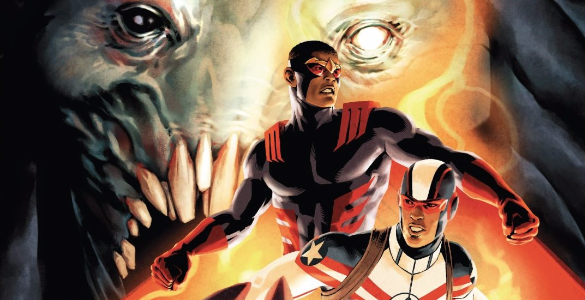
The Marvel Universe is full of odd little corners that don’t always interact. I mean, sure, the X-Men will show up for the big summer crossover series, and Wolverine shows up in everything (even when he was still ostensibly dead), but they largely exist in a world separate from Spider-Man or Thor. Likewise, Spider-Man and Thor occupy worlds separate from each other. This obviously falls out of some practical concerns — plans for certain characters may not facilitate their appearances elsewhere — but there are also important aesthetic ones, as well. Chief among them is concerns of “fit” — while it might be fun to see a cosmic-level hero take a side adventure into some street-level action (or vice versa), it’s not exactly what fans of their series signed up for. So: team-ups between, say, Silver Surfer and Hawkeye are few and far between. I found myself thinking a great deal about fit as Falcon 2 emphasizes the demonic threat Sam is up against. Continue reading

She-Hulk 159: Discussion

by Drew Baumgartner and Spencer Irwin

She-Hulk 159

This article containers SPOILERS. If you haven’t read the issue yet, proceed at your own risk!

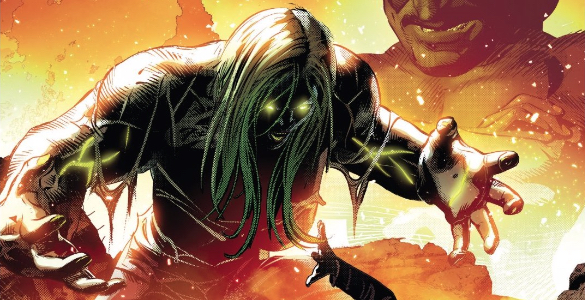
Drew: Why do we like superheroes? For some, the appeal might be whiz-bang action or modern mythologies, but I’ve personally always been drawn to the genre for its ability to comment on everyday life (albeit by blowing it up to epic proportions). It’s not a feature of every superhero story — far from it — but there’s a certain type of superhero story that manages to scale up relatable conflicts and struggles to matters of life and death. Mariko Tamaki’s work with Jen Waters (formerly on Hulk, now retitled and renumbered as She-Hulk) has always fit into this category with ease, using Jen’s Hulk-outs as a stand-in for PTSD-fueled anxiety attacks. It’s an approach that served the character and the story beautifully, creating a series decidedly unlike any other superhero story on the shelves. This issue is at its best when it focuses on those relatable elements, though the introduction of a bona fide supervillain might just blow the parallels out of the water. Continue reading

Black Lightning: Cold Dead Hands 1 Gets Political

by Drew Baumgartner

Black Lightning Cold Dead Hands 1

This article contains SPOILERS. If you haven’t read the issue yet, proceed at your own risk!

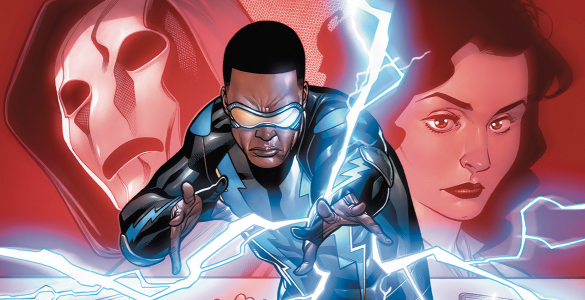
It’s remarkable how many comics fans claim their perceived politicization of superheroes is ruining the medium. It represents a profoundly ahistorical worldview that falls apart under even the lightest scrutiny. I’m not convinced any work of art could be apolitical, but superhero comics certainly aren’t — virtually every character, from Captain America to Superman, advanced very specific political opinions. More broadly, the relative cheapness of comics as a medium has long lent it to political advocacy. Comics have always been political. Superheroes have always been political. Readers may disagree with — or even resent — the political attitudes reflected in a given comic, but that a comic is political is not a valid reason to dismiss it. To me, the quality of a comic has everything to do with how clearly and effectively it makes its point — whether that point is political, emotional, or something else. Only looking at the first issue, it’s impossible to say exactly what point Black Lightning: Cold Dead Hands will ultimately make, but this issue does suggest a rich array of political points it can choose from. Continue reading

Gravediggers Union 1 and the Art of the Cold Open

by Drew Baumgartner

Gravediggers Union 1

This article contains SPOILERS. If you haven’t read the issue yet, proceed at your own risk!

My name is Walter Hartwell White. I live at Albuquerque, New Mexico. To all law enforcement entitles, this is not an admission of guilt. I am speaking to my family now. Skyler you are the love of my life. I hope you know that. Walter, Junior you’re my big man. There are going to be some things things that you’ll come to learn about me in the next few days. I just want you to know that no no matter how it may look, I only had you in my heart. Good-bye.

Walter White, Breaking Bad

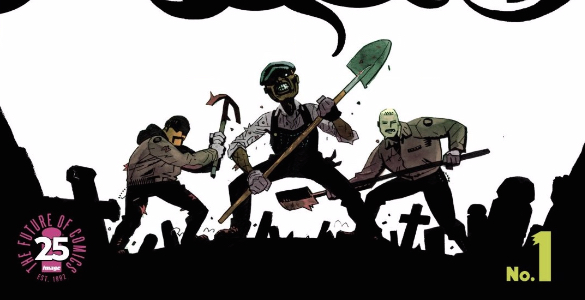
What’s your favorite cold-open? Breaking Bad had some doozies, to be sure, but the most memorable almost all fall into the category of “flash forward,” usually dropping us into the climax (or aftermath) of the episode in question before winding back to explain how we got there. It’s an approach that’s understandably popular — why not open with the most exciting moment of the story? — but is far from the only option when kicking off a story. I personally am a bit more partial to the 2001: A Space Odyssey cold open, taking place millions of years ago, connected to the plot of the movie proper only by the thematic connections we can draw between them. That opening clearly appeals to Wes Craig, who kicks off Gravediggers Union 1 in a remarkably similar fashion. Continue reading

Paper Girls 17: Discussion

by Drew Baumgartner & Patrick Ehlers

Paper Girls 17

This article contains SPOILERS. If you haven’t read the issue yet, proceed at your own risk!

slim-banner

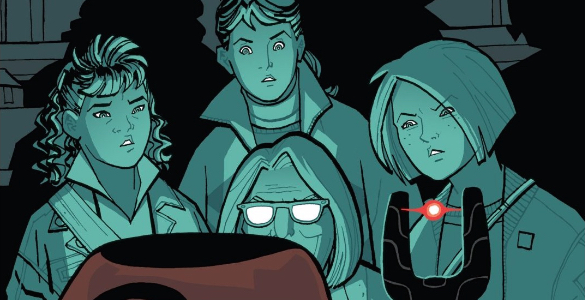
Drew: Brian K. Vaughan series are hard to pin down, generically. I mean, they obviously fall into big capital-G genres like “sci-fi” or “space opera,” but the list of specific influences — which Vaughan often name-checks — can shift from issue to issue. Case in point, Paper Girls has sprinted through dozens of generic touchstones in its 17 issues. And yet, I’ve been holding onto its starting point in the Spielberg/Columbus-style suburbia of the late ’80s as some kind of essential component of its DNA, even as the series hasn’t been in that setting since its very first arc. While some of the girls may still be in that head-space (Mac sure seems to be), they’re traversing worlds that have entirely different points of reference (both for the people who live in those worlds, and the stories we tell about them), which seems to be leaving an impression on them. Continue reading

Glitterbomb – The Fame Game 2: Discussion

by Patrick Ehlers & Drew Baumgartner

This article contains SPOILERS. If you haven’t read the issue yet, proceed at your own risk!

slim-banner

Patrick: What are we doing here? I mean, here, reading (or in my case, writing) a piece critical of a work of art? The art itself, issue two of Glitterbomb The Fame Game, is an exploration of emotional voyeurism, and is openly critical of the people profiting off the vulnerability of others. The risk associated with saying anything about this issue is always going to pale in comparison to the risk the creators take in actually expressing the story therein. Writer Jim Zub and artists Djibril Morissette-Phan and K. Michael Russell lay their own fears of fame out on the page in naked, sometimes groaningly obvious, ways. I can point this out and say “look how obvious this is”, but this is always going to be a weaker product than the story that actually says something. Continue reading

Trust and Impetuousness in Batgirl 16

By Drew Baumgartner

Batgirl 16

This article contains SPOILERS. If you haven’t read the issue yet, proceed at your own risk!

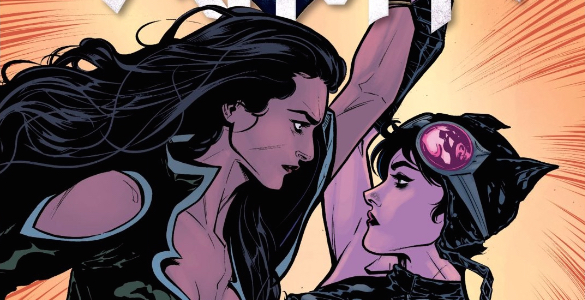
Guys, I love American Vandal. It’s sendup of Netflix-style documentaries is spot-on, but the thing I love most about it is just how accurately it captures teen life. It renders the goofiness and triviality of high school life in intricate, loving detail, fixating on details that is both hilarious and instantly familiar. But at the center of all the dick jokes and awkwardness is the very real disconnect between the impulsive actions of teens and the logical analysis of adults. What’s more, it examines how the “seriousness” that adults adopt maybe leads them to dismiss important details (like the absence of “ball hairs” on graffiti dicks) that a teen — who actually takes those details seriously — wouldn’t. It makes a rather compelling case for teens as the best detectives for teen-related crimes, as they’re more sensitive to the heightened emotional states and subtle social cues of their fellow teens and more immune to the idea that those details are irrelevant. Hope Larson tilts at something similar in Batgirl 16, suggesting that Babs and Dick might have actually been better detectives when they were younger. Continue reading