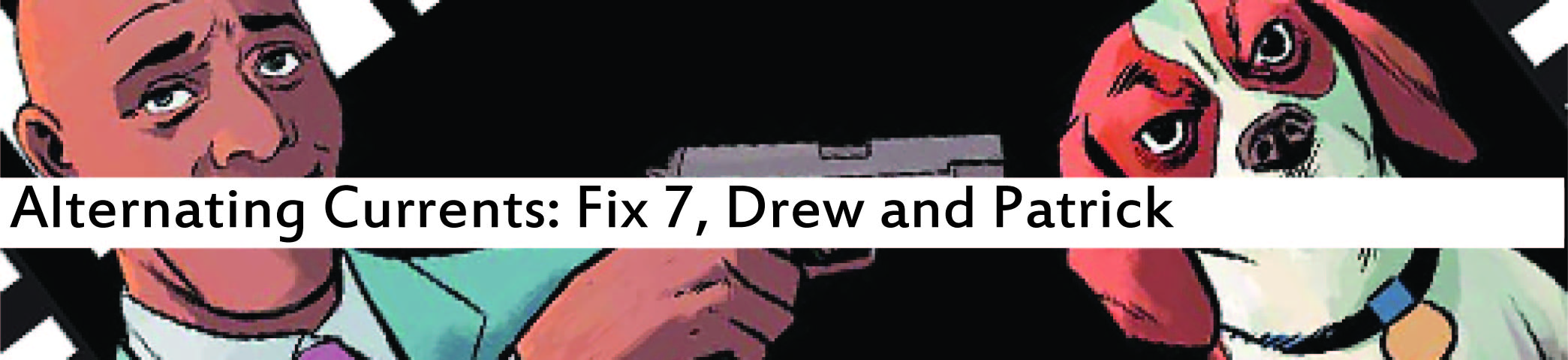
Today, Drew and Patrick are discussing The Fix 7, originally released December 21st, 2016. As always, this article contains SPOILERS.

I originally pitched [Breaking Bad] to the studio with one line. I told them: “This is a story about a man who transforms himself from Mr. Chips into Scarface.”
Vince Gilligan
Drew: Vince Gilligan’s elevator pitch for Breaking Bad might be one of the most well-known loglines in modern television — my dad knows it, if that’s any indication. I suspect people are attracted to the simplicity of Gilligan’s analogies; he calls on two films to paint before and after portraits of Walter White. For me, though, the very fact that he used two film characters to chart the endpoints of Walter’s evolution speaks to the differences between television and film — or, rather, the specific narrative capabilities of serialized stories. Where Walter White’s character is fundamentally one in transition between two points, film characters like Mr. Chips and Scarface are better understood as points.
To me, this is simply down to the matter of time. We don’t have enough time with film characters to form strong enough senses of who they are for all but the most obvious changes to even register. Any subtler changes might just be seen as inconsistency while we’re still forming our first impressions. In serialized narratives, though, we have much more time to develop a clear sense of who a character is — what they want, what they fear, what they will or won’t do — so can appreciate smaller, subtler changes. In a series like Breaking Bad, those changes slowly accumulate, building to drastic transformations that somehow never feel drastic at the moment. In a series like The Fix, those changes can provide a much more nuanced portrait when a character is pushed to the limit. Continue reading →









 Retcon Punch