Last Sons of America 1

Alternating Currents: Last Sons of America 1, Drew and Ryan D.

Today, Drew and Ryan D. are discussing Last Sons of America 1, originally released November 11th, 2015.

As a distant planet was destroyed by old age, a scientist placed his infant son within a hastily devised space-ship, launching it toward Earth!

Action Comics 1, Jerry Siegel

Drew: I’m tempted to make the argument that world-building is an inherent aspect of comics storytelling — the environment that the characters inhabit literally needs to be created, line by line — but whatever the reason, world-building has been an integral part of comics at least as far back as Action Comics 1. Indeed, world-building has become increasingly important in modern comics, as characters are spun off into multi-platform franchises. It’s also become increasingly important for certain segments of comics readers, who catalogue every piece of continuity and police every perceived contradiction. Those readers tend to forget that the world is the setting, not the story, and that even the most intriguing worlds are nothing without compelling characters and an actual narrative. Sometimes that means a brilliant setting is relegated to the background, but when the story itself grabs you, as it does in Last Sons of America 1, that’s the right choice. Continue reading
Howling Commandos of S.H.I.E.L.D. 1

howling commandos 1
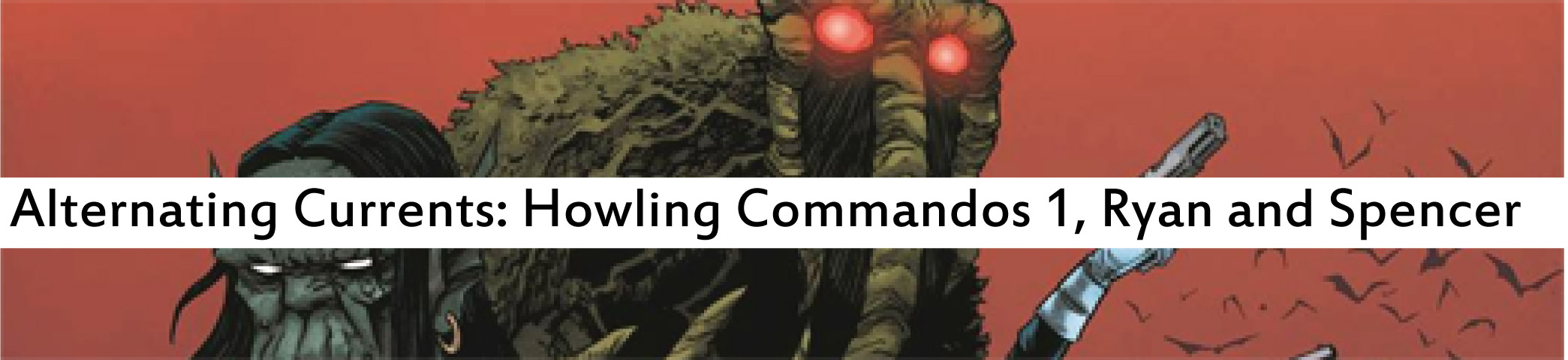
Today, Ryan D. and Spencer are discussing Howling Commandos of S.H.I.E.L.D. 1, originally released October 28th, 2015.

Ryan D.: Just in time for Halloween season, Howling Commandos reads like a love letter to the schlocky B-Movie horror gems of the late Sixties and early Seventies, along the lines of Dracula vs. Frankenstein. Is it any good? Who am I to apply such a binary judgement to a creative work? Continue reading

The Shield 1

Alternating Currents: The Shield 1, Drew and Ryan

Today, Drew and Ryan D. are discussing The Shield 1, originally released October 21st, 2015.

Drew: Who are remakes for? I have loads of cynical answers, from “vain artists” to “money-hungry IP owners,” but the most cynical — and, unfortunately, perhaps the most true — is simply “not fans of the original.” We’re all familiar with film buffs wincing at the thought of a classic being redone, but they’re clearly not the target audience: there’s no reason to remake something for someone who loves the original. Unless, of course, you aren’t being as cynical as I tend to be. It’s entirely possible for a remake to celebrate what was great about the original without being tied to it — that is, it welcomes both new and old fans alike. That’s the name of the game for Archie’s Dark Circle imprint, which manages that tricky balance again in Shield 1. Continue reading

Ms. Marvel 19

Alternating Currents: Ms. Marvel 19, Ryan and DrewToday, Ryan D. and Drew are discussing Ms. Marvel 19, originally released October 14th, 2015. This issue is a Secret Wars tie-in. For more Secret Wars coverage from the week, check out our Marvel Round-Up.

secret wars div

Ryan: As you may already know, Ms. Marvel is a delight to read. I, personally, have not had so much fun reading a comic since Vaughn’s Runaways, with all of its silly and earnest characterizations. The comic being discussed today features the same amount of oddball quirk and spirited dialogues, but also does not shy away from the heavier side of human emotions, making Ms. Marvel 19 a joyful kick to the gut. Though it may seem a little odd reading a Secret Wars tie-in dealing with the Incursion about five months since Hickman took us to Battleworld, the this issue offers a completely fresh, focused perspective on the cataclysmic event, wherein our titular character does not even don her tights. Instead of sweeping battle scenes, Wilson and Alphona treat audiences to a pay-off of inter-personal relationships and redemption in the face of confusion and helplessness. Continue reading

Batman Annual 4

batman annual 4Today, Ryan D. and Taylor are discussing Batman Annual 4 originally released September 30th, 2015. 

Ryan: Batman has been happening for quite some time, both in the real world and in the oft rebooted DC Universe. Fans of the series remember his numerous encounters with his rogues gallery throughout the years, as villains escape time after time from the doldrums of Arkham Asylum to once again terrorize the city of Gotham. The formula for Batman may even be seen as a little tiresome: villain arrives, terrorizes Batman, Batman wins, villain returns again, eventually — maybe teaming with another foe, something messed up happens to Bruce Wayne’s personal life, his family rescues him, rinse, repeat. So what is it that draws us back into Batman narratives when the conceit can seem formulaic? Much of its appeal, I would argue, comes from the long-standing history which the reader shares with the character, one which can make jumping into a title so compounded with spin-offs and mini-series and event tie-ins intimidating for some. Batman Annual 4 offers an easy jumping-in point as Bruce Wayne undergoes yet another identity crisis, catching a casual or first-time reader up while showing the audience why a protagonist mired in the past can be so fascinating.

Continue reading

Injection 5

Alternating Currents: Injection 5, Ryan and Drew

Today, Ryan D. and Drew are discussing Injection 5, originally released September 9th, 2015.

Ryan: Who is the main character in this comic? At first glance, I fancied Maria Kilbride to be our lead. Her character arc seems to be one of the most vivid; every issues’ flashback scenes show her as the bright-eyed genius responsible for tying together the Cultural Cross-Contamination Unit, full of piss and vision. Seeing how cheerful she was in this issue when Brigid suggested they all get matching tattoos stands in stark contrast to the gaunt, hollowed lone-wolf who tackles a Cornish spriggan infestation head-on. Though her foe here be mystical, Kilbride is haunted more closely by the Injection, which finally reveals itself plainly. The fingerprints of the Injection are stamped on every curious happenstance which has taken place over the past five issues, making a compelling case to call this creation the main character. Its character journey has taken place predominately off-page, with the bulk of its exposition in the dialogue of its “parents”, the remnants of the CCCU. It now rears its invisible head to Maria, and in doing so shows that it is responsible for the previously anonymous, seemingly omnipotent yellow narrative text littering each issue. Continue reading

We Stand On Guard 3

we stand on guard 3

Today, Ryan D and Taylor are discussing We Stand On Guard 3, originally released September 2nd, 2015.

Ryan: Canada and America at war. Total war. At first glance, this seems highly unlikely, almost unimaginable. But at issue three of a six-part miniseries, We Stand on Guard is far past first glance. Brian K. Vaughn and Steve Skroce keep pulling back the curtains, and every reveal in this issue fits perfectly into the universe created. The real hook, aside from the soaring tension and slick action, is that the fiction is not incredibly far from the truth.

Continue reading

Trees 12

Alternating Currents: Trees 12, Drew and RyanToday, Drew and Ryan are discussing Trees 12, originally released August 19th, 2015.

he·ro

/ˈhirō/
noun
noun: hero; plural noun: heroes

  1. a person, typically a man, who is admired or idealized for courage, outstanding achievements, or noble qualities.
  2. the chief male character in a book, play, or movie, who is typically identified with good qualities, and with whom the reader is expected to sympathize.

Drew: I think I’ve always thought of those two definitions as functionally identical — we acknowledge heroes in real life for the same qualities we admire them in fiction — but a closer look reveals a rather profound difference in how much agency is required to satisfy these two definitions. That is, the first definition is about deeds performed by the would-be hero, whereas the second definition is more about the heroes place in the narrative; no agency is actually required. It’s no surprise to me that the morally grey characters of Warren Ellis and Jason Howard’s Trees don’t satisfy the “noble qualities” clause of the first definition, but I was a bit more surprised to discover how passive they all have been. The biggest turning points in this series find the characters completely passive, from Professor Bongiorno’s acceptance of his own murder to Marsh’s decision to not sound the alarm about the Svalbard poppies. Issue 12 still features plenty of characters boxed in by their circumstances, but also gives Creasy the opportunity to actually do something. Continue reading

Lazarus 18

lazarus 18Today, Spencer and Ryan are discussing Lazarus 18, originally released July 29th, 2015.

Spencer: There’s a certain rush that comes with new stories, with watching a whole world full of new characters and relationships being established right before your eyes, but it’s a rush that by definition can’t last forever, and late-series attempts to keep things fresh often misfire. The answer isn’t continually adding new characters and concepts, which can often leave a story feeling bloated and distract from its core themes; the best storytellers know the power that comes from mixing up established relationships, throwing together characters who have never really interacted before, and finding new perspectives to view their cast through. Greg Rucka and Michael Lark’s Lazarus is well into its second year and fourth storyline, and it’s exactly these kind of techniques that keeps issue 18 feeling as compelling as ever. Continue reading

Wolf 1

wolf 1

Today, Ryan and Drew are discussing Wolf 1, originally released July 22nd, 2015.

Ryan: Stop me if you have read this comic before: a dark, supernatural noir following a seemingly immortal protagonist and featuring Lovecraftian — oh, yes, that’s Ed Brubaker’s Fatale. Or this one, then: a hard-nosed paranormal detective named Wolf tries to right wrongs in a major American city populated by folkloric — yup, you got it, that is Fables. The first issue of Wolf strides over well-trodden territory — really, we have seen this all before. So why, then, does it work so well? Better yet, what is it that Ales Kot is doing better than everyone else? Continue reading