Detective Comics 50

detective comics 50

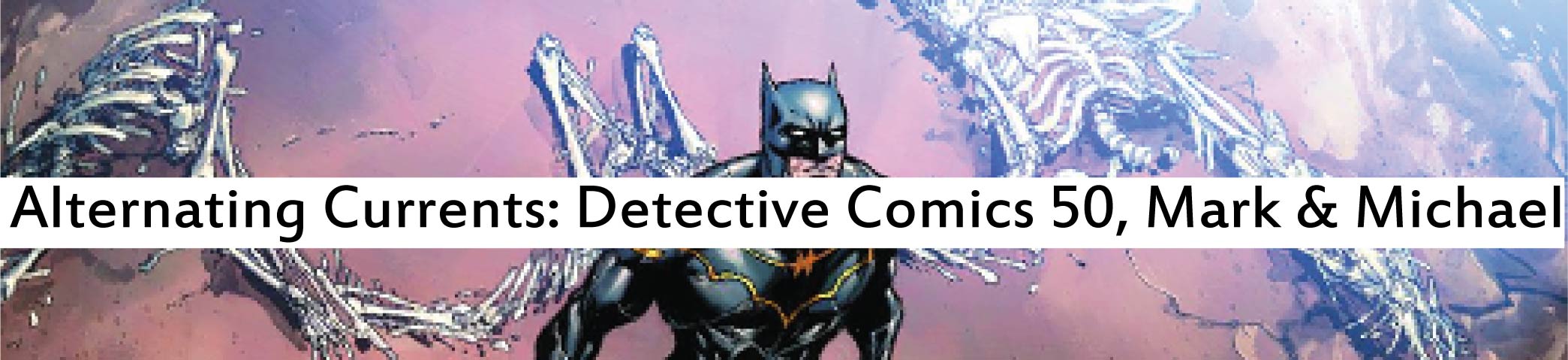
Today, Mark and Michael are discussing Detective Comics 50, originally released March 9th, 2016.

Mark: Well…huh. Is that all there is?

Writing a mystery story in any medium is an unenviable task. It’s basically impossible to nail the landing. For my money, the ideal solution to any mystery is both surprising and logical. Once the solution is revealed, the audience wants to see that the answer was hiding in plain sight all along. Writing a satisfying conclusion like that is nearly impossible. It’s why when something like The Sixth Sense comes along it is so successful. But M. Night Shyamalan learned the wrong lesson from its success, thinking that audiences craved a “GOT YA” ending. And it’s why his other films that attempted a twist failed. Sure, the twists are surprising…but they’re meaningless and add no additional understanding to what came before. So after two (and a half) strong issues of Peter J. Tomasi’s Detective Comics mystery, we reach the end of The Bronze Age arc and, again, I ask: is that all there is? Continue reading

Gotham Academy 16

gotham academy 16

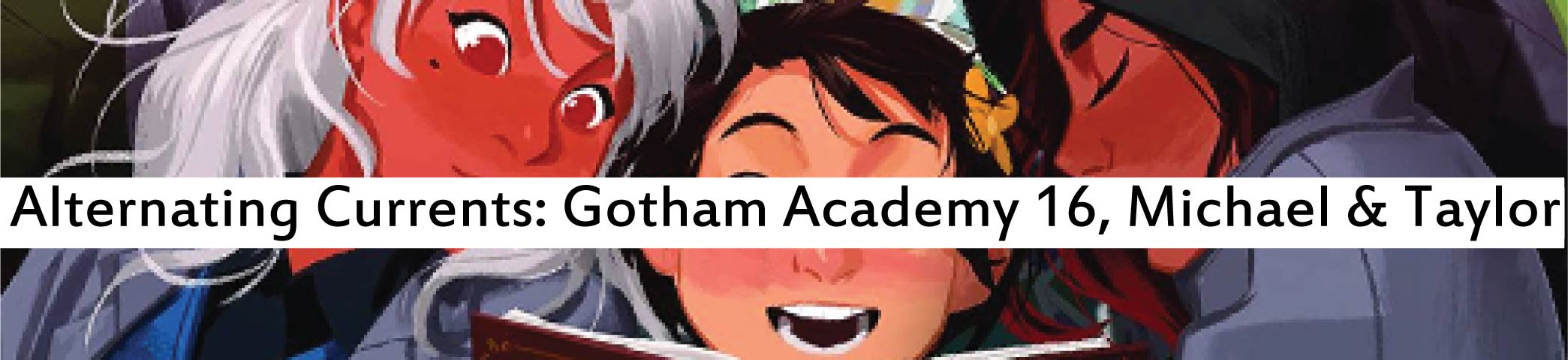
Today, Michael and Taylor are discussing Gotham Academy 16, originally released March 9th, 2016.

Michael: What is the proper way for a comic book series to say goodbye? Depending on the critical and commercial success of that book, the answer may vary. You might have the fore-sight or -knowledge to plot things towards a conclusion or just have to wrap things up as quickly as possible with a few issues. Though DC’s Rebirth will be bringing us another Gotham Academy series — Gotham Academy: Next Semester — these are the last few issues of the series as we have known it. Brenden Fletcher is joined by a handful of other creators to relish in the whimsical nature of Gotham Academy before he says his (brief?) goodbye. Continue reading

Midnighter 10

midnighter 10

Today, Spencer and Mark are discussing Midnighter 10, originally released March 2nd, 2016.

Spencer: I was a little know-it-all as a kid. One of my earliest memories is interrupting a lecturer on a field trip to a planetarium to correct him about outer space trivia; “well, actually” might as well have been my catchphrase in elementary school. Even as an adult with decidedly screwed-up self esteem, I still occasionally find myself falling prey to the snare of overconfidence; in many ways, I think it’s just human nature. Supreme confidence has always been presented as one of Midnighter’s most charming attributes, but after suffering yet another loss, Midnighter 10 starts to explore whether that confidence is an asset or a hindrance, and one of the most effective ways it does so is by comparing it to the overconfidence of the rest of the cast. Continue reading

Batman 49

batman 49

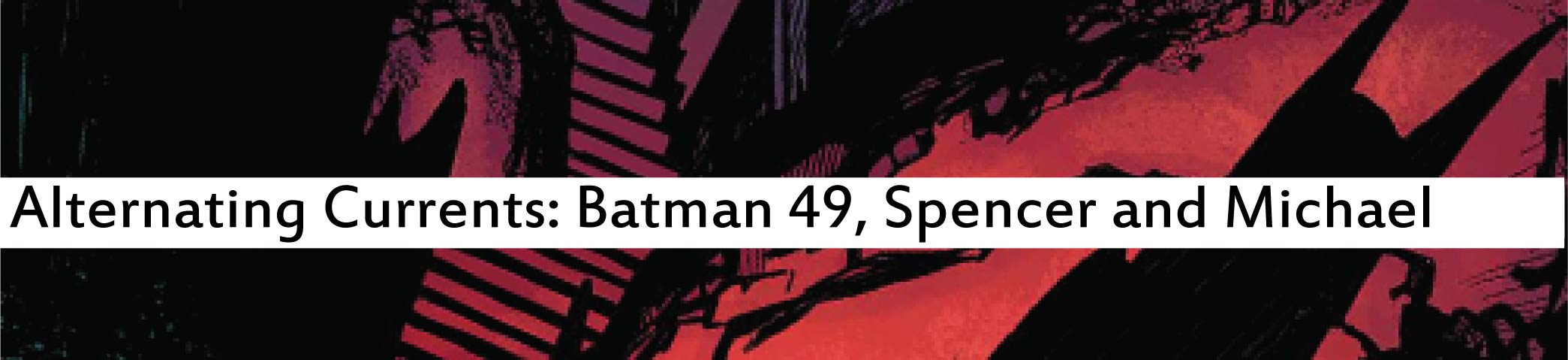
Today, Spencer and Michael are discussing Batman 49, originally released February 10th, 2016.

Spencer: One of the concepts that’s made Batman such a popular hero for the past 75 years is the idea that anybody could become Batman. None of us are alien refugees or Amazon princesses, none of us can expect to be struck by Speed Force lightning or bitten by a radioactive spider (and survive, at least), but with the right training, resources, and determination, anyone could become Batman; and sure, most of us don’t have access to the seemingly unlimited wealth, technology, or training Bruce Wayne had, but they’re at least goals that someone living in our real world could feasibly aspire to achieve. In Batman 49, though, Scott Snyder and Yanick Paquette make all those qualifications — and, indeed, the very possibility of anyone besides Bruce Wayne ever truly becoming Batman — moot. Being Batman is about more than gear or training or money. Becoming Batman requires great, tragic sacrifice; it involves dying, whether figuratively or literally. Continue reading

Detective Comics 49

detective comics 49

Today, Michael and Drew are discussing Detective Comics 49, originally released February 3rd, 2016.

Michael: Jim Gordon has been Gotham’s Dark Knight since June and with Bruce descending into the Batcave in the pages of Batman, it seems that Gordon’s rooftop days are nearing their end. That kind of bums me out to be honest. While Snyder’s work on Gordon in Batman has been bombastic fun, I’m not sure that he’s had enough time to engage in the wide array of Batman capers. Enter Pete Tomasi’s three-part story arc: “The Bronze Age.” Continue reading

Batman 48

batman 48

Today, Drew and Patrick are discussing Batman 48 originally released January 20th, 2016.

Drew: There’s a concept in biology of “synapomorphy” which is, essentially, a trait that’s unique to one biological group (which can then be used to distinguish that group from all others). Milk production would be a synapomorphy of mammals, for example. What’s interesting is that these synapomorphies can pile up such that a given biological group might have many distinguishing characteristics — to expand on our mammal example, hair, inner ear bones, and a unique type of teeth are all synapomorphies. Each of these traits developed separately, but all have come to define mammals as a whole.

A similar thing can happen with the defining characteristics of fictional characters — particularly characters who exist in multiple media in stories told by multiple people. Batman is a prime example of this, with countless defining characteristics that range from costuming to gadgets to locations to supporting cast to overarching themes. Some were there more-or-less from the beginning, but others have become essential more recently as new stories are told. A few years ago, Patrick suggested that deconstructions of the Batman mythos have become so common as to become a defining characteristic of the character itself. I was initially skeptical — I can certainly think of plenty of great examples of Batman stories that are as straightforward as can be — but the more I think about it, the more convinced I am that we’re living through the time when meta-commentary is becoming a defining characteristic of Batman storytelling. Or, at least, it’s a defining characteristic of Scott Snyder and Greg Capullo’s Batman, but when they do it so well, it’s hard to argue that it should be any other way. Continue reading

Best of 2015: Best Mini-Series

best mini-series 2015More self-contained than an ongoing series (which may build on decades of backstory), but capable of more depth than a one-off, the mini-series may stand as the truest analog to novels that monthly comics can provide. 2015 was a banner year for mini-series, with both of the big two switching to minis almost entirely during their respective crossover events, and many more stellar minis coming from other publishers. These our our top 10 mini-series of 2015.
Continue reading

Best of 2015: Best Issues

best issues 2015
Episodic storytelling is the name of the game in monthly comics. Month- or even multi-year-long arcs are fine, but a series lives and dies by its individual chapters. From self-contained one-offs to issues that recontextualize their respective series, this year had a ton of great issues. Whittling down those issues to a list was no easy task (and we look forward to hearing how your lists differ in the comments), but we would gladly recommend any (and all) of these issues without hesitation. These are our top 10 issues of 2015. Continue reading

Batman 47

batman 47

Today, Drew and Mark are discussing Batman 47 originally released December 9th, 2015.

Drew: I’ve complained before about the prescriptive nature of Chekhov’s Gun — that our awareness of Chekhov’s “rule” necessarily gives away elements of the ending. A great example of this is the first season of The Killing — I enjoyed it quite a bit, but Chekhov’s gun dictated that something must tie the mayoral campaign that features so heavily to the titular crime. The specifics can still surprise us, but we know we’re not being shown that stuff just for fun. Of course, the predictability of Chekhov’s rule loses its stranglehold on narratives that aren’t driven by plotting — say, a character study or a situational comedy. In those cases, we might actually be shown things just for fun (or nuance, or detail, etc). We tend to think of superhero comics as plot-driven narratives, but B-stories can often take on less plotty structures, as we learn more about a character, or are amused by their situation. It can be difficult, then, to know if a given element of a B-story represents a gun that will eventually go off, or just a portrait of someone who has a gun. These are the questions in my mind as Bruce grapples with his own obscured history in Batman 47. Continue reading

Midnighter 7

midnighter 7

Today, Mark and Spencer are discussing Midnighter 7, originally released December 2nd, 2015.

Mark: Well, shit. After complaining about the anti-climactic fight between Frankenstein and Superman in Action Comics 47, writer Steve Orlando does not make the same mistake in Midnighter 7′s climactic matchup between Midnighter and Prometheus. This is a knock down, drag out battle that serves as an appropriate follow-up to last issue’s shocking reveal. Continue reading