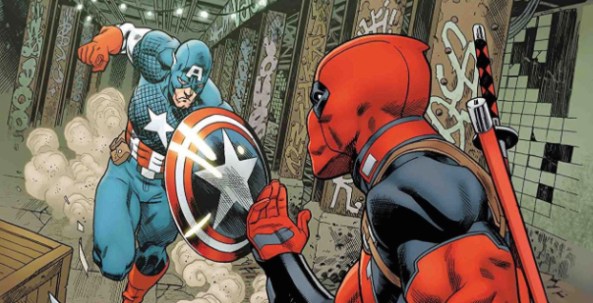
Culminating Repercussions in Despicable Deadpool 296

by Drew Baumgartner

Deadpool 296

This article contains SPOILERS. If you haven’t read the issue yet, proceed at your own risk!

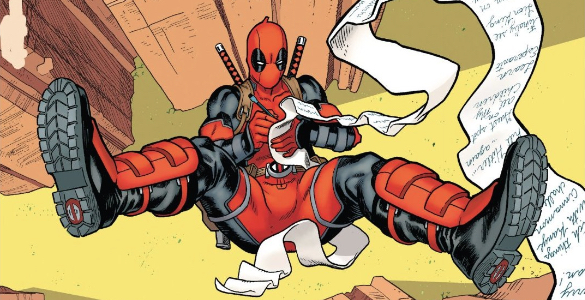
Are reverence and irreverence mutually exclusive? Linguistically, we might understand these words as opposites, but practically, we recognize that they coexist all around us. This is especially true in standup comedy, a field that both finds humor in what we take seriously and takes what we find funny very seriously. It’s no coincidence, then, that Gerry Duggan’s Deadpool run has had such a rich mix of reverence and irreverence, adopting some of the “sad clown” stylings of his comedic friends and collaborators, lending an otherwise goofy character real pathos. Indeed, one of the most distinctive features of Duggan’s work with this character was in crafting a tragic (but nonetheless joke-filled) backstory that could lend itself to reverence. With issue 296, Despicable Deadpool aims to cash in on much of that reverence, drawing on everything from Duggan’s earliest work with the character to some of his most recent. Continue reading

The Burden and Joy of Public Service in Captain America 699

by Drew Baumgartner

Captain America 699

This article will contain SPOILERS. If you haven’t read the issue yet, proceed at your own risk!

For many superheroes, superheroics are a means of righting some cosmic injustice — the death of a loved one a the hands of a criminal, for example. Indeed, that particular motivation is so ubiquitous, it’s easy to forget that many heroes are motivated not out of some personal vendetta, but because they feel morally compelled to help when they can. We tend to think of Spider-Man (death of a loved one at the hands of a criminal notwithstanding) for that kind of power/responsibility stuff, but I’ll suggest that Captain America might embody those ideals even more thoroughly. For Cap, superheroing is a public service, no different from volunteering at a soup kitchen or picking up trash at your local park. He’s able to make the world a better place by being Captain America, so he has to be Captain America. Again, it’s not an attitude that’s entirely unique to Steve Rogers, but as Mark Waid and Chris Samnee crank that aspect up to eleven in Captain America 699, it’s hard to imagine any other character living that ideal so perfectly. Continue reading

Dystopia in the Not-So-Distant Future in Captain America 698

by Spencer Irwin

This article will contain SPOILERS. If you haven’t read the issue yet, proceed at your own risk!

I was raised on classic television, and as a kid I remember always getting a big kick out of the fact that the original Lost in Space series took place in the “distant future” of 1997. As a general rule, ascribing a specific date to your fictional future is a great way to rob it of its power and wonder, but Captain America 698 turns that rule completely on its head, finding its most effective twist in the “when” of its dystopian future. Continue reading

There’s No Justice in the Justice System in Despicable Deadpool 292

by Taylor Anderson

This article contains SPOILERS. If you haven’t read the issue yet, proceed at your own risk!

slim-banner

If you’ve ever listened to the podcast Serial or watched the Netflix series the Making a Murderer, you are more than aware of the failings of the American justice system. In the case of these two series, innocent people were sent to jail for dubious reasons, but that is far from being the only reason why the justice system should be looked at with a wary eye. There are too many points to raise about this issue here, but suffice it to say, the justice system lacks…well, justice. Not only is this true in our world, but also in the world of Marvel comics, as Deadpool learns when he pays a visit to his old nemesis, Stevil Rogers. Continue reading

An Attack on Steve’s Morality in Captain America 697

by Spencer Irwin

This article will contain SPOILERS. If you haven’t read the issue yet, proceed at your own risk!

Mark Waid and Chris Samnee’s take on Captain America is already drastically different from Nick Spencer’s that preceded it, doling out mostly episodic adventures in comparison to the one long story Spencer told, and focusing less on actual politics and more on the idea of Steve Rogers being a good and righteous man, and trying to inspire others to be the same. The return to simpler, more swashbuckling tales has been a nice palate cleanser, especially as readers reacquaint themselves to the original, non-Hydra version of Cap, but I’m hoping we get something a little more substantial sooner rather than later. Continue reading

Steve Goes Freelance in Captain America 696

by Drew Baumgartner

Captain America 696

This article will contain SPOILERS. If you haven’t read the issue yet, proceed at your own risk!

Do the citizens of the Marvel Universe adequately compensate their superheroes? There’s little doubt that the entire planet benefits from the efforts of Captain America and his ilk, but whatever gratefulness the citizens feel doesn’t put food on the table. Which is why so many superheroes either take day jobs (with S.H.I.E.L.D. or the Heroes for Hire, for example), institutionalizing their heroic output, are already independently wealthy (like Tony Stark), or have some wealthy patron (like Tony Stark). That notion of patronage hints at what I’m getting at: superheroism is a bit like making art — society may value the idea of it generally, but that doesn’t exactly translate to money in the bank. It’s a lesson Steve Rogers is learning as his journey as a freelance superhero begins in earnest in Captain America 696. Continue reading

Action and a Message in Captain America 695

by Spencer Irwin

This article contains SPOILERS. If you haven’t read the issue yet, proceed at your own risk!

What does Captain America mean to you? Given not only our current political climate, but the outcry Secret Empire and its lead-ins created among many passionate Cap fans, it seems like a more pertinent question than ever. What is it about Steve Rogers that inspires so many? That’s what Mark Waid, Chris Samnee, and Matthew Wilson set out to discover in Captain America 695. Continue reading

Generations Sam Wilson Captain America & Steve Rogers Captain America 1: Discussion

by Patrick Ehlers and Ryan Mogge

This article contains SPOILERS. If you haven’t read the issue yet, proceed at your own risk!

slim-banner

Patrick: One of the harsher truths of Secret Empire is that America was always run on an engine of hatred and fear. Racism, sexism, classism, fascism — neither Hydra Cap nor Donald Trump invented these things. They didn’t even popularize or legitimize them, they’re simply high profile embodiments thereof. It is increasingly easy to read the totality of American history as ugly and hateful, filled with crass opportunists, liars, and mass murderers. That can make the USA a hard hero to root for. With Generations Sam Wilson Captain America & Steve Rogers Captain America 1, writer Nick Spencer goes back in time, giving both Sam Wilson and his readers a lifetime to reconsider the value in fighting for what may, at times, appear to be a lost cause. Continue reading

Gwenpool 20 Stays Sincere in a Landscape of Cynicism

by Patrick Ehlers

Unbelievable Gwenpool 20

This article contains SPOILERS. If you haven’t read the issue yet, proceed at your own risk!

This arc of Gwenpool appears to be taking a lot of its cues from the recently concluded Secret Empire. While not retreading any of the same thematic ideas, the narrative structure of one moral-extreme version of a character over-writing the history of the opposite-moral-extreme version of that same character features in both. For Captain America, this is a battle over the national zeitgeist, a startling reflection of the persistence of racism and white nationalism, but for Gwenpool, the stakes are more personal. Secret Empire Omega 1 just chillingly illustrated how definitive, national change is virtually impossible, but Gwenpool 20 offers a more hopeful path for the individual and — more importantly — for the comic fan. Continue reading

Secret Empire: Omega 1: Discussion

By Ryan Mogge and Drew Baumgartner

This article contains SPOILERS. If you haven’t read the issue yet, proceed at your own risk!

Ryan: Every event in your memory left some sort of mark. When it comes to trauma, those marks are more like deep grooves. No matter how much you heal, or how much better off you are, you are changed by what has happened to you. In the wake of a rebellion against a group of fascists bent on world domination with the face of the most trusted man alive, you certainly can’t expect to move forward without being changed. In Secret Empire: Omega 1, Nick Spencer and Andrea Sorrentino offer a mixture of back-to-normal plot points and artful rumination that operate quite differently but still offer the same themes of trauma and the scars left behind. Continue reading