Silence is Golden in Black Panther 169

By Ryan Desaulniers

Black Panther 169

This article contains SPOILERS. If you haven’t read the issue yet, proceed at your own risk!

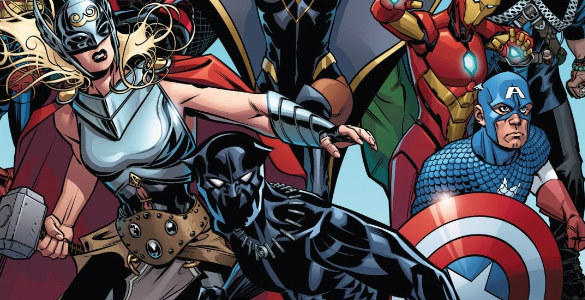
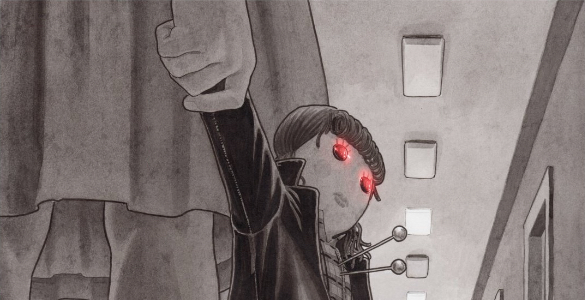
All comics are silent comics. This is an immutable fact due to their very nature as a static, visual medium. This makes it all the more impressive that artists can imbue a page with a bevvy of techniques which trick our beautiful brains into not only interpreting some onamonpaeatic words as sound, but even suggest the sound’s quality in a way that we, as readers, hardly notice as we go. Black Panther 169 takes away the sense of perceived sound and employs a level of visual storytelling which this title had not yet utilized, making for a gripping read, one focused on two characters, in opposition, in a high-stakes sprint to their objectives. Continue reading

The Reader Knows Too Much in Action Comics 996

by Michael DeLaney 

This article contains SPOILERS. If you haven’t read the issue yet, proceed at your own risk!

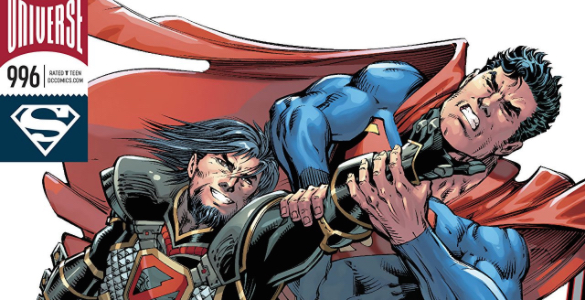
Action Comics 996 has me thinking about our expectations and interactions with an individual comic book issue. As readers, we are operating in a dimension above the characters on the comic book page. We are omniscient in that we know what Lois and Superman are up to in their separate times and spaces. Unlike Superman, we know that Zod’s son lies in wait for our hero because of Dan Jurgens’s cover for the issue. Since Lor-Zod’s appearance is a foregone conclusion, does that “spoil” the story at all? Does it diminish the final page reveal? Continue reading

Black Magick 10 Defines its Allegory

by Drew Baumgartner

Black Magick 10

This article contains SPOILERS. If you haven’t read the issue yet, proceed at your own risk!

[W]e conceive the Devil as a necessary part of a respectable view of cosmology. Ours is a divided empire in which certain ideas and emotions and actions are of God, and their opposites are of Lucifer. It is as impossible for most men to conceive of a morality without sin as of an earth without ‘sky’. Since 1692 a great but superficial change has wiped out God’s beard and the Devil’s horns, but the world is still gripped between two diametrically opposed absolutes. The concept of unity, in which positive and negative are attributes of the same force, in which good and evil are relative, ever-changing, and always joined to the same phenomenon — such a concept is still reserved to the physical sciences and to the few who have grasped the history of ideas.

Arthur Miller, The Crucible

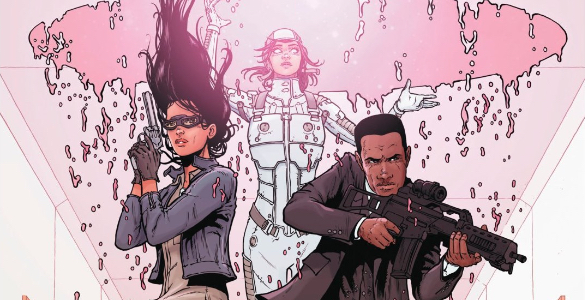
I don’t think I fully appreciated The Crucible until this last year. Or, more precisely, without any direct reference for McCarthyism, I couldn’t fully appreciate the allegory that underpins The Crucible. That we once again live in a world where problems can be made up and pinned on innocent individuals gives The Crucible an unfortunately renewed relevance, suggesting once again that we haven’t come as far from 1690s Salem as we might like to think. Black Magick 10 carries a similar allegorical weight, also centering around the persecution of witches, with the obvious difference that the witches in Black Magick actually exist. In this way, the parallels to our modern political climate (and, heck, that of McCarthyism) might be stronger — the persecuted class does actually exist, they just aren’t the scapegoats society has made them out to be. It reflects the attitudes that politicizes someone’s very identity, suggesting that peace and happiness should only be reserved for those who conform to society’s norms. Continue reading

Narrative Distance in The Wild Storm 11

by Drew Baumgartner

Wild Storm 10

This article contains SPOILERS. If you haven’t read the issue yet, proceed at your own risk!

As readers, we’re all duly familiar with the narrative modes — third person omniscient, first person, objective observer, etc — we’re taught them from an early age, and are aware of them in basically all narrative writing. We’re far less aware of the narrative modes in visual storytelling, and lack the kind of common nomenclature to identify them that we have for literary narrative modes. But there’s no doubt that they profoundly influence our perceptions of visual media — there’s a profound difference between a camera shooting from over a character’s shoulder to one that is meant to literally represent their point of view, and we can feel that difference, even if we don’t have precise language to describe it. It allows visual storytelling to be much more visceral and subtle than prose, as we’re not necessarily consciously aware of its effects. With The Wild Storm 11, Warren Ellis and Jon Davis-Hunt exploit this feature of visual narrative for all its worth, keeping us at a distance from any of the events of the issue. Continue reading

The Futility of Definition in Inhumans: Judgment Day 1

By Patrick Ehlers

This article contains SPOILERS. If you haven’t read the issue yet, proceed at your own risk!

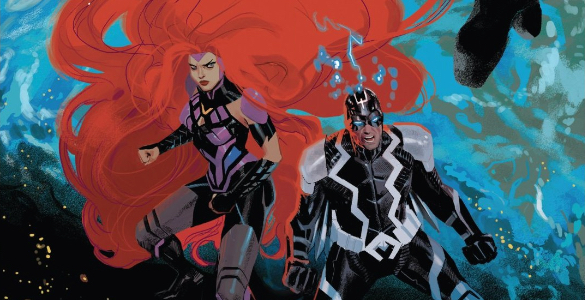
Reading any on-going comic is an exercise in accessing memory. If a writer, or an editor, is feeling particularly generous, there might be a note on the page to jog that memory a bit. Can’t remember what’s up with Karnak? Don’t worry, an editorial note has that addressed. Can’t remember what Swain’s power is? A narration box has your back with a one-word explanation: “Empath.” But these characters are too complex for that, right? Al Ewing’s Inhumans: Judgment Day 1 explores the limits of definition as it applies to a cast of characters that is both constantly changing, and constantly changing back. Continue reading

Japanese Influences in Lumberjanes 46

by Taylor Anderson

This article contains SPOILERS. If you haven’t read the issue yet, proceed at your own risk!

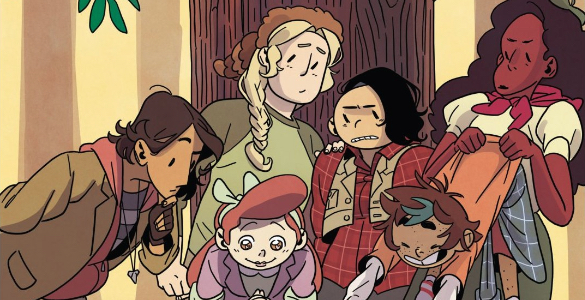
Being a middle school teacher helps me keep my ear to ground when it comes to trends that the young folk are into these days. Of these trends, one that seems to be the most popular is manga. Manga isn’t new to American and it certainly isn’t new to pop-culture. However, it has now become a mainstay in youth culture, or are least middle school culture. Most kids have read at least one manga by the time they’re in 7th grade, and it’s safe to say more have read this version of pictoral stories than their American (or European) counterparts. As such, it’s no surprise Ayme Sotuyo is the chosen artist of the Lumberjanes series, as it’s the perfect style for a comic written with young readers in mind.

Continue reading

Tapping Into the Raven of Old in Raven: Daughter of Darkness 1

by Spencer Irwin

This article contains SPOILERS. If you haven’t read the issue yet, proceed at your own risk!

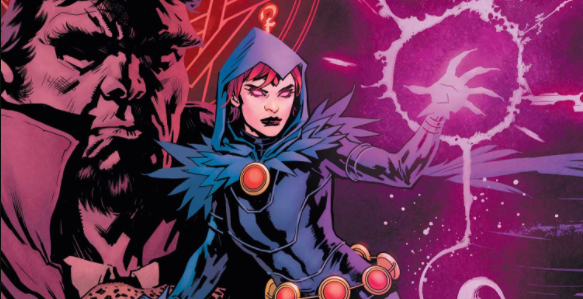
When talking about the three new characters he co-created at the outset of The New Teen Titans, writer Marv Wolfman has said that, while he’d probably eventually run out of ideas for Cyborg and Starfire, he felt like he could continue on writing Raven stories forever. I find it sweet and admirable to see how Wolfman has stuck to that nearly 40 years later, continuing to pen the occasional new Raven story even as the character has changed so much from the one he originally conceived.  Continue reading

Abbott 1: Discussion

by Patrick Ehlers and Mark Mitchell

This article contains SPOILERS. If you haven’t read the issue yet, proceed at your own risk!

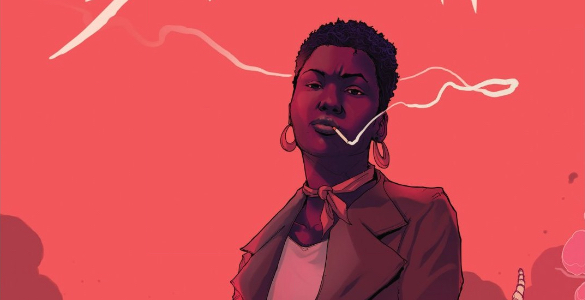
Patrick: I love the moment in every episode of X-Files or Buffy the Vampire Slayer where whatever otherworldly threat our heroes are facing reveals itself to be alarmingly similar to some current societal ill. Sometimes it comes late to the story, and it’s not until two episodes into a three-episode arc that you realize these demons are riffing on toxic masculinity. I suppose that’s been the M.O. for science- and genre-fiction forever: lure the reader in with the hook and then gradually reel them in to the message. Writer Saladin Ahmed and illustrator Sami Kivelä work that formula in reverse in Abbott 1. The setting, a racially divided Detroit in 1972, and the supernatural mystery are slowly collapsed into one cohesive experience. Continue reading

Monster Magic in Marvel Two-In-One #2

by Taylor Anderson

This article contains SPOILERS. If you haven’t read the issue yet, proceed at your own risk!

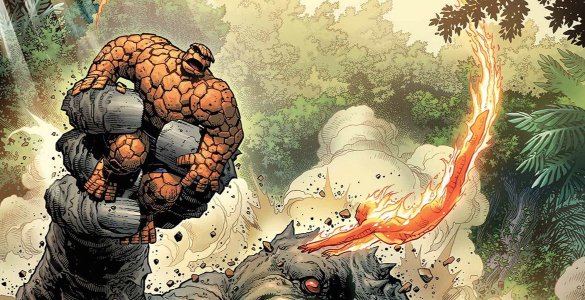
As I read Marvel Two-In-One #2 I realized that I’ve never read a Fantastic Four comic before, which is surprising given how much I love Marvel and their universe. But when I consider it, a Fantastic Four comic is actually somewhat of rarity. It’s been published on and off now for awhile, with its last issue coming out in 2015. This probably has something to do with the Fantastic Four movies, which have done more harm than good to the franchise with their general terribleness. I was prepared for anything in this issue and I’m happy to say I liked it, given the way it hearkens to the roots the series is steeped in (I think). Continue reading

Villains Done In By Their Own Mistakes in Star Wars: Poe Dameron 23

by Michael DeLaney 

This article contains SPOILERS. If you haven’t read the issue yet, proceed at your own risk!

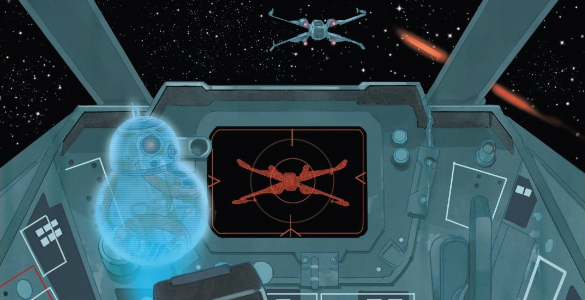
In the battle of good vs. evil, two things are usually true about the bad guys: they are stupid and they are crazy. In Star Wars: Poe Dameron 23, writer Charles Soule gives us some examples of both of these in the First Order agents Malarus and Terex.  Continue reading