Pacing Reveals in Cannibal 7

by Drew Baumgartner

Cannibal 7

This article contains SPOILERS. If you haven’t read the issue yet, proceed at your own risk!

This sentence has five words. Here are five more words. Five-word sentences are fine. But several together become monotonous. Listen to what is happening. The writing is getting boring. The sound of it drones. It’s like a stuck record. The ear demands some variety. Now listen. I vary the sentence length, and I create music. Music. The writing sings. It has a pleasant rhythm, a lilt, a harmony. I use short sentences. And I use sentences of medium length. And sometimes, when I am certain the reader is rested, I will engage him with a sentence of considerable length, a sentence that burns with energy and builds with all the impetus of a crescendo, the roll of the drums, the crash of the cymbals–sounds that say listen to this, it is important.

Gary Provost

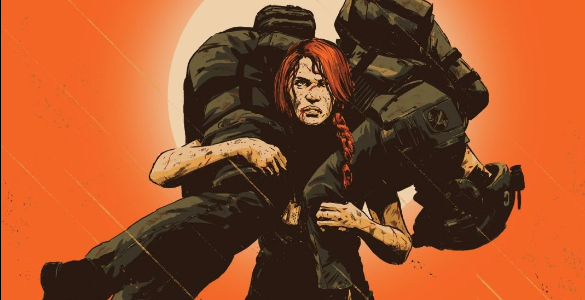
Pacing is the silent artistry of every medium, the kind of essential element that you only ever notice when it’s either poorly or remarkably well done. As such, pacing is not the kind of thing we always get to talk about around here — beyond the fact that the bulk are paced competently, comics pacing usually takes several pages to really sink in, so is a difficult point to illustrate in a short essay. But then there are comics that do it so well, they almost demand that effort. Cannibal 7 is one of those comics. Continue reading
Prioritizing Responsibilities in Peter Parker: The Spectacular Spider-Man 2

by Drew Baumgartner

Peter Parker The Spectacular Spider-Man 2

This article contains SPOILERS. If you haven’t read the issue yet, proceed at your own risk!

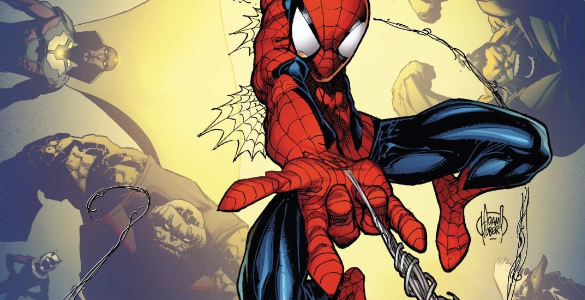
It’s always easy to score political points against the president by suggesting they’re spending too much time relaxing. Folks of every political persuasion have made this argument at some point or another, and it always sounds reasonable because the President obviously has more important things to be doing. With great power, as the saying goes, must also come great responsibility. But of course, even Presidents are people, and while we should certainly hold them to a high standard in terms of workload (that it’s a stressful job is part of the job description), expecting them to never take a vacation is inhumane. This is a point Peter Parker has always fluctuated on. He obviously respects the responsibilities that come with his powers, but he’d also like to be a human being with a fulfilling professional and personal life. Usually, that means he’s constantly running out on dates or jobs to save the day, but Chip Zdarksy and Adam Kubert find a decidedly different approach in Peter Parker: The Spectacular Spider-Man 2. Continue reading

Lazarus X+66 1: Discussion

By Drew Baumgartner and Ryan Desaulniers

Lazarus X+66 1

This article contains SPOILERS. If you haven’t read the issue yet, proceed at your own risk!

Some are born great, some achieve greatness, and some have greatness thrust upon ’em.

William Shakespeare, Twelfth Night

Drew: This quote often comes up when discussing historical figures, but to my eye, it’s really all about the narratives we build around people. That is, this describes fictional heroes — from “chosen ones” destined for greatness to utterly reluctant nobodies that rise to the occasion — stories so familiar to us, we can’t help but project them on the world around us. But, like, what does it mean to be “born great,” and how do we distinguish that from someone having greatness thrust upon them? Those kinds of distinctions might make sense in stories where deities and magic put concepts like destiny in play, but the real world is much messier than that. Such is the case with Casey Solomon, whose greatness is anticipated by Forever Carlyle. Is her greatness inborn, or is it something she only achieved in order to live up to expectations? Continue reading

The Banality of Magic in Curse Words 6

by Drew Baumgartner

Curse Words 6

This article contains SPOILERS. If you haven’t read the issue yet, proceed at your own risk!

There are countless diagnoses for the success of Harry Potter, but I have to think at least part of the appeal is that the stories embraced both the pleasant and unpleasant extremes of fictional magic. On the one hand, there are enchanting magical novelties — everything from candies to sports to boarding schools — and on the other, there are evil characters that practice corrupted magic in order to kill their adversaries and gain power. While plenty of fiction has embraced one or the other of those extremes in their depiction of magic, few took on the whole spectrum, treating the world of magic as if it were every bit as messy and nuanced as the real world. Curse Words has gladly taken up that cause, and indeed takes it several steps further, exchanging Harry’s naive wonderment for more mundane complacency, emphasizing how commonplace and banal magical acts are in Hole World. Continue reading

Complicating the Schematic in The Wild Storm 6

by Drew Baumgartner

Wild Storm 6

This article contains SPOILERS. If you haven’t read the issue yet, proceed at your own risk!

If there’s an aesthetic that could define all of comics — perhaps we’d call it a medium-defining aesthetic — it’s that of simplification and omission. Those acts are simply built into creating comics, where characters, settings, objects and ideas have to be depicted in two dimensions. That is, even the most detailed, photo-realistic style is a simplified representation of the 3-dimensional space it aims to represent. But the rigors of a monthly deadline put even that level of simplification out of reach, leading many to an even more simplified line-art approach. And then, of course, there are storytelling choices, as only a finite number of panels can fit in a given comic — some moments must be omitted. The choices of which moments to include is really what the art of comics storytelling is, whether it’s this character’s face versus another’s hands, or picking up on these conversation a beat or two later, or even omitting a scene altogether. That aesthetic often comes together in a way that prioritizes clarity, simplifying designs and actions and omitting needless details to make sure every beat is understood by the audience. In this way, we might understand a given comic to function as a kind of schematic — a simplified version of the world it depicts. This is certainly true of The Wild Storm, which is brimming with truly schematic, almost clinically clear sequences, though it puts them to use in ways that are far more complicated than they may initially seem. Continue reading

Becoming a Hero in Gotham Academy: Second Semester 11

by Drew Baumgartner

Gotham Academy Second Semester 11

This article contains SPOILERS. If you haven’t read the issue yet, proceed at your own risk!

I think it’s safe to say Maps Mizoguchi is the breakout character of Gotham Academy. Her enthusiasm for adventuring is infectious, and often positions her as a kind of audience surrogate. Plus, she runs circles around the rest of the Detective Club in terms of actual detective skills. In many ways, she’s the Hermione Granger of Gotham Academy, skilled beyond her classmates in just about every way that matters. But she’s not quite Hermione Granger. Importantly, while she may outpace her friends on the detective front, her relative youth means that she’s not quite as emotionally mature. It’s a detail that hasn’t come into play much thus far, but issue 11 reveals that it might just be Brenden Fletcher, Becky Cloonan, and Karl Kerschl’s smartest piece of groundwork. Continue reading

Surprising Surprises in Rocket 3

by Drew Baumgartner

Rocket 3

This article contains SPOILERS. If you haven’t read the issue yet, proceed at your own risk!

Any comics creator worth their salt understands that page turns are the most basic currency of comics storytelling. It’s built right into the format of the comic book — there are images that we can’t see that are suddenly revealed to us when we turn the page. There are certainly ways to surprise the reader within a page or spread, but none of those techniques are quite as inherent to the medium. Which means you can pack a lot of surprises into an issue by doing nothing other than leaning into the page turns. Page turns certainly aren’t the only technique Al Ewing and Adam Gorham rely on for surprises in Rocket 3, but they’re used so emphatically, it’s hard for those moments not to stand out. Continue reading

Allusions Become the Text in Bug! The Adventures of Forager 3

by Drew Baumgartner

Bug! The Adventures of Forager 3

This article contains SPOILERS. If you haven’t read the issue yet, proceed at your own risk!

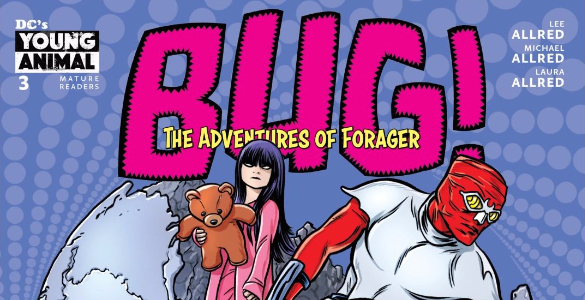
That this series riffs on the entirely of Jack Kirby’s DC work isn’t just a given — it’s a primary draw. And there’s plenty of work to touch upon. While this series is tangentially related to Kirby’s well-known Fourth World mythology, much of the focus has been on Kirby’s lesser-known DC creations. But what fascinates me about this issue isn’t just the presence of deep-cut characters like Atlas (and his vendetta against Hyssa the Lizard King), but that it does so while also making allusions to non-comics works. The effect is a densely literate work, as crystalline as the shards of “possible outcomes” that feature so prominently in this issue. Continue reading

Reconstructing the Superhero Mythos in Jupiter’s Legacy Volume 2 5

by Drew Baumgartner

Jupiter's Legacy Vol 2 5

This article contains SPOILERS. If you haven’t read the issue yet, proceed at your own risk!

There have been some truly great deconstructions of the superhero genre. Watchmen set the bar in that particular corner of superherodom, but there have been countless imitators in the decades since. Indeed, there’d be enough to think that the very idea of deconstructing a superhero story has lost all meaning — but of course, in comics, any issue might be someone’s first, so any deconstruction might feel subversive to newcomers, even if the rest of us have seen it a million times. That was more or less my assessment of Jupiter’s Legacy when it started back in 2013; this was an attractive, well-observed series that ultimately felt decidedly familiar. But, of course, that was its starting point, not its raison d’être. The fifth and final issue of volume two clarifies that this series was about taking superhero mythology from that tired deconstructed wasteland and reconstructing its original spirit of optimism. Continue reading

Shifting Tone in All-New Wolverine 22

by Drew Baumgartner

All-New Wolverine 22

This article contains SPOILERS. If you haven’t read the issue yet, proceed at your own risk!

The tonal range of Tom Taylor’s All New Wolverine is truly remarkable. We’ve seen issues of high drama and irreverent fun, all of which gives this series a depth of emotional experience that at least approaches real life. Moreover, the range allows Taylor to wield tone with a nuance that is rare in superhero comics, juxtaposing and combining them within issues to evoke ever more specific emotions. The surprising tonal twist in issue 22 is far from the most subtle Taylor has ever pulled, but I’ll be darned if it isn’t effective. Continue reading