Ironheart 1: Discussion

by Drew Baumgartner and Michael DeLaney

Ironheart 1

This article contains SPOILERS. If you haven’t read the issue yet, proceed at your own risk!

RiriwhydidyoubecomeIronheart?

Xavier King

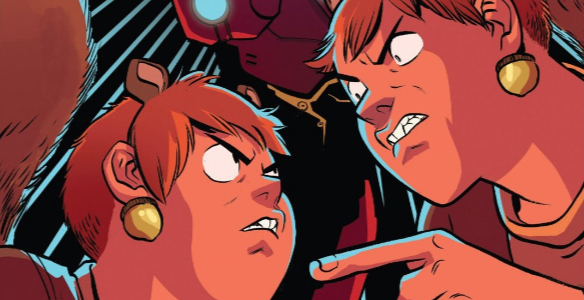
Drew: My favorite scene of Eve Ewing, Kevin Libranda, and Luciano Vecchio’s Ironheart 1 takes up most of the third act. Riri, exhausted from a day of inventing, superheroing, and unexpected tour-guiding, is rudely woken by her phone. The call is from Riri’s old neighbor, Xavier, whose out-of-the-blue call makes her suspicious. Sure enough, the call was Riri’s mom’s idea — exactly the kind of thoughtful meddling a teen would resent. In spite of this the two find some common ground with their shared enthusiasm for sci-fi and Hip-Hop. But then the other shoe drops, and Xavier blurts out the breathless question quoted above. In many ways, Xavier is articulating the central question of this series: Why is Riri Williams Ironheart? Continue reading
West Coast Avengers 4: Discussion

by Drew Baumgartner and Spencer Irwin

West Coast Avengers 4

This article contains SPOILERS. If you haven’t read the issue yet, proceed at your own risk!

I just wanted to [work in the documentary format] to see what it was like. You know, to take those weights off our ankles. I feel like 30 Rock and Community never get an award for doing a format that’s twice as hard. Because it really is twice as hard. Not only can you not lay in a voiceover, sort of explaining what people are doing and how they feel, but on top of that, you are combining all of the crutches that come from flashbacks and jumping around in time and multiple points of view. I wanted to do it and verify that it actually is easier to make an episode funnier using that format. And the answer is, yeah, it is. I mean, there were a lot of jokes in the episode, and it just seemed faster, like we were able to fire off more and pack more into it.

Dan Harmon on “Intermediate Documentary Filmmaking”

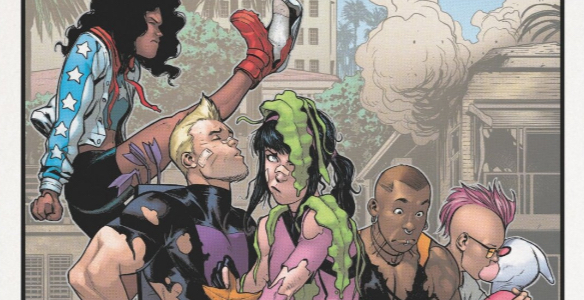
Drew: I regret that this quote is so critical of the documentary format, since my takeaway isn’t that it’s “easy” to be funny using that format, but that the format itself is well-suited to comedy. (Honestly, it’s hard for me to imagine caring about how easy or difficult a joke is to tell — I just care if it’s funny.) Indeed, I’d argue that selecting the format that best tells the story is of the upmost importance, and a format that is funnier and faster is ideal for a series like West Coast Avengers. In many ways, the documentary format itself — represented in this issue by the confessional sequences delivered directly to camera — sets the pacing for this issue, establishing six square panels as a kind of heartbeat for each page. Continue reading

Defusing the Tension in The Unbeatable Squirrel Girl 38

By Drew Baumgartner

Unbeatable Squirrel Girl 38

This article contains SPOILERS. If you haven’t read the issue yet, proceed at your own risk!

You guys, I love The Thing. That’s the John Carpenter movie, not Ben Grimm (though he’s cool, too). I’m a sucker for parlor mysteries in general, but the thought that “the killer” might actually be an imposter adds room for extra little twists that make the mysteries more mysterious and the tension more tense. Ryan North and Derek Charm play with this concept in the opening scene of Unbeatable Squirrel Girl 38, as Doreen and her computationally-minded friends devise a perfectly logical means of verifying everyone’s true identity. In Squirrel Girl’s world, there’s no white-knuckle blood-test scene, just the shortest route to diffusing that tension. It’s a choice North and Charm make throughout the issue, and while it sounds like it would rob the scenes of drama, it actually helps keep the pace moving along at a dizzying clip. Continue reading

Mister Miracle 12: Discussion

by Drew Baumgartner and Patrick Ehlers

Mister Miracle 12

This article contains SPOILERS. If you haven’t read the issue yet, proceed at your own risk!

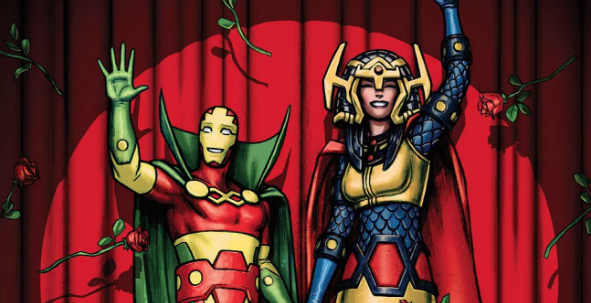
Drew: Critics of postmodern fiction often suggest that its self-reflexiveness is flashy, but devoid of meaning. According to the argument, postmodernism is a bit like racing stripes on a car — it might be superficially appealing, but doesn’t actually change what’s under the hood. I would argue that those critics are forgetting (or perhaps taking for granted) one of the most basic roles fiction plays in our lives, as an analogy for reality, augmented and enhanced to reveal something to us about the world we live in. In that way, postmodern self-reflexivity is simply part of that analogy — particularly apt for addressing our own existential crises. There’s no clearer exemplar of this argument than Mister Miracle 12, which twists all of the miniseries’ questions about Scott Free’s reality into a moving commentary on life with depression. Continue reading

Smash-cuts Break Up the Storytelling in Outer Darkness 1

by Drew Baumgartner

Outer Darkness 1

This article contains SPOILERS. If you haven’t read the issue yet, proceed at your own risk!

Space: the final frontier. These are the voyages of the starship Enterprise. Its five-year mission: to explore strange new worlds. To seek out new life and new civilizations. To boldly go where no man has gone before!

Star Trek

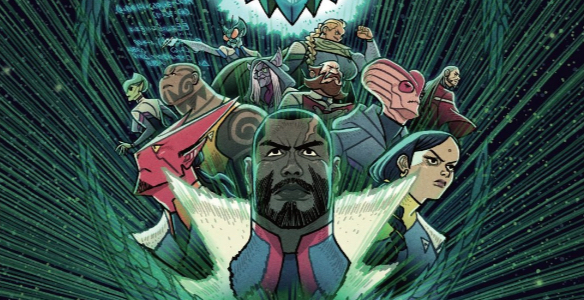
Not a lot of fiction gives you a mission statement quite as clearly as Star Trek. In just a few sentences (and fragments), the opening credits establish the where, what, and why of what of an entire universe, providing fuel for decades of new iterations and reimaginings. The mission statement for Outer Darkness is a bit more complicated, building on what writer John Layman calls “dramas set on spaceships” (in the grand tradition of Star Trek), while also folding in “outer space sci-fi horror,” for which he has charmingly few examples. The result is something obviously more difficult to pin down than that clear logline of Star Trek, but while this issue doesn’t quite cover its entire mission, it absolutely articulates its storytelling sensibilities, as Layman and artist Afu Chan make some distinctive choices to broadcast their tone. Continue reading

Extermination 4: Discussion

by Drew Baumgartner and Spencer Irwin

Extermination 4

This article containers SPOILERS. If you haven’t read the issue yet, proceed at your own risk!

There’s no time to explain!

Evasive Characters, Traditional

Drew: There comes a point in any mystery where the effort of maintaining the secret is obviously more trouble for the characters than simply admitting the truth. Writers may delay the inevitable by interrupting much-needed explanations, or adding some urgency that makes such explanations impossible, but inevitably, just taking a moment to put everyone on the same page is better for everyone. That is, “There’s no time to explain,” almost invariably causes more confusion and delays, taking more time than actually explaining what’s going on, and any character who is truly concerned about time would recognize that. Case in point: young Cable’s cause, when he finally gets around to explaining it in Extermination 4, is so compelling that virtually everyone who hears it is immediately on board with his plan. It would have saved him a ton of time sneaking around and fighting if he had any confidence in the necessity and righteousness of his mission. Fortunately, writer Ed Brisson has written in a remarkably effective explanation for young Cable’s illogical behavior: he’s a teenager. Continue reading

Strategies at Cross-Purposes in Coda 6

by Drew Baumgartner

Coda 6

This article contains SPOILERS. If you haven’t read the issue yet, proceed at your own risk!

I think it’s fair to say that Coda is set in a particularly fantastical world. Beyond the trappings of magical beings and beasts, the characters themselves recognize that they’re in a kind of mythical world that almost fetishizes heroic virtues of bravery and self-sacrifice. Which makes the cowardly pragmatism of our protagonist a distinguishing characteristic. He’s not an idealist willing to die in the battle against evil — he’s just a guy who wants to settle down for a quiet life with his wife somewhere. In pulling away from heroism, Hum forces us to reexamine the assumptions we have about what it means to be a hero, and what it means to not be one. It’s a subject Simon Spurrier and Matías Bergara have been playing with since the first issue, but one that comes to the fore in issue 6, as Hum argues his position with Serka. Continue reading

Batman 57 Pushes Through the Looking-Glass

by Drew Baumgartner

Batman 57

This article contains SPOILERS. If you haven’t read the issue yet, proceed at your own risk!

slim-banner

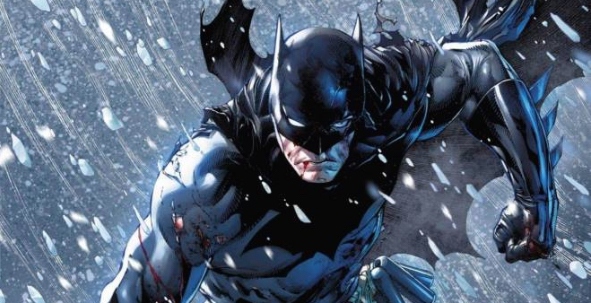
In his write-up of Batman 55, our very own Spencer Irwin highlighted the formal differences between the sequences featuring Dick Grayson and those featuring the mysterious “Mr. Zimmerman.” The Dick Grayson layouts are freewheeling and unpredictable, while “The Zimmerman sequences are highly regimented, each and every one depicted as nine-panel grids. This seems to represent how cold and calculated Zimmerman is and how mercenary and transnational his life is, but also how isolated he’s become.” Issue 56 drove that point home further, doubling down on the formal differences between the two stories (even after Dick Grayson stopped appearing). So by the time we read Batman 57 we’re pretty well conditioned to the notion that nine-panel grids = the KGBeast’s story, while anything else = Batman’s. It’s an expectation Tom King and his collaborators upend brilliantly, forcing us to question those conclusions we drew about these formal choices way back at the start of this arc. Continue reading

Lucifer 1: Discussion

by Drew Baumgartner and Patrick Ehlers

Lucifer 1

This article contains SPOILERS. If you haven’t read the issue yet, proceed at your own risk!

…its attempts at rising are hopeless. As all attempts are.

Lucifer, Lucifer 1

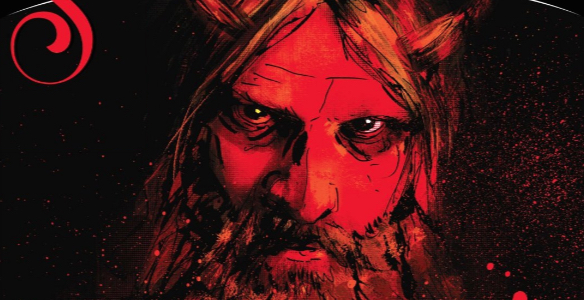
Drew: When I spoke with Lucifer writer Dan Watters about the teaser pages for this series that appeared in Sandman Universe 1, he was unequivocal about the symbolic meaning of the death of a character named Hope:

I’ve made it quite clear, at least I tried to, that this is going to be a dark book. This is the darkest corner of the Sandman Universe — at least that’s being explored right now. Which, you know, by the nature of the character, by the book, I think it should be. It’s definitely a statement of intent.

And the book is definitely dark. Lucifer‘s assertion that all “attempts at rising are hopeless” comes on the first page, before the issue plunges us into the present day of a status quo Lucifer clearly wishes to rise out of. A character learning to embrace hope would normally be an upbeat moral, but it takes on a twisted meaning here — whatever it is that could force Lucifer into retreat must be truly harrowing. And this is the story of what that experience was. Continue reading

Commentary Track – Dan Watters Talks Sandman Universe 1

Commentary Track Sandman Universe 1

Expanding on the world of Neil Gaiman’s Sandman, August’s Sandman Universe 1 served as the launchpad for four new ongoing series from DC Vertigo — The DreamingHouse of Whispers, Books of Magic, and Lucifer — each promising to explore different corners of that Universe. Just before Lucifer 1 released this week, we sat down with writer Dan Watters to go through his Sandman Universe 1 sequence page by page, so get your copy out and join us on the Commentary Track. Continue reading