The Visual Language of History and Myth in Teenage Mutant Ninja Turtles Universe 13

by Patrick Ehlers

This article contains SPOILERS. If you haven’t read the issue yet, proceed at your own risk!

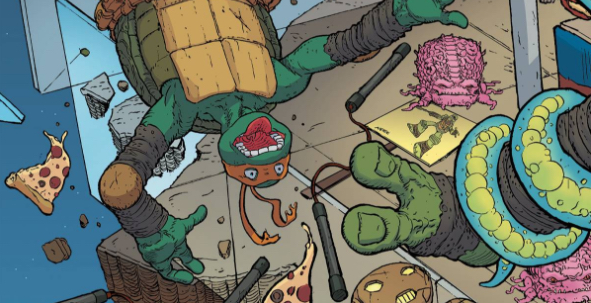
When we talk about character perspectives, we’re usually referring to lens crafted by their specific values, experiences, passions, fears — their view on the world. It is telling that I’m not able truly able to define perspective without using two different metaphors for perception (“lens” and “view”). Sophie Campbell and Erik Burnham’s Teenage Mutant Ninja Turtles Universe 13 continues to explore Karai’s perspective, presenting it almost entirely visually, letting the reader draw their own cultural connections. Continue reading

Teenage Mutant Ninja Turtles Dimension X 1: Discussion

By Patrick Ehlers and Taylor Anderson

This article contains SPOILERS. If you haven’t read the issue yet, proceed at your own risk!

Patrick: I recently spent the week with my three year old niece. Like all three year olds, she’s totally incapable of not expressing her emotions — everything that upsets her triggers a screaming fit and everything that delights her… triggers a screaming fit, but just a different kind. Spending the day with her is, of course, equal parts charming and exhausting, but the thing that struck me the most was how honest that time is. She’s got no way of hiding, muting or dulling her emotional reactions. As a crusty ol’ adult, I’ve got decades of training tamping those things down, to the point where I have to actively attempt to express what I’m feeling. There’s a strength to being able to feel without filter, and the young simply haven’t developed that filter yet. Paul Allor and Pablo Tunica’s Teenage Mutant Ninja Turtles Dimension X 1 explores how that strength manifests itself in our heroes as they visit a planet that makes emotions manifest physically. Continue reading

Jessica Earns the Ring in Green Lanterns 28

by Patrick Ehlers

This article contains SPOILERS. If you haven’t read the issue yet, proceed at your own risk!

Part Two of Sam Humphries and Eduardo Pansica’s “Out of Time” story arc is a rarity for superhero comic. Save an opening flashback, and a final page stinger, the entire issue is a single scene, taking place in one location over the course of a matter of minutes. That’s the closest thing you’re going to see to “real time” in a comic. There are no cuts around to more exotic settings or events, just the simple insistence on working out nine non-complementary personalities.  Continue reading

Vader Abandons Emotion in Darth Vader 4

by Patrick Ehlers

This article contains SPOILERS. If you haven’t read the issue yet, read on at your own risk!

We’re told that the strength of the Dark Side comes from tapping into one’s emotions. Basically, the more Anakin hates, the more strength he has. Jedi are trained to stomp out their emotions, which makes their control of the force more measured, but also markedly more dispassionate. That’s what makes Luke such an expectedly effective Force user — while he sorta learns from ancient Jedi masters, he’s too old and emotional to keep his feelings in check. He’s like 80% Light Side, with some Dark Side mixed in, just for extra oomph. But why wouldn’t the reverse be true? Darth Vader frequently draws on his rage, his grief and is isolation to make him powerful beyond measure, but it’s ultimately his dispassionate moves that make him most intimidating. Choking an officer to death to make a point? That shit’s calculated, not emotional. In Darth Vader 4, we see where the Sith Lord learns the power of not giving a fuck. Continue reading

Saga 45: Discussion

by Ryan Desaulniers and Patrick Ehlers

This article containers SPOILERS. If you have not read the issue yet, proceed at your own risk!

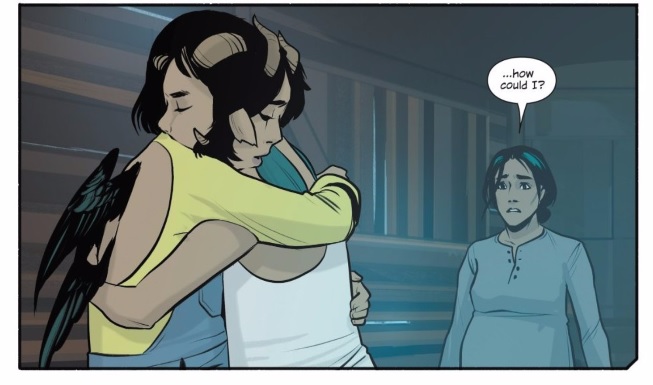
Ryan D: Since last issue’s final splasy page reveal — which Brian K. Vaughn and Fiona Staples love doing to us — my friends and I have been theorizing what the heck is happening with this male-looking version of Hazel who appears to Alana. The easy explanation would be that Alana is sick with her stillborn child and hallucinating. I find myself extremely pleased now, after reading this issue, that the approach the creative team took here is much more dramatically interesting than a mere hallucination. Having this apparition be a side-effect of the magical abilities which Alana temporarily sports due to her miscarriage helps to further the lore of the Horns’ magical abilities and the context in which they were used, and the fact that Marko, Alana, and Hazel all share sight of this magical illusion-child offers us crushing moments like this:

Continue reading

How a War of Language Escalates to Full-On War in Captain America Steve Rogers 19

by Patrick Ehlers

This article contains SPOILERS. If you haven’t read the issue yet, proceed at your own risk!

There are few political and social movements in my lifetime that have caused my peer group to stand up and say “fuck that whole ideology.” The rise of Trump and white nationalists is one such movement. I do it too — I find the ideas and attitude so repugnant, that I can’t help but extend my disgust to the people who preach it. Whether I’m justified in jumping to such combative language (did I really just use the f-word in the first sentence of a Retcon Punch piece?) the effect is undeniable: I’m contributing to the adversarial relationship that makes it feel like there’s moral gulf between myself and a Trump supporter. And with a chasm between us, how do we ever find common ground? Captain America Steve Rogers 19 asks these same questions, and unsettlingly lands on an answer: war.

Continue reading

How Lettering Sells the Loss in Deadpool 34

by Patrick Ehlers

This article contains SPOILERS. If you haven’t read the issue yet, proceed at your own risk!

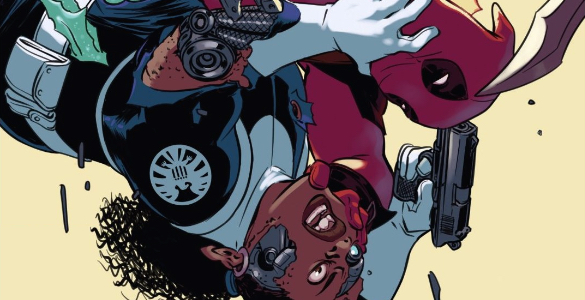
Comic book creators have so many tools at their disposal for exploring sadness. There’s the acting of the characters, the framing of a panel, setting, color and even dialogue if it comes down to it. Throughout their run with The Merc With the Mouth, writer Gerry Duggan and artist Matteo Lolli have utilized every one of these tools to convey the extreme despair at the center of Wade’s life, and his climatic battle with Preston is no exception. The sky turns red, and all other color disappears, in the abandoned town of Pleasant Hill, setting a strong emotional tone for the battle. The previous issue saw Preston turning off her emotions (literally — she’s a robot and can just mute those things), but Lolli’s insistence on her steely visage actually ends up communicating more about the fatalism driving Wade’s fall from grace. Continue reading

Teenage Mutant Ninja Turtles Usagi Yojimbo 1: Discussion

by Patrick Ehlers and Spencer Irwin
This article contains SPOILERS. If you haven’t read the issue yet, proceed at your own risk!

I grew up in Europe — where the history comes from. Oh yeah. You tear your history down man: “30 years old? Let’s tear it down and build a car park here.” I have seen it in stories — I saw a program on something in Miami. They said “we’ve redecorated this building to how it looked over 50 years ago!” People going: “No! Surely not, no! No one was alive then!”

Eddie Izzard, Dressed To Kill

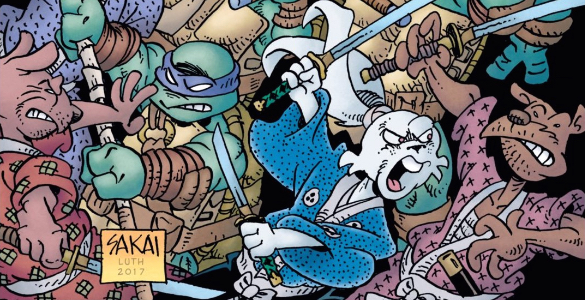
Patrick: One of the things we here at Retcon Punch find so impressive about IDW’s run with the Ninja Turtle series is the storytelling team’s commitment to remixing, recontextualizing, and reimagining the franchise’s immense history. Tom Waltz, Bobby Curnow, Kevin Eastman and a murders row of artists and writers have been pulling in influences from over thirty years of comics, TV shows, movies, video games, action figures, music videos, stage shows — you name it. It’s an impressive feat, but is also an exercise that rings weirdly hollow when compared to what Stan Sakai has always done with Usagi Yojimbo. The Long-Eared Samurai has been the protagonist in remixed stories from Japanese folklore for decades — literally as long as the TMNT have been around. With this latest crossover, Sakai again proves he is the king of narrative remix, reaching back way further than 1984 for his source material. Continue reading

Action is Character in Teenage Mutant Ninja Turtles Universe 12

by Patrick Ehlers

This article contains SPOILERS. If you haven’t read the issue yet, proceed at your own risk!

For a character we’ve been hanging out with for like 60 issues, we don’t know an awful lot about Karai. She is the fiercely loyal Chunin of Oroku Saki’s Foot Clan, solely responsible for both the clan and its leader coming back to life in the 21st century. She’s a character of constant struggle, and she has an adversarial relationship with everyone. Erik Burnham and Sophie Campbell’s first chapter in Karai’s post-New York saga starts with circumstantial violence, and escalates it into meaningful scheming and action — and Karai is the merciless engine behind all of it. Continue reading

Irony vs. Sincerity in All-New Guardians of the Galaxy 6

by Patrick Ehlers

This article contains SPOILERS. If you haven’t read the issue yet, proceed at your own risk!

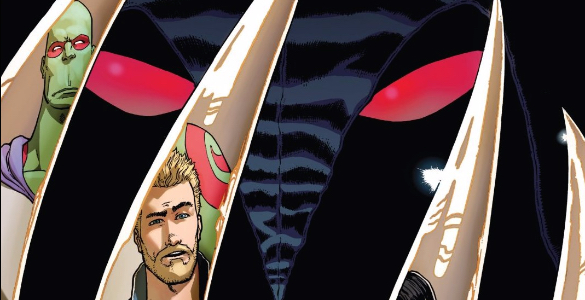
There’s a little bit of a disconnect between the crew of the Milano. On one hand, you’ve got Gamora and Drax, honor-bound warriors who are deeply entrenched in the galactic mythology that shapes the universe around them. On the other, you’ve got Star-Lord and Rocket, both of whom would happily throw sarcastic scare quotes up around “Guardians of the Galaxy.” It’s a tension of values — irony vs. sincerity — that eventually melts away in Guardians of the Galaxy 6. Continue reading