Kill Or Be Killed 10: Discussion

By Ryan Desaulniers and Drew Baumgartner

Kill or Be Killed 10

This article contains SPOILERS. If you haven’t read the issue yet, proceed at your own risk!

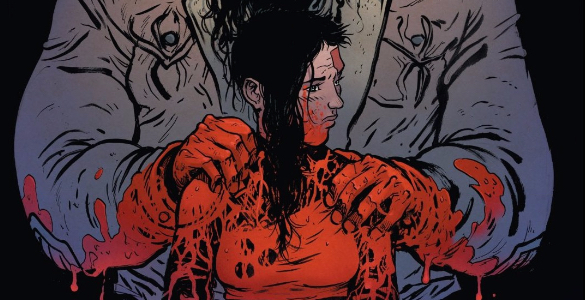
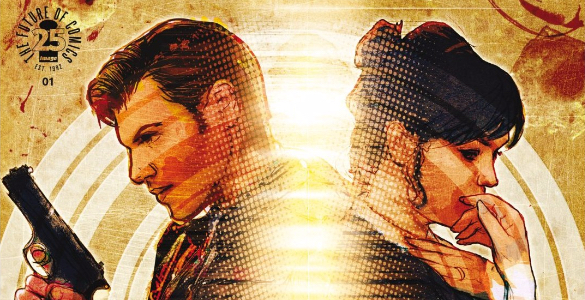
Ryan D: Maybe you were one of those people, like I was, who trudged through all six seasons of the TV series LOST, debating what was really going on underneath the framework narrative, listening to countless fan theories and devising your own. Perhaps the most popular of these theories was that the characters in the show were all in Purgatory, which show-runners Damon Lindelof and Carlton Cuse refuted until they were blue in the face. The tricky thing about fan theories, though, is that when the finale of the series did include a narrative reveal revolving around a state of limbo, many audience members felt disappointed and off-put. They had assumed and hoped that the creators would have devised a finish more surprising than what every Joe and Jill had guessed back in season one, and that the clues given to support this ending were feints and decoys, not the actual resolution. In a similar way, the creative team of Kill or Be Killed, in its tenth issue, confronts the fan theory which has been on everyone’s mind since the first issue: the demonic force which serves as a catalyst for Dylan’s violent turn might by a by-product of a mental condition. While some readers might be anxious about exploring the most obvious of possible explanations of Dylan’s actions, the deftness of writer Ed Brubaker and his visual team of Sean Phillips and Elizabeth Breitweiser keeps this pseudo-reveal exciting and the narrative fascinating. Continue reading

Reconstructing the Superhero Mythos in Jupiter’s Legacy Volume 2 5

by Drew Baumgartner

Jupiter's Legacy Vol 2 5

This article contains SPOILERS. If you haven’t read the issue yet, proceed at your own risk!

There have been some truly great deconstructions of the superhero genre. Watchmen set the bar in that particular corner of superherodom, but there have been countless imitators in the decades since. Indeed, there’d be enough to think that the very idea of deconstructing a superhero story has lost all meaning — but of course, in comics, any issue might be someone’s first, so any deconstruction might feel subversive to newcomers, even if the rest of us have seen it a million times. That was more or less my assessment of Jupiter’s Legacy when it started back in 2013; this was an attractive, well-observed series that ultimately felt decidedly familiar. But, of course, that was its starting point, not its raison d’être. The fifth and final issue of volume two clarifies that this series was about taking superhero mythology from that tired deconstructed wasteland and reconstructing its original spirit of optimism. Continue reading

The Wicked + The Divine 29 Continues to Ask “What Comes Next?”

by Spencer Irwin

This article contains SPOILERS. If you haven’t read the issue yet, proceed at your own risk!

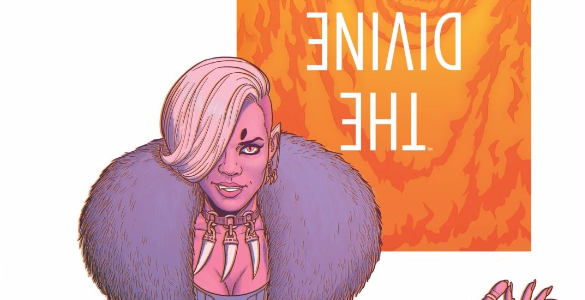
The first part of the “Imperial Phase” storyline was all about answering the question “what comes next?” — all about the Pantheon figuring out how to proceed after Ananke’s death, and generally doing so in the most self-indulgent manner possible. In The Wicked + The Divine 29, Kieron Gillen, Jamie McKelvie, and Matthew Wilson kick off the second part of “Imperial Phase” by asking the same exact question, only this time in the aftermath of Sakhmet’s deadly attack on her followers. The Pantheon’s answers to that question don’t appear to have changed much. Continue reading

Desperation and Inevitability in Extremity 5

by Mark Mitchell

This article contains SPOILERS. If you haven’t read the issue yet, proceed at your own risk!

Vince Gilligan, creator of Breaking Bad, pitched his TV show as one man’s journey from Mr. Chips to Scarface. But at what point does Walter White turn from mild mannered high school chemistry teacher to ruthless murderer/drug lord? When is the precise moment that the switch is flipped? Jerome has done some terrible things over the course of Extremity‘s first few issues, but Extremity 5 is the first time his actions cross the line into unjustifiable cruelty — or rather, murdering Jessica is the first time felt him crossing the line. Continue reading

Secret Weapons 1: Discussion

by Patrick Ehlers and Drew Baumgartner

This article contains SPOILERS. If you haven’t read the issue yet, proceed at your own risk!

slim-banner

Patrick: Thwip! Bamf! Snikt! You know those sound effects: respectively, they mean a) Spider-Man shooting some web fluid, b) Nightcrawler teleporting away, and c) Wolverine deploying his claws. It is perhaps illustrative of the predictability of their superpowers that there are immutable sound effects that accompany them. You know exactly what it sounds like when Wolvie pops his claws, but you also know exactly what he can do with them. These powers are used in unsurprising ways to save the day, but what happens when the superheroes have powers that aren’t so easy to understand? Well, then you’ve got the residents of The Willow and the cast of Secret Weapons. Continue reading

Definition by Contrast in Saga 44

by Ryan Mogge

This article contains SPOILERS. If you haven’t read the issue yet, proceed at your own risk!

When you are a kid, your family creates your idea of normal. It’s only when you go to a friend’s house and things are done just a little differently, that you can really define what makes your family unique. In Saga 44, Fiona Staples and Brian K. Vaughan reinforce what we know about Marko, Alana, and Hazel by giving us a fun-house mirror version of their family.

Continue reading

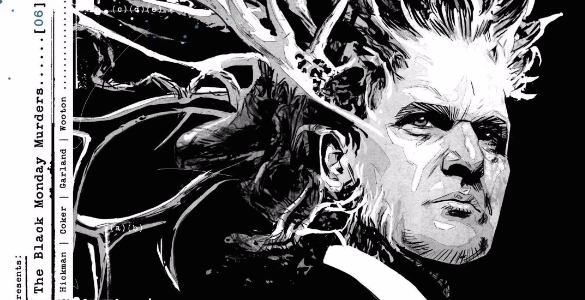
Finding a Balance in The Black Monday Murders 6

by Ryan Desaulniers

Black Monday Murders 6

This article contains SPOILERS. If you haven’t read the issue yet, proceed at your own risk!

If you know Jonathan Hickman’s past work, you know he can get…complicated. Reading The Black Monday Murders 1-5 to catch up for last month’s full conversation proved a deep dive into an intricate world full of ancient conspiracy theories, old money, the occult, convoluted machinations, epistolary inserts, and shadow-soaked boardroom conversations. This issue returns to show some of the fallout of the recent occurrences and again displays Hickman and artist Tomm Coker’s tightrope walk approach to action, exposition, and reaction. Continue reading

Crosswind 1: Discussion

by Spencer Irwin and Taylor Anderson

This article contains SPOILERS. If you haven’t read the issue yet, proceed at your own risk!

slim-banner

Spencer: “Boys will be boys.” I can’t think of another phrase that seems so innocent, yet is in actuality so malicious. It does nobody any favors. It teaches men (and yes, for some reason this phrase is just as often — if not more often — applied to teenagers or grown men as it is children) that they have no control over their impulses and actions, while it simultaneously teaches women that they should just accept whatever men throw their way because men can’t help themselves, can’t be taught or trained or reasoned with. What started as a reminder of little boys’ natural boundless energy has become an excuse for misogyny, abuse — sometimes even murder. This phrase is also the only thing connecting the otherwise entirely disparate lives of Cason Ray Bennett and Juniper Elanore Blue, the dual protagonists of Cat Staggs and Gail Simone’s Crosswind. Continue reading

The Non-Quixotic Quest in The Old Guard 5

by Drew Baumgartner

The Old Guard 5

This article contains SPOILERS. If you haven’t read the issue yet, read on at your own risk!

To dream the impossible dream
To fight the unbeatable foe
To bear with unbearable sorrow
To run where the brave dare not go

Joe Darion, “The Impossible Dream”

Is Andy the anti-Don Quixote? Her world-weary cynicism is certainly the opposite of his delusions of chivalry; her bitter pragmatism the opposite of his flights of fancy. But the thing that strikes me most is that Andy is the unbeatable foe, the kind of mythical being Quixote could only dream of. Of course, this gives them different priorities — while he’s focused on those imaginary beings, she’s utterly undaunted by the mortal tilting at her. Sure, the mortal can get in a few good licks, but is more of an annoyance than a nemesis. Indeed, it turns out the only thing worthy of an unbeatable foe’s attention is another unbeatable foe. Continue reading

There’s No Virtue in Compliance in Bitch Planet Triple Feature 1

by Drew Baumgartner

Bitch Planet Triple Feature 1

This article will contain SPOILERS. If you haven’t read the issue yet, proceed at your own risk!

It is more important that innocence should be protected, than it is, that guilt be punished; for guilt and crimes are so frequent in this world, that all of them cannot be punished…. when innocence itself, is brought to the bar and condemned, especially to die, the subject will exclaim, ‘it is immaterial to me whether I behave well or ill, for virtue itself is no security.’ And if such a sentiment as this were to take hold in the mind of the subject that would be the end of all security whatsoever.

John Adams

There are always folks who will defend punishment for the guilty — whether it’s prison, public shaming, or being shot by a cop — but that often necessitates retroactively framing those who receive punishment as guilty. In the wakes of countless police (and neighborhood watchmen) shootings, the offenses that have been deemed worthy of death have ranged from stealing a pack of cigarettes to wearing a goddamned hoodie. It’s an absolutely despicable line of reasoning (even when it’s “I agree they didn’t deserve to die, but…”), but it falls completely on its face in the case of Philando Castile, who was inarguably guilty of no crime whatsoever. This is exactly the situation Adams was warning against. There is no virtue in innocence or — in the parlance of Bitch Planet — compliance, so why follow the rules at all? Continue reading