Material 1

material 1

Today, Drew and Patrick are discussing Material 1, originally released May 27th, 2015.

It was the best of times, it was the worst of times, it was the age of wisdom, it was the age of foolishness, it was the epoch of belief, it was the epoch of incredulity, it was the season of Light, it was the season of Darkness, it was the spring of hope, it was the winter of despair, we had everything before us, we had nothing before us, we were all going direct to Heaven, we were all going direct the other way – in short, the period was so far like the present period, that some of its noisiest authorities insisted on its being received, for good or for evil, in the superlative degree of comparison only.

Charles Dickens, A Tale of Two Cities

Drew: Like most Americans, I first read A Tale of Two Cities in high school, and like most Americans, that experience utterly ruined the book for me. My 9th grade teacher proudly trotted out all sorts of historical information about the French Revolution, making it all the more difficult to keep in mind that its themes of privilege and oppression are, unfortunately, timeless. Indeed, I’d long seen the famous opening paragraph’s use of past tense as an affirmation of that historical distance, but only because I’d forgotten the less-quotable final clause that reminds us that this is mostly remarkable for being “so far like the present period.” It’s that same “present period” that is reflected in Ales Kot and Will Tempest’s Material 1, which offers a tale of many cities that is just as timeless as Dickens’, but also decidedly more of-the-moment. Continue reading

Trees 9

Alternating Currents: Trees 9, Ryan and Drew

Today, Ryan and Drew are discussing Trees 9, originally released May 20th, 2015.

…Hurled headlong flaming from the ethereal sky
With hideous ruin and combustion down
To bottomless perdition, there to dwell
In adamantine chains and penal fire

John Milton, Paradise Lost

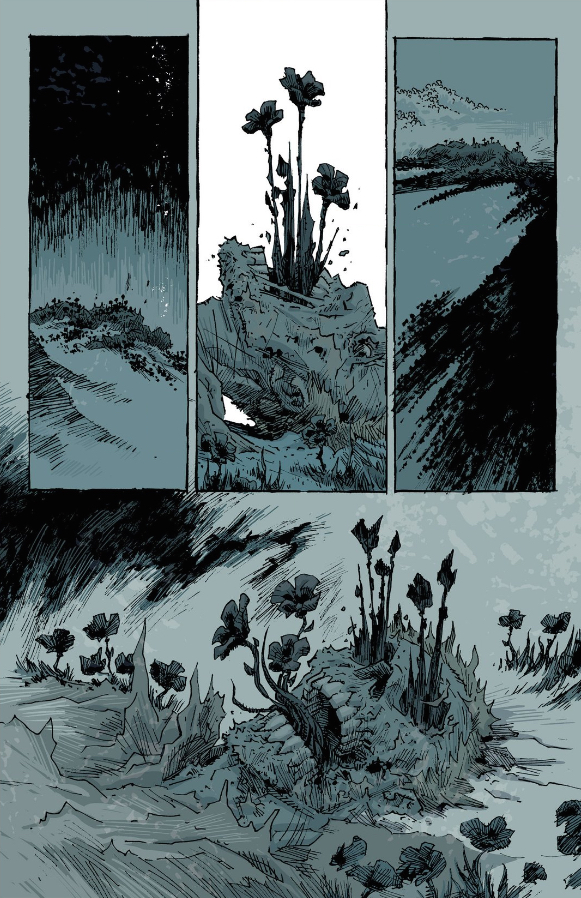
Ryan: The curtains rise in Trees 9 on three silent pages chronicling the Luciferian Fall of poor, poor Marsh. My favorite character in this series rests, undone by the very thing which drove him to the brink of madness:

Flowers mark his grave

The nefarious flowers bloom in his desiccated corpse as if in an elegy: Here Lie Marsh, Whose Name Was Writ Only in Alien Poppies. Thank you, Jason Howard, for the send-off which Dr. Marsh needed. Continue reading

Kaptara 2

kaptara 2

Today, Patrick and Michael are discussing Kaptara 2, originally released May 20th, 2015.

Patrick: Fun personal fact about me: I get sorta stressed out writing about some of the more prestige comics that Retcon Punch covers. While something like Saga or Nameless or Velvet might be both excellent and full of meaning, those creators are savvy enough to obscure any absolute reading of their work. The masters know enough to resist reducing their work to an easy slug line. I find the exact same quality to be true of Chip Zdarsky and Kagan McLeod’s Kaptara. Is it a subversion of high fantasy tropes? Or does the naturalistic, jokey approach to storytelling invalidate any comparisons one could draw to the standards of the genre? Issue two hints at commentary on celebrity, politics, gender dynamic, but doesn’t stay with anything long enough to make a point. But it may just be Kaptara’s refusal to make any point that makes it so damn fun. Oh, and the Cat Tanks. Obviously. Continue reading

The Fade Out 6

Alternating Currents: The Fade Out 6, Drew and Patrick

Today, Drew and Patrick are discussing The Fade Out 6, originally released May 20th, 2015.

Fuck you; I gave you a reason to live and you were more than happy to help. You lie to yourself! You don’t want the truth, the truth is a fucking coward. So you make up your own truth.

Teddy, Memento

Drew: The more I think about Memento, the more I love it. It’s easy to see the backwards structure as gimmickry, but I’m absolutely enamored of how it draws us into Leonard Shelby’s subjectivity. And I mean “draws us in” — that the scenes are shown to us in reverse order doesn’t just put us in his shoes, it forces us to trust him in spite of his obvious shortcomings as a narrator. His unreliability is front-and-center from the start, but because we’re lost with him, we have no choice but to trust him. Charlie Parish’s unreliability is decidedly less tangible, but no less central to his story — the whole mystery surrounding Valeria’s death hinges on him not remembering what happened. As The Fade Out ramps into its second arc, his subjectivity becomes an ever more important element of the series. Continue reading

Injection 1

Alternating Currents: Injection 1, Drew and Ryan

Today, Drew and Ryan are discussing Injection 1, originally released May 13th, 2015.

Drew: The conventional wisdom on writing is that you must hook your audience from the very first sentence. “Don’t give the reader a chance to put it down,” my old professor used to say. It’s logical advice, but I always chaffed at how prescribed it felt. The complexity of ideas you can convey in a sentence or two is necessarily limited, and it seems silly to deny ourselves access to more complex ideas for fear of a fickle audience. Maybe it’s because my background is in classical music, where the audience is necessarily more captive, but it always seemed a tad alarmist to presume the audience is constantly looking to stop reading. If we allow that hook come later than the first sentence or two, it’s less tied to a single image, idea, or quote — it can become more about characters, atmosphere, even pacing. This is exactly the kind of approach Warren Ellis, Declan Shavley, and Jordie Bellaire take in their new series, drawing us in as much by what they don’t show us as what they do. Continue reading

Saga 28

Alternating Currents: Saga 28, Drew and Patrick

Today, Drew and Patrick are discussing Saga 28, originally released May 13th, 2015.

Drew: There are few things more depressing than studying altruism at a biological level. In a world driven by survival, what could possibly compel an individual to risk life and limb (or, more modestly, share food and shelter) with another? For sexually mature individuals, the most obvious answer is reproduction — helping your mate or your offspring survive increases the chance of your genes, and thus, the behavior of protecting your mate and offspring, will be carried on to future generations. But what about other relationships? Well, in 1964, W.D. Hamilton proposed that we help others for basically the same reason we protect our offspring: because we share genes with them. Importantly, we only share genes with those that are actually related to us, and a key part of Hamilton’s formula was the “relatedness coefficient” — essentially, you’re more likely to help your sibling than your cousin because you’re more related to them, or, more precisely, because you’re more likely to share genes with them. Which is to say, we don’t help people at all, we help their genes, and only because their genes are our genes. From that perspective, “altruism” doesn’t exist at all — we’re all just working in service of totally self-interested genes.

Of course, we’re not entirely driven by our genes. If genes give us our hardware, culture gives us our software, allowing us to do all kinds of things our genes wouldn’t dream of, from taking vows of celibacy to covering a live grenade to protect our platoon. Those are some extreme examples, but I think they become more relatable when we think of those acts as protecting family. Sure, a religious congregation or military unit aren’t technically families, but they can act as families for those who need it. It’s exactly these types of makeshift families — and the sacrifices they elicit — that Saga 28 is all about. Continue reading

Zero 16

Alternating Currents: Zero 16, Drew and Taylor

Today, Drew and Taylor are discussing Zero 16, originally released May 6th, 2015.

“You” believed this was “your voice” and “you” were a story “you” were telling to a boy who was “your son” but “who” was telling the story of “you” telling the story to “your son?”

Ales Kot, Zero 16

Drew: In our discussion of Zero 14, I noted that, while the framing device of Zero telling his story to the boy about to shoot him gave us a narrator for our story proper, I had to wonder who was “telling” the story of that framing device. Of course, that was just before writer Ales Kot pulled the camera back even further to reveal another framing device in issue 15. That issue explained that the “higher narrator” is actually William S. Burroughs, introduced as a character in the comic, but still left open the question of who was presenting us with that framing device. That kind of nested reality could go on forever, but this issue actually finds Kot doing something much more clever — dissolving the borders between these framing devices. It’s a fascinating trick that brings us closer to the fiction that is Zero…or is it that it brings Zero closer to reality? Continue reading

The Wicked + The Divine 10

wicked and divine 10

Today, Patrick and Spencer are discussing The Wicked + The Divine 10, originally released May 6th, 2015.

You know what hope is?
Hope is a bastard.
Hope is a liar, a cheat and a tease.
Hope comes near you?
Kick its backside:
Got no place in times like these.

Ben Folds and Nick Hornby, “Picture Window”

Patrick: The world of The Wicked + The Divine posits that everyone wants something just beyond their reach. Fans just want to connect with the gods, the gods just want to live a little bit longer. Their goals always seem tenable, but for the simple fact that they aren’t. This extends directly to the reader — ten issues in and we should be able to speak more definitively about whether Lucifer killed that judge, but we can’t. This issue explores the gulf created by what the characters want, and only sheepishly celebrates what they have. Continue reading

Lazarus 16

Alternating Currents: Lazarus 16, Drew and Patrick

Today, Drew and Patrick are discussing Lazarus 16, originally released April 22nd, 2015.

Drew: My first experience with an epistolary novel was Karen Cushman’s Catherine, Called Birdy, presented as the diary of the titular character. It seemed like such a novel concept to me (no pun intended), but the epistolary novel actually predates the modern novel by over 100 years. It makes sense that the documentary-style of the epistolary novel as a collection of letters and diary entries might be more approachable than the entirely artificial convention of having a character (or third person narrator) telling the story to us. While Lazarus has often stayed close to Forever’s perspective, it’s never committed to any one narrator, which makes issue 16 all the more unusual, presented largely as the diary entries, transmissions, conversation transcripts, and training materials of Sister Bernard, punctuated with only a few short instances of dialogue. Continue reading

Kaptara 1

kaptara 1

Today, Michael and Mark are discussing Kaptara 1, originally released April 22nd, 2015.

Space, why you gotta be like that?

Kaptara 1

Michael: Compared to other genres of fiction, science fiction is still relatively young. Despite this, most science fiction — smart science fiction — relies on the intelligence of its audience in the way that it references and respects the space epics that have come before it. We’ve made similar observations in our write-ups of recent sci-fi books like Saga and Nameless: good science fiction trusts that even if you haven’t seen every Star Wars or Alien film, you will be familiar enough with the situation that they are trying to honor, re-enact or subvert. And when you’re dealing with a comic book produced by an independent publisher like Image, there is more freedom to directly reference these situations and tropes in-story. Such is the beauty of Kaptara. Continue reading