Injection 1

Alternating Currents: Injection 1, Drew and Ryan

Today, Drew and Ryan are discussing Injection 1, originally released May 13th, 2015.

Drew: The conventional wisdom on writing is that you must hook your audience from the very first sentence. “Don’t give the reader a chance to put it down,” my old professor used to say. It’s logical advice, but I always chaffed at how prescribed it felt. The complexity of ideas you can convey in a sentence or two is necessarily limited, and it seems silly to deny ourselves access to more complex ideas for fear of a fickle audience. Maybe it’s because my background is in classical music, where the audience is necessarily more captive, but it always seemed a tad alarmist to presume the audience is constantly looking to stop reading. If we allow that hook come later than the first sentence or two, it’s less tied to a single image, idea, or quote — it can become more about characters, atmosphere, even pacing. This is exactly the kind of approach Warren Ellis, Declan Shavley, and Jordie Bellaire take in their new series, drawing us in as much by what they don’t show us as what they do. Continue reading
Zero 16

Alternating Currents: Zero 16, Drew and Taylor

Today, Drew and Taylor are discussing Zero 16, originally released May 6th, 2015.

“You” believed this was “your voice” and “you” were a story “you” were telling to a boy who was “your son” but “who” was telling the story of “you” telling the story to “your son?”

Ales Kot, Zero 16

Drew: In our discussion of Zero 14, I noted that, while the framing device of Zero telling his story to the boy about to shoot him gave us a narrator for our story proper, I had to wonder who was “telling” the story of that framing device. Of course, that was just before writer Ales Kot pulled the camera back even further to reveal another framing device in issue 15. That issue explained that the “higher narrator” is actually William S. Burroughs, introduced as a character in the comic, but still left open the question of who was presenting us with that framing device. That kind of nested reality could go on forever, but this issue actually finds Kot doing something much more clever — dissolving the borders between these framing devices. It’s a fascinating trick that brings us closer to the fiction that is Zero…or is it that it brings Zero closer to reality? Continue reading

The Autumnlands: Tooth and Claw 5

tooth and claw 5

Today, Spencer and Patrick are discussing The Autumnlands: Tooth and Claw 5, originally released March 25th, 2015.

Spencer: I like to think that I’m an optimistic person, but if there’s one thing I allow myself to be unabashedly cynical about, it’s politics. Now, I don’t think that everyone involved in politics is up to no good, but for every politician trying to do right by their voters, there’s ten thousand more looking out only for themselves. In The Autumnlands: Tooth and Claw 5, Kurt Busiek and Benjamin Dewey focus a bit on that dilemma, showing how the political maneuverings of the selfish can drown out those with more noble intentions, even in a world of magic and great champions. Continue reading

Zero 15

zero 15

Today, Patrick and Drew are discussing Zero 15, originally released January 28th, 2015.

Patrick: Last time we talked about Zero, Drew was interested in the discrete loops of experience necessarily unshared by the artist and the audience. This came on the heels of two issues which seemed to actively push the audience away — largely wordless volumes soaked cover-to-cover in intense, non-romantic violence with cryptic references to half-remembered song lyrics — so it was easy, almost necessary, to rely solely on the reader’s perspective of the events in question. With issue 15, Ales Kot and artist Ian Bertram re-introduce the concept of the meta-narrative first explored in issue 10, and along with it, a fictionalized version of Williams S. Burroughs, as the author of this story. The move simultaneously buys into the culture of exploring authorial intention and discounting it all together, as the experiences, reality, dreams and non-reality of creator and creation merge, both on the page and off. Continue reading

The Surface 1

Alternating Currents: The Surface 1, Drew and Spencer

Today, Drew and Spencer are discussing The Surface 1, originally released March 11th, 2015.

Writing becomes not easier, but more difficult for me. Every word is like an unnecessary stain on silence and nothingness.

Samuel Beckett

Drew: It’s not often that we scrutinize whether a work of art “justifies its own existence.” Indeed, it’s a focus we tend to reserve for sequels, re-masterings, new editions, or other works that might be accused of returning to a specific well, but it’s curious that we’re not equally dubious of ALL art. I suspect it’s because we don’t actually care. Why a work of art exists may be an easy target when we dislike it, but ultimately, the only thing that matters is how it exists. There may be creator-side issues that explain why the nuts and bolts of a work of art are the way we are, but on the audience side, we can really only evaluate whether or not those nuts and bolts work. As a guiding principle, that philosophy has kept me happy, allowing me to both separate art from the artists that make it and remain blissfully ignorant of whatever business considerations might go on behind the scenes. But with that happiness came a kind of complacency, forgetting that there might be works of art that might actually be about their own existence. The Surface 1 is one such work, focusing so self-consciously on its own existence that I can’t help but feel a little insecure about justifying a written discussion of it — not because it’s bad, but because that self-consciousness is kind of infectious. Continue reading

Princess Leia 1

princess leia 1

Today, Taylor and Patrick are discussing Princess Leia 1, originally released March 4th, 2015.

Taylor: The Empire Strikes Back features a memorable scene where Han and Leia share their first kiss. The scene is a gem, with both of them behaving in such a manner so essential to their characters that they (and the audience) can’t resist each other. Han is charming, smooth talking, and a little sleazy. Leia, on the other hand, is cool, distant, and fiercely independent. Looking at this scene, you can’t help but recognize that this is who Leia is. Even though we know passion burns hotly underneath her cool exterior, she’s never one to give away her true feelings. Princess Leia 1 picks up on these characteristics and fleshes out not only one of cinema’s most famous heroines, but also fleshes out Star Wars at the same time. Continue reading

Zero 14

zero 14 Today, Drew and Taylor are discussing Zero 14, originally released January 28th, 2015. Art and Social Function

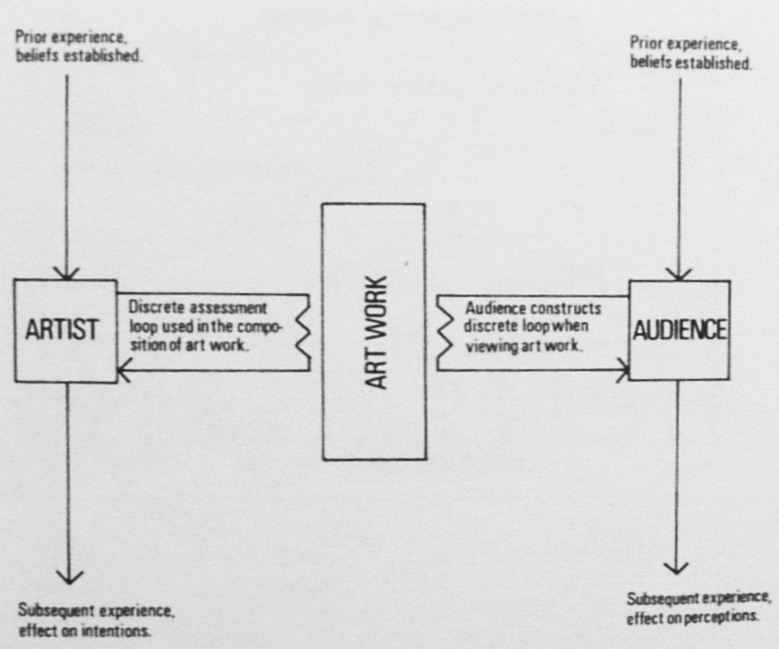
Two fundamental discrete cognate loops are shown, which are isolated from each other by the artwork. There is no form of interaction between the two which could generate mutual understanding as would be the case in a successful conversation. In the absence of such a procedure both the audience and the artists become locked in their own perceptual biases.

Stephen Willats, Art and Social Function

Drew: Where does meaning happen? I was brought up on the postmodern ideals outlined in the epigraph, but it seems that a great deal of modern society still clings to romantic notions of artistic intention. We celebrate and scorn artists based on their intentions, forgetting that the value of their art may not have anything to do with the artist. Indeed, we’re so obsessed with intention that we conflate it with meaning, minimizing the audience’s role — a role I might argue is the whole point of art in the first place. It’s because of this climate that I enjoy art that obscures its artist’s intentions. It’s easy to assume the moral is the “point” of one of Aesop’s fables, but it’s decidedly harder to draw such a clean line in something like Zero 14, where ambiguity and sheer density of ideas makes any meaning we can parse decidedly our own. Continue reading

Best of 2014: Best Issue

Best of 2014: Best IssueEpisodic storytelling is the name of the game in monthly comics. Month- or even multi-year-long arcs are fine, but a series lives and dies by its individual chapters. From self-contained one-offs to issues that recontextualize their respective series, this year had a ton of great issues. Whittling down those issues to a list was no easy task (and we look forward to hearing how your lists differ in the comments), but we would gladly recommend any (and all) of these issues without hesitation. These are our top 14 issues of 2014.
Continue reading

Best of 2014: Best Colorist

Best of 2014: Best Colorist
From lines at conventions to the internet petitions every time an assignment changes, its clear comic fans put a lot of stock in who writes and draws their comics, often to the exclusion of the rest of the creative team. While colorists have slowly been gaining more recognition, they are still largely the unsung heroes of the comics world, adding depth and meaning to the storytelling in ways so subtle as to be almost invisible. As we started preparing our year-end lists, we realized that we, too, had been overlooking the contributions of these indispensable artists, and decided it was high time to offer the best the praise they so rightly deserve. These are our top 14 colorists of 2014.
Continue reading

Zero 13

Alternating Currents: Zero 13, Drew and PatrickToday, Drew and Patrick are discussing Zero 13, originally released December 17th, 2014.

What has been will be again, what has been done will be done again; there is nothing new under the sun.

Ecclesiastes 1:9

Drew: It’s easy for the neophile to be frustrated with art. As much as our society claims to value innovation, our art tends to rely heavily on the comforts of the known. That’s not to say the majority of art is devoid of surprise, just that the forms that those surprises take are so prescribed as to be relatively predictable. Whether it’s the hero returning home or the melody returning to the home key, our most tried-and-true structures leave only the smaller details to truly distinguish themselves. Zero 13 contains a masterful example of this kind of small surprise, but this issue’s biggest surprise might lie in what it reveals about the larger form of the series. Continue reading