Failure Defeated by Pure Action in Daredevil 601

By Patrick Ehlers

This article contains SPOILERS. If you haven’t read the issue yet, proceed at your own risk!

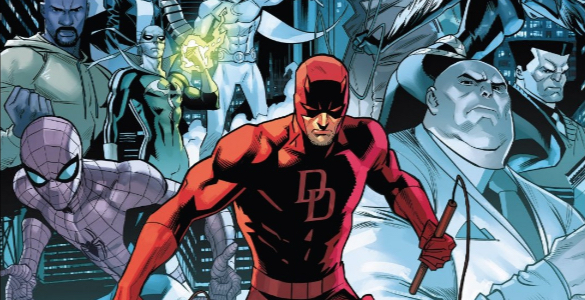
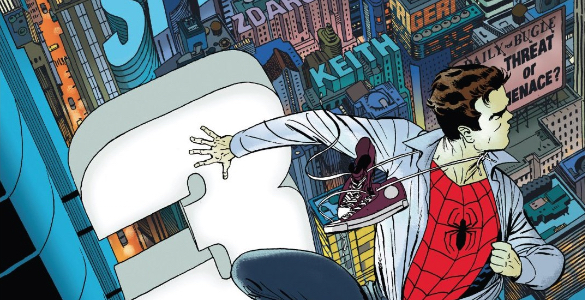
Daredevil is a punching bag. I know all superheroes suffer — conflict is the engine of story, and masked dudes with superpowers have to really be put through the ringer for a desensitized audience to feel anything. But Matt Murdock is a special case: his default state seems to be “just got beat up.” I mean, look at the cover to this issue. No one’s going to ask “oh no, is Matt gonna be okay?” Yeah, sure — he’ll be fine. He always bleeds from the face when he’s working on a plan. So part of what makes Daredevil 601 feel so unsettling is how smoothly everything goes for the Mayor Without Fear. Continue reading

Fun With Familiar Ideas in The Amazing Spider-Man 799

by Spencer Irwin

This article contains SPOILERS. If you haven’t read the issue yet, proceed at your own risk!

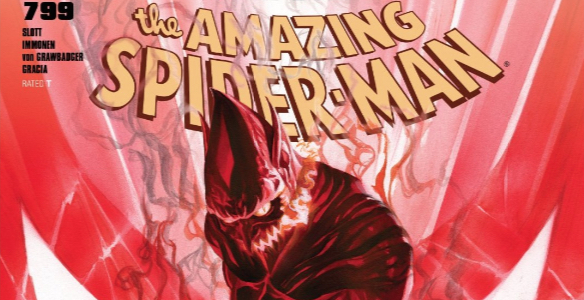
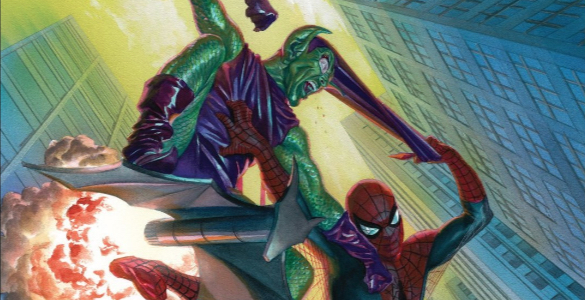
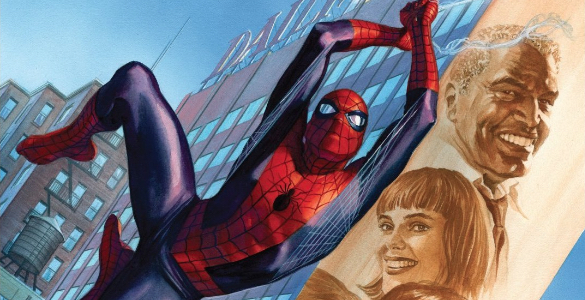
The end of a creative team’s run often finds the team building to a story that spans their entire tenure on the title, bringing together all their loose ends into one grand climax. Dan Slott, though, has simply been writing The Amazing Spider-Man too long to realistically do that; in fact, he’s tied up most of his long-running plots over the last few storylines, instead using much of his final arc to return Peter Parker to a kinda-sorta classic status quo for future creators to play with. Slott, though, has always found quite a bit to mine from classic status quos, from familiar plots and the immutable core of his characters. Even stories as well-known as “Norman Osborn returns to terrorize Peter and Harry” and “Spider-Man and Goblin fight” find a new life under Slott’s pen, and that’s no different in The Amazing Spider-Man 799, which finds Slott and Stuart Immonen tackling these familiar stories from new angles, from different perspectives, with a few surprises hiding up their sleeves. Continue reading

Daredevil 600: Discussion

by Patrick Ehlers and Ryan Desaulniers

This article containers SPOILERS. If you have not read the issue yet, proceed at your own risk!

Patrick: Where does power come from? I’ve been seriously grappling with this one since Trump was elected to the White House, but this question obviously extends waaaay beyond that fucking monster. Does power ultimately come from money? From social connections? From one’s willingness to sacrifice their friendships? From violence? From non-violence? As the battle between Wilson Fisk and Daredevil reaches a fever pitch, questions of where either of them gets their power are posed right alongside the question of where Daredevil 600 gets its power. This is a six-hundredth issue, after all — so what makes this one special? Continue reading

Peter’s Problems Outpace His Growth in Amazing Spider-Man 798

by Drew Baumgartner

Amazing Spider-Man 798

This article contains SPOILERS. If you haven’t read the issue yet, proceed at your own risk!

I had a college professor who liked to talk about “the ascending spiral groove thang” — the notion that we tend to cycle through the same problems, but always with our previous experience informing each new iteration, turning that cycle into a kind of spiral staircase. It’s an elegant idea that helps turn the hopelessness of facing down the same issues again and again feel like an opportunity for improvement. It’s an idea that Peter Parker embodies almost perfectly, vowing to improve (if never quite perfect) the decisions that led to the deaths of his loved ones. But what if those problems have an ascending spiral groove thang of their own? What if Peter’s problems are getting smarter and more mature along with him? That’s exactly what he’s up against in Amazing Spider-Man 798, as Norman Osborn returns with the Carnage symbiote. Continue reading

Amazing Spider-Man 797 Does What Only a Comic Book Can

by Spencer Irwin

This article contains SPOILERS. If you haven’t read the issue yet, proceed at your own risk!

I was initially drawn to comic books simply because I loved superheroes, and wanted to find more stories about them. Story is still probably my favorite part of comics (or anything, really), but over the years I’ve learned to appreciate the specific strengths of comic books as an art-form, the things they can do that no other medium can. Dan Slott and Stuart Immonen certainly understand those strengths, as their Amazing Spider-Man 797 revolves around a sequence that just wouldn’t work on TV or in the movie theater. Continue reading

Spidey in a Nutshell in Peter Parker: The Spectacular Spider-Man 300

by Taylor Anderson

This article contains SPOILERS. If you haven’t read the issue yet, proceed at your own risk!

Over the years, Spider-Man has come to mean a lot of different things to a lot of different people. That being the case, it’s still interesting to ponder what about Spidey resonates with so many fans. After all, there are plenty of superheroes who have had comics, but few who are as popular as the web-slinger. I can’t help but feel that there must be something about Spider-Man that all people enjoy — something that makes him almost universal in his appeal. Figuring that out is perhaps a taller order than I can accomplish in this article, but in issue 300 of the Spectacular Spider-Man, there are hints which suggest why he is such a likable hero. Continue reading

Old Habits Die Hard in Amazing Spider-Man 796

by Drew Baumgartner

Amazing Spider-Man 796

This article contains SPOILERS. If you haven’t read the issue yet, proceed at your own risk!

There’s a concept in psychology of the “repetition compulsion,” which essentially lays out a kind of self-fulfilling prophecy for our neuroses. A straightforward (and non-pathological) example would be an introvert avoiding big crowds, which in turn prevents them from developing comfort around (or at least strategies to cope with) big crowds, which in turn encourages them to avoid big crowds, but this phenomenon can be seen operating at everything from our smallest habits to our biggest problems. Lest this sound too fatalistic, those cycles of repetition can be broken, but my actual point in bringing them up is just to emphasize how cyclical our lives can be — even when embarking on a new adventure, our old habits may force them to resemble our old adventures. Such has long been the case of superheroes, whose new adventures are in part only marketable because people liked the old adventures, so leaning into those repetition compulsions (even the destructive ones) is a logical choice.

Writer Dan Slott has always managed to keep a remarkable balance between the old and the new, repeating enough to keep his characters recognizable, but changing enough to keep the stories exciting, largely by changing the big patterns (Pete’s job, relationship status, identity, etc) but holding onto the small ones (Pete’s talkativeness, bad luck, sense of responsibility, etc). But with issue 796, Slott and co-writer Christos Gage begin folding some of those larger repetitions back into the mix, suggesting that Slott might just be putting the toys back in place as he hands over the reigns of the series he’s been writing for over a decade. Continue reading

Clashing Tones in The Amazing Spider-Man Annual 42

by Drew Baumgartner

Amazing Spider-Man Annual 42

This article contains SPOILERS. If you haven’t read the issue yet, proceed at your own risk!

It’s hard to separate a character from the types of stories they inhabit. Indeed, it’s an idea that doesn’t even really make sense in most media, where characters tend to inhabit just the one story, but it kind of runs amok in comics, where there are countless forces pushing characters into other types of stories. There’s crossovers and cameos, which will pull the guest-starring character into the (potentially very different) tonal world of the home series. There’s cross-media franchises, which will accentuate the parts of the character that best suit the medium, whether it’s an action movie, a video-game, or a kids cartoon. And, perhaps more than anything, there’s the monthly grind of telling yet another story with this character, inspiring creators to think outside the box to find something new and exciting to show us. Those forces compound over the decades, such that a given character is less defined by the type of stories they inhabit than the range of stories they could inhabit. Such is the case with Spider-Man, who is so famously versatile to have teamed up with basically everyone in the Marvel Universe, has appeared in countless film and television iterations, and often stars in multiple comics series at once. Even so, there seem to be a few types of stories that Spider-Man isn’t quite suited for, as The Amazing Spider-Man Annual 42 illustrates. Continue reading

Mulligans Are Good in Golf, Not in Amazing Spider-Man 795

By Taylor Anderson

This article contains SPOILERS. If you haven’t read the issue yet, proceed at your own risk!

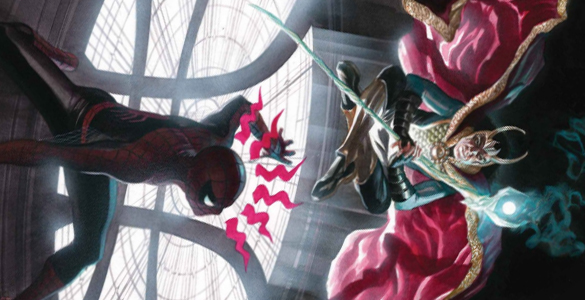
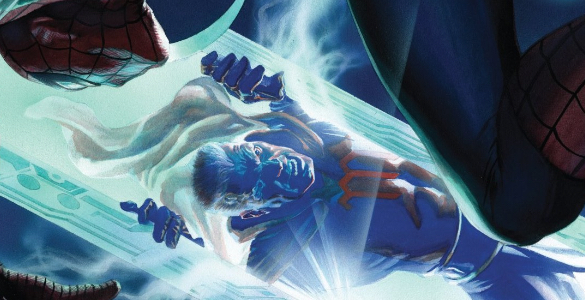
Anyone who knows anything about magic and time travel knows there’s always cost for either of them. Use magic to help yourself out, and you better bet your ass that some ironic malady will strike you later. Use time travel and you better be prepared for the consequences caused by your mucking up the time-space continuum. But if you’re Loki, these rules may not apply to you, and in that case, why not mess with both? He does just this with Peter Parker, but with there being no consequences to these actions, it seems like a pointless gesture in more ways than one.

Continue reading

Amazing Spider-Man 794: Discussion

By Drew Baumgartner and Taylor Anderson

Amazing Spider-Man 794

This article contains SPOILERS. If you haven’t read the issue yet, proceed at your own risk!

I never get enough sleep. I stay up late at night, cause I’m Night Guy. Night Guy wants to stay up late. “What about getting up after five hours sleep?” Oh that’s Morning Guy’s problem. That’s not my problem, I’m Night Guy.

Jerry Seinfeld

Drew: I’ve never heard anyone defend procrastination. We know it’s stupid and lazy, passing off the problem on our future selves, but we still do it, anyway. Charitably, we might describe this as some kind of prioritization or planning maneuver, but more often than not, it’s just putting off whatever work needs to actually be done. But here’s the thing: there are rarely any consequences for procrastination. I mean, sure, you might put writing your term paper (or government budget) off so long that you completely blow your deadline, but so long as you don’t fall into that trap, procrastination is more of a recipe for annoyance than it is failure. Case in point: Spidey’s delayed showdown with Scorpio in Amazing Spider-Man 794. Continue reading