Zero 14

zero 14 Today, Drew and Taylor are discussing Zero 14, originally released January 28th, 2015. Art and Social Function

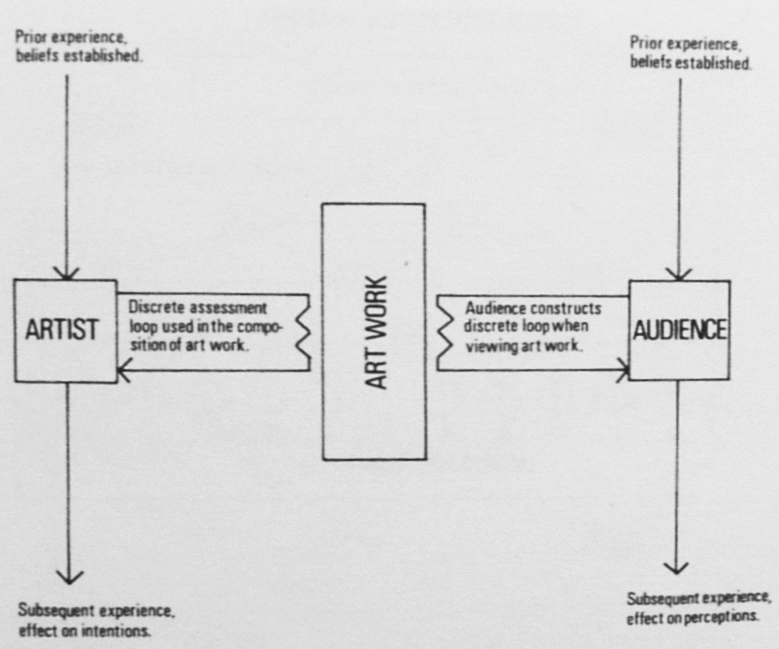
Two fundamental discrete cognate loops are shown, which are isolated from each other by the artwork. There is no form of interaction between the two which could generate mutual understanding as would be the case in a successful conversation. In the absence of such a procedure both the audience and the artists become locked in their own perceptual biases.

Stephen Willats, Art and Social Function

Drew: Where does meaning happen? I was brought up on the postmodern ideals outlined in the epigraph, but it seems that a great deal of modern society still clings to romantic notions of artistic intention. We celebrate and scorn artists based on their intentions, forgetting that the value of their art may not have anything to do with the artist. Indeed, we’re so obsessed with intention that we conflate it with meaning, minimizing the audience’s role — a role I might argue is the whole point of art in the first place. It’s because of this climate that I enjoy art that obscures its artist’s intentions. It’s easy to assume the moral is the “point” of one of Aesop’s fables, but it’s decidedly harder to draw such a clean line in something like Zero 14, where ambiguity and sheer density of ideas makes any meaning we can parse decidedly our own. Continue reading

Uncanny X-Men 30

uncanny xmen 30

Today, Drew and Michael are discussing Uncanny X-Men 30, originally released January 28th, 2015.
There was an old lady who swallowed a cow
I don’t know how she swallowed a cow
She swallowed the cow to catch the dog
She swallowed the dog to catch the cat
She swallowed the cat to catch the bird
She swallowed the bird to catch the spider
She swallowed the spider to catch the fly
I don’t know why she swallowed a fly — Perhaps she’ll die!

Traditional

Drew: Way back in All-New X-Men 1, Hank McCoy was up against a problem so insurmountable, his only solution was to drag the original X-Men into the present to help solve it. Uncanny X-Men 30 finds Eva Bell against an even more insurmountable problem, one the original X-Men already failed to solve. What’s she left to do but to go back in time and call in the X-Men’s boss? It’s escalation in its purest (and most obvious) form, but does bringing Charles Xavier back from the dead suffer from the repetition? Continue reading

Gotham Academy 4

gotham acadamy 4

Today, Spencer and Suzanne are discussing Gotham Academy 4, originally released January 28th, 2015.

Spencer: Every property handles the supernatural a little differently. Some reject supernatural elements entirely while others use them as their primary concept; shows like Scooby Doo or Doctor Who regularly tease the supernatural before inevitably revealing them to be hoaxes or extraterrestrial in nature, while at DC Comics the supernatural is a well-known, accepted part of the universe, but one that rarely takes center stage. This is particularly true in Gotham City, so I always kinda assumed that the supernatural elements in Becky Cloonan, Brenden Fletcher and Karl Kerschl’s Gotham Academy would turn out to be hoaxes; two different reveals in issue four prove me right, but what I appreciate about these reveals is how they both help to expand and develop the world of Gotham Academy in drastically different, but equally effective ways. Continue reading

The Multiversity Guidebook

multiversity guidebook 1

Today, Michael and Mark are discussing The Multiversity Guidebook, originally released January 28th, 2015.

Michael: Currently I’m re-watching Animaniacs, a children’s show which often wore the disguise of an educational tool pretending to be a cartoon. Sure, the characters are goofy and zany, but they still teach you the names of all of the countries of the world in a catchy tune. With that in mind, The Multiversity Guidebook is a story disguised as a “history book.” There’s a lot of information thrown at you about the multiple earths of the DC Universe, but it is clearly the connective tissue of every chapter of The Multiversity thus far. It’s the history of the same story: The DC Universe story. Continue reading

Thor 4

Alternating Currents: Thor 4, Spencer and Drew

Today, Spencer and Drew are discussing Thor 4, originally released January 28th, 2014.

Spencer: Would my life be different if I had a different name? Back in high school I thought Spencer was a nerdy sounding name and that it gave me an automatic handicap when it came to being “cool,” but now that I’ve matured I’ve come to realize that my name didn’t dictate my personality or path in life. Still, as I’ve grown to love and appreciate my name it’s come to feel like an intrinsic part of my personality; it may not have shaped my life, but it’s grown with me and absorbed my qualities, and if somebody took my name away from me, it would feel like I was losing a part of myself. That’s the exact situation Thor Odinson finds himself facing in Jason Aaron and Russell Dauterman’s Thor 4, an issue that firmly establishes the new Thor while also showing just exactly what that means for the old one. Continue reading

All-New X-Men 35

Alternating Currents: All-New X-Men 35, Ryan and Patrick

Today, Ryan and Patrick are discussing All-New X-Men 35, originally released January 21st, 2015.

Ryan: The “how” of All-New X-Men 35 may come off as complicated, but is fairly straightforward compared to some of the dimension and timeline hopping we have seen recently. With the grown-up, 616-proper X-men all converging on the last will and testament of one Charles Xavier, the temporally and dimensionally-displaced All-New (plus X-23) find themselves in the Ultimate Universe thanks to the powers of a new mutant named Carmen. These X-men find the heroes on Earth-1610 still recovering from the devastation of Gah Lak Tus’s attack during Cataclysm, and a general populace wherein mutants are not only marginalized, but actively outlawed. See? Simple. Continue reading

Deadpool 41

deadpool 41

Today, Taylor and Drew are discussing Deadpool 41, originally released January 28th, 2015.

Taylor: When someone mentions Deadpool to you, what’s the first word that comes to mind? Is it lunatic? Madman? Goof-off? Ask a fan to describe the titular character of the most recent run of Deadpool and you might get some of these same answers, but a few might throw in descriptors such as melancholy, complex, and heartwarming asshole. Wade Wilson is many things, and depending on how you read the series, he could be any of the things listed above. However, even though we’ve known Wade for a long time now, can any of us really say we know him? Taking into consideration that the man hardly knows himself, this question becomes even more confounding. Continue reading

Effigy 1

effigy 1

Today, Patrick and Spencer are discussing Effigy 1, originally released January 28th, 2015.

Patrick: How many different police procedurals are on TV right now? Like a billion. (Don’t check my facts on that.) They’re all basically the same, and you can usually determine whodunnit by the order the characters are introduced (or by who’s the most prestigious guest star), so what’s the difference between them really? Perhaps intuitively, it’s the detectives themselves that make or break a detective show. The light sci-fi premise of The X-Files might have sold the series, but it’s the personalities of Fox Mulder and Dana Scully that give the series staying power. Tim Seely’s new series, Effigy, works extra hard to give us a clear and unique vision of our detective, so by the time the mystery finally hits, we’re already invested.  Continue reading

Batman 38

Alternating Currents: Batman 38, Drew and Patrick

Today, Drew and Patrick are discussing Batman 38 originally released on January 28th, 2015.

Drew: Fiction has a complex relationship with expectations. We want fiction to meet some expectations — that it should feature the conflicts and conceits pitched on the back cover, that it meets whatever network of expectations that might make it “believable” — but we also want it to defy others. The story of a farm girl suffering a concussion during a tornado may be believable, but it doesn’t capture our imaginations in the same way as the adventures she has when she thinks she’s whisked off to the magical land over the rainbow. Exactly how a story balances meeting and subverting our expectations varies from genre to genre, writer to writer, even moment to moment, but most stories seem to get the most mileage out of meeting our expectations just long enough to really surprise us when the unexpected hits. After three epic arcs of defying expectations, Scott Snyder and Greg Capullo’s Batman has an even more complex relationship with the expected, creating a situation where the surprises may very well be the expected norm to be subverted. Continue reading

Fables 148

fables 148
Today, Drew and Patrick are discussing Fables 148, originally released January 21st, 2015.

Once upon a time…

Traditional

Drew: Where would you say your story begins? Your first memory? Your birth? Your conception? Your parents’ first date? Their births? It’s easy enough to trace that back ad infinitum, as the circumstances that allowed you to become the person you are were set in motion at the very dawn of time. The same could be said of when your story ends. Is it your death? The death of the last person who knew you? Perhaps your mere existence influences events until the very end of time. Obviously, the scope of an individual story tends to be a bit narrower — infinite context is rarely necessary or informative — but what about the scope of all stories? The folklore origins of Fables have always given the characters a certain vintage of origin, and the modern-day setting gives them a certain end-date, but issue 148 finds important context stretching further in both directions, effectively widening the scope of the series to the narrative arc of the entire universe. Continue reading