Secret Wars Round-Up: Issues released 5/20/15

secret wars roundup1

Today, Drew and Patrick discuss Ultimate End 1, Battleworld 1, Planet Hulk 1, Spider-Verse 1, and Deadpool’s Secret Secret Wars 1.
secret wars div

I have no idea what Secret Wars is going to be.

Retcon Punch, Traditional

Drew: Seriously, though: what is Secret Wars? Is it an excuse to revisit popular stories from Marvel’s history? Is it a means to merge the 616 Universe with the most popular elements of the Ultimate Universe? Is it an open field for creators to try out goofy ideas? Is it a stupid summer crossover event designed to sell comics? Offering the first real taste of what the tie-in issues, this week’s offerings suggest that the answer to all of our questions is “yes.” Continue reading

Convergence Round-Up: Week Seven

convergence roundup 7
Today, Shane leads a discussion about
Convergence 7, Adventures of Superman 2, Batman & the Outsiders 2, Green Lantern Corps 2, Hawkman 2, Justice League of America 2, Superboy & The Legion 2, Swamp Thing 2, and Wonder Woman 2.

convergence divShane: I’m not saying that it’s easy to write a story, but there’s still a basic structure that, if followed, makes the work a bit simpler. You’re going to set the stage and introduce the characters, before moving on to a rising action to give way to the ultimate conflict. Eventually, you’ll turn everything on its head with the climax of the story and begin to settle various plot points, before eventually drawing up an ending. Convergence is no different, and even though the series has been split into eight main issues, these five have all been strongly represented (so far, at least—we aren’t at the conclusion yet!)—but it’s been equally fascinating to see how each two-issue miniseries uses this story structure, as well. Notably, with this month’s final issues, we’ve seen a lot of titles subvert the classic formula, offering conclusions but still sending their characters onward and back into the main event. It’s been done in some cases better than others (I’m now just as sick of the earthquake as I was Telos’ speech in the first month), but it’s refreshing to see that even if a miniseries is the last time we’ll see a character star, their story has at least the potential to continue. Continue reading

Convergence: The Flash 2

flash 2 conv

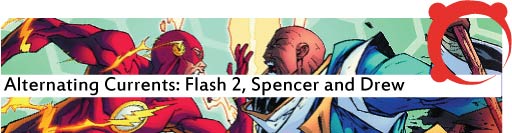
Today, Spencer and Drew are discussing Convergence: The Flash 2, originally released May 20th, 2015. This issue is part of Convergence. For our conversations about the rest of Convergence this week, click here.

convergence div

Spencer: For the several decades that fell between Crisis on Infinite Earths and The Flash: Rebirth, Barry Allen was DC’s greatest hero. He was also dead, mind you, but that’s the exact reason why Barry became so legendary. The Flash sacrificed his life to save the entire multiverse, and by martyring himself he became this almost mythic figure, inspiring the entire DC universe — fans were even known to call him “Saint Barry.” But when Barry returned to life, he was overwhelmed by the praise. Fame was never something he wanted, and he knew he was far from perfect. Every action he took as the Flash, from stopping a mugger to sacrificing his life to save the universe, was taken with only one thought in mind — helping others. This dichotomy between how others view Barry and how he views himself is one of the central themes of Dan Abnett and Federico Dallocchio’s Convergence: The Flash 2. Continue reading

The Fade Out 6

Alternating Currents: The Fade Out 6, Drew and Patrick

Today, Drew and Patrick are discussing The Fade Out 6, originally released May 20th, 2015.

Fuck you; I gave you a reason to live and you were more than happy to help. You lie to yourself! You don’t want the truth, the truth is a fucking coward. So you make up your own truth.

Teddy, Memento

Drew: The more I think about Memento, the more I love it. It’s easy to see the backwards structure as gimmickry, but I’m absolutely enamored of how it draws us into Leonard Shelby’s subjectivity. And I mean “draws us in” — that the scenes are shown to us in reverse order doesn’t just put us in his shoes, it forces us to trust him in spite of his obvious shortcomings as a narrator. His unreliability is front-and-center from the start, but because we’re lost with him, we have no choice but to trust him. Charlie Parish’s unreliability is decidedly less tangible, but no less central to his story — the whole mystery surrounding Valeria’s death hinges on him not remembering what happened. As The Fade Out ramps into its second arc, his subjectivity becomes an ever more important element of the series. Continue reading

Weekly Round-Up: Comics Released 5/13/15

round up

Look, there are a lot of comics out there. Too many. We can never hope to have in-depth conversations about all of them. But, we sure can round up some of the more noteworthy titles we didn’t get around to from the week. Today, Patrick, Drew, and Spencer discuss East of West 19, C.O.W.L. 10, Southern Cross 3, Astro City 23, ODY-C 5, Chrononauts 3, Howard the Duck 3, Ms. Marvel 15, and Captain Marvel 15

slim-banner4

Drew: There are a ton of (poorly sourced) articles out there claiming poll data that suggests 40% of American adults believe we’re living in the end times. Whether or not that particular statistic is true, it’s no doubt that the end of the world plays a key role in our pop culture. Whether you’re reading The Walking Dead or watching the latest Mad Max movie, the apocalypse is everywhere. That’s particularly true of comics this week. Both of the Big Two universes are fighting for their lives, while the indies on our pull swirl around the notion of the end, whether that’s the world itself, or just our window on it. We’ve exhaustively covered those Big Two events elsewhere, but here’s a look at the smaller apocalypses going around the rest of comicdom. Continue reading

Injection 1

Alternating Currents: Injection 1, Drew and Ryan

Today, Drew and Ryan are discussing Injection 1, originally released May 13th, 2015.

Drew: The conventional wisdom on writing is that you must hook your audience from the very first sentence. “Don’t give the reader a chance to put it down,” my old professor used to say. It’s logical advice, but I always chaffed at how prescribed it felt. The complexity of ideas you can convey in a sentence or two is necessarily limited, and it seems silly to deny ourselves access to more complex ideas for fear of a fickle audience. Maybe it’s because my background is in classical music, where the audience is necessarily more captive, but it always seemed a tad alarmist to presume the audience is constantly looking to stop reading. If we allow that hook come later than the first sentence or two, it’s less tied to a single image, idea, or quote — it can become more about characters, atmosphere, even pacing. This is exactly the kind of approach Warren Ellis, Declan Shavley, and Jordie Bellaire take in their new series, drawing us in as much by what they don’t show us as what they do. Continue reading

Secret Wars 2

secret wars 2

Today, Mark and Drew are discussing Secret Wars 2, originally released May 13th, 2015. 

Mark: This summer finds both DC and Marvel presenting readers with big crossover events where their heroes fight for survival, but the approaches couldn’t be more different. For all of the problems DC’s Convergence has (and the list is not brief), one advantage is that DC has a long, storied history of multiverses, continuities, and characters to choose from. It does my nerd heart good to see characters like pre-Flashpoint Superman once again, characters to which I have a lot of attachment. Maybe it’s a cheap thrill, but there’s something to seeing these heroes from different times and universes coming together. Marvel does not have the luxury of history. They’ve always employed a rolling continuity that keeps their characters’ histories current without having to do a hard reboot like the New 52. Outside of Earth-616, the Ultimate universe has been a depressing mess for such a long time that Miles Morales was the only reason to keep it limping along at all. So in order for Marvel to create an interesting clash of heroes, they had to basically build one from the ground up.

Enter Battleworld. I admit to having Jonathan Hickman fatigue after his sometimes messy, always talky Avengers/New Avengers run, and I honestly found Secret Wars 1 to be rather boring, but I appreciated the mash up of sci-fi and fantasy tropes with the Marvel Universe found in Secret Wars 2. Continue reading

Convergence Round-Up: Week Six

convergence roundup 6Today, Spencer leads a discussion about Convergence 6, Aquaman 2, Batman: Shadow of the Bat 2, Catwoman 2, Green Arrow 2, Justice League International 2, Suicide Squad 2, Supergirl: Matrix 2, and Superman: The Man of Steel 2.

convergence divSpencer: Early in Convergence, when first issuing his decree that the various cities fight for their survival, Telos declared that if anybody refused to fight, or tried to team-up and work against him, both their cities would be destroyed. It was a threat he made good on almost immediately by destroying the people of Kandor, and as a plot point, it forced confrontations between the cities that otherwise probably wouldn’t have happened. In this week’s Convergence tie-ins, though, that decree officially becomes moot as team after team decide to quit fighting and instead take Telos on together. Cooperation — or, at least, attempts at cooperation — is the name of the game in Week Six. Continue reading

Saga 28

Alternating Currents: Saga 28, Drew and Patrick

Today, Drew and Patrick are discussing Saga 28, originally released May 13th, 2015.

Drew: There are few things more depressing than studying altruism at a biological level. In a world driven by survival, what could possibly compel an individual to risk life and limb (or, more modestly, share food and shelter) with another? For sexually mature individuals, the most obvious answer is reproduction — helping your mate or your offspring survive increases the chance of your genes, and thus, the behavior of protecting your mate and offspring, will be carried on to future generations. But what about other relationships? Well, in 1964, W.D. Hamilton proposed that we help others for basically the same reason we protect our offspring: because we share genes with them. Importantly, we only share genes with those that are actually related to us, and a key part of Hamilton’s formula was the “relatedness coefficient” — essentially, you’re more likely to help your sibling than your cousin because you’re more related to them, or, more precisely, because you’re more likely to share genes with them. Which is to say, we don’t help people at all, we help their genes, and only because their genes are our genes. From that perspective, “altruism” doesn’t exist at all — we’re all just working in service of totally self-interested genes.

Of course, we’re not entirely driven by our genes. If genes give us our hardware, culture gives us our software, allowing us to do all kinds of things our genes wouldn’t dream of, from taking vows of celibacy to covering a live grenade to protect our platoon. Those are some extreme examples, but I think they become more relatable when we think of those acts as protecting family. Sure, a religious congregation or military unit aren’t technically families, but they can act as families for those who need it. It’s exactly these types of makeshift families — and the sacrifices they elicit — that Saga 28 is all about. Continue reading

Thor 8

thor 8

Today, Taylor and Drew are discussing Thor 8, originally released May 13th, 2015.

Taylor: Motion is an important thing to people. Most of us don’t like to be stagnant for any set amount of time whether it be an hour, a month, or a year. We visualize our lives as having a narrative that is always moving forward. Likewise, as a society, we like to think that we are also making a steady motion forward. In other words, we like to think of our society as making progress. And while most of the country can get behind progress (just look at how rapidly gay marriage became acceptable) there are always going to be those who oppose it. Thor 8 recognizes this dichotomy and in doing so makes a strong statement about the need for acceptance of progress and just how hard that can be for those who don’t want to see things change. Continue reading