Is Time Travel Gimmick Enough in Faith and the Future Force 1?

by Ryan Desaulniers

This article contains SPOILERS. If you haven’t read the issue yet, proceed at your own risk!

Time travel is theoretically impossible, but I wouldn’t want to give it up as a plot gimmick.

Isaac Asimov

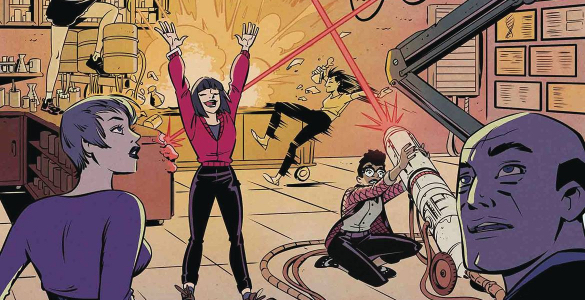
Faith Herbert returns after a very brief hiatus from her solo series for Faith and the Future Force, wherein time’s been tampered with and Faith sets out to fix it under the guidance of Timewalker Neela Sethi. It’s a simple premise, sure, but simple premises can be great; however, I am finding the nature of this story being based around time-travel to be a bit underwhelming. Nowadays, I feel like a decent time-travel yarn needs a significant gimmick, as the trope’s been so heavily used. Recent titles like ChrononautsGreen Valley, and TMNT: Beebop and Rocksteady Destroy Everything show that time-travel can still be done well, but an extra layer of contrivance really helps to help the works stand out. Continue reading
Happy Endings Aren’t Always Happy in Unstoppable Wasp 8

by Taylor Anderson

This article will contain SPOILERS. If you haven’t read the issue yet, proceed at your own risk!

When asked what the best Star Wars movie is, most people will tell you Empire Strikes Back is where it’s at. Objectively, there’s no denying that it is the most cinematically sound of the all the movies, but I think a lot of people respond to it because it ends on a dour note. Seeing Han, Luke, and Leia fail resonates with so many people because it more accurately reflects our own life experiences. Aside from a select few, most of us know more failure than we do success, so the realism of a sad ending is often times preferable to a happy one. Unstoppable Wasp 8 doesn’t end sadly, in fact the entire issue is quite the opposite, and for that reason the issue falls somewhat flat. Continue reading

Jessica Earns the Ring in Green Lanterns 28

by Patrick Ehlers

This article contains SPOILERS. If you haven’t read the issue yet, proceed at your own risk!

Part Two of Sam Humphries and Eduardo Pansica’s “Out of Time” story arc is a rarity for superhero comic. Save an opening flashback, and a final page stinger, the entire issue is a single scene, taking place in one location over the course of a matter of minutes. That’s the closest thing you’re going to see to “real time” in a comic. There are no cuts around to more exotic settings or events, just the simple insistence on working out nine non-complementary personalities.  Continue reading

There’s Beauty in Letting Go in Hadrian’s Wall 8

by Spencer Irwin

This article contains SPOILERS. If you haven’t read the issue yet, proceed at your own risk!

Letting go — of grudges, of hatred, of resentment — is one of the hardest things a human being can do. It feels good to nurse a grudge, yet it can feel even better to finally let go — there’s beauty, there’s true catharsis in it. With the incomparable Rod Reis on art, it’s impossible for Hadrian’s Wall 8 not to find the literal beauty in letting go, even as writers Kyle Higgins and Alec Siegel emphasize how truly difficult this action is for their characters. Continue reading

Superman 28: Discussion

by Spencer Irwin and Michael DeLaney

This article contains SPOILERS. If you haven’t read the issue yet, proceed at your own risk!

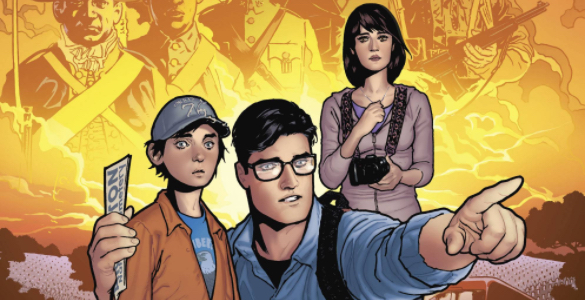
Spencer: I’ve never considered myself very patriotic. I appreciate the freedoms and privileges I enjoy as an American citizen, of course, as well as the sacrifices so many have made in order to ensure them, but it’s hard for me to fully support a country built on slavery and genocide, a country that’s struggled to properly care for minorities and the poor, a country that effortlessly and thoughtlessly kills foreign innocents in their own homes. I’m not comfortable putting my faith in an organization whose agendas so often shift (or can so easily be bought); I’d rather put my faith in individual people.

On paper, then, I probably shouldn’t like Superman 28, the conclusion of Peter Tomasi, Patrick Gleason, and Scott Godlewski’s brief “Declaration” storyline. In many ways Clark, Lois, and Jon’s road trip is patriotism at its finest, yet what endears me to this story is the focus the creative team puts on people; on the people who sacrificed so much to fight for their beliefs, and on the very human cost of America’s many wars. That’s a thesis I can get behind. Continue reading

Things Get Bleaker, but Never Hopeless in Extremity 6

by Mark Mitchell

This article contains SPOILERS. If you haven’t read the issue yet, proceed at your own risk!

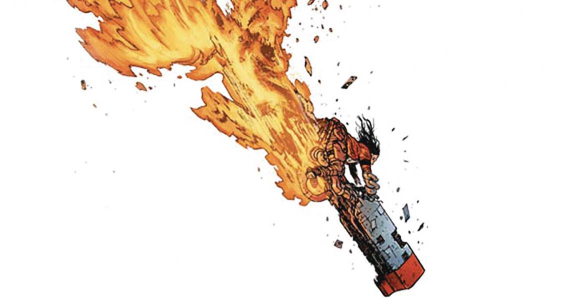
Creator Daniel Warren Johnson has managed to top himself with every issue of Extremity, and in Extremity 6, he plumbs new depths of horror and heartache. Last issue, I wondered if Jerome could ever be redeemed after ruthlessly crossing the line into needless murder, and while it’s still possible he will eventually see the errors of his way, Extremity 6 finds Jermone sinking even deeper, and it’s his bloodthirst that brings his clan to its knees. Continue reading

Vader Abandons Emotion in Darth Vader 4

by Patrick Ehlers

This article contains SPOILERS. If you haven’t read the issue yet, read on at your own risk!

We’re told that the strength of the Dark Side comes from tapping into one’s emotions. Basically, the more Anakin hates, the more strength he has. Jedi are trained to stomp out their emotions, which makes their control of the force more measured, but also markedly more dispassionate. That’s what makes Luke such an expectedly effective Force user — while he sorta learns from ancient Jedi masters, he’s too old and emotional to keep his feelings in check. He’s like 80% Light Side, with some Dark Side mixed in, just for extra oomph. But why wouldn’t the reverse be true? Darth Vader frequently draws on his rage, his grief and is isolation to make him powerful beyond measure, but it’s ultimately his dispassionate moves that make him most intimidating. Choking an officer to death to make a point? That shit’s calculated, not emotional. In Darth Vader 4, we see where the Sith Lord learns the power of not giving a fuck. Continue reading

Challenges Posed by Starting in the Middle in Teenage Mutant Ninja Turtles 72

by Ryan Mogge

This article contains SPOILERS. If you haven’t read the issue yet, proceed at your own risk!

When a story opens in media res, it’s a promise in two parts. First, the audience is given a glimpse at the excitement of the climax, a bit of a tease for when is it to come. The second and more tricky element is that by opening up at that point and then going back, the writer is telling us that the story of how they got there is somehow as interesting as what is to come. Often, there is a heavy layer of dramatic irony on the proceedings (preceedings?), characters laying out boundaries that we know they will cross, assurances of “what could go wrong?” when we have the exact answer, etc. In Teenage Mutant Ninja Turtles 72, the “Before.” section is more of a recap and road map, making it feel superfluous.
Continue reading

The Price of Being an Icon in Captain America: Sam Wilson 24

by Spencer Irwin

This article contains SPOILERS. If you haven’t read the issue yet, proceed at your own risk!

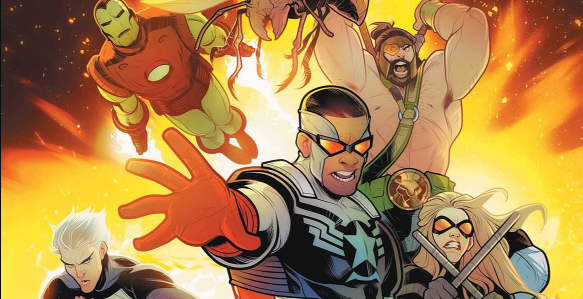
As Falcon, Sam Wilson was free to be Sam Wilson. Falcon no doubt meant quite a bit to many people, but it was still a very personal identity for Sam. Captain America, though…Captain America is an icon, and what Sam does as Captain America automatically means more to the public, for better or for worse, than anything he ever did as Falcon. Captain America is a responsibility, Captain America means something. I don’t think Sam ever fully understood that, or was ever fully prepared to shoulder that awesome responsibility, until now. Continue reading

Wonder Woman 27: Discussion

By Drew Baumgartner and Ryan Mogge

Wonder Woman 27

This article contains SPOILERS. If you haven’t read the issue yet, proceed at your own risk!

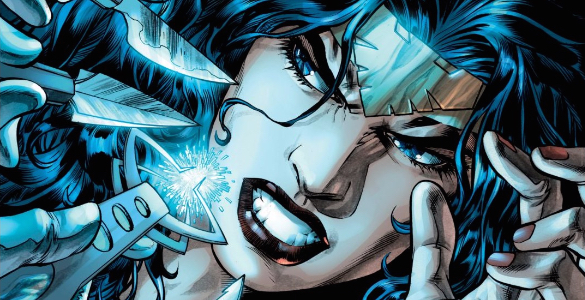
Drew: I think it’s safe to say our society is obsessed with patrilineage. Our last names (generally) come from our fathers. We have sayings about the sins of the father. And daddy issues abound in modern storytelling. This holds very true for superhero comics, where characters like Batman and Superman only survived their initial tragedies thanks to the heroic efforts of their fathers (at least in some versions). But Wonder Woman has always been different in that regard. As an Amazon born of clay, she has no father, nor a father-like figure in her life — this is a character poised to emphasize the roles of mothers. With issue 27, Shea Fontana and Mirka Andolfo do just that, albeit in unexpected ways. Continue reading