Batman Eternal 6

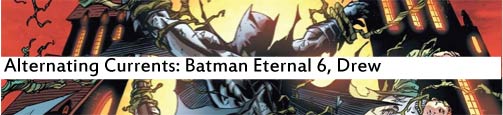
Alternating Currents: Batman Eternal 6, DrewToday, Drew leads a discussion on Batman Eternal 6, originally released May 14th, 2014.

Drew: Why does society seem to place a premium on auteurism? The vast majority of artforms are highly collaborative, yet we still talk about directors, show-runners, composers, and other creators as if theirs is the only intent that matters. Aside from a few notable exceptions, comics have always been a collaborative medium, but there’s something palpably different about a written-by-committee series like Batman Eternal. Indeed, it seems to have more in common with the conveyer-belt system of network tv than the short-season, tightly controlled cable model, but is that a bad thing?
Continue reading

The Wake 8

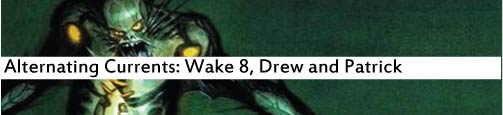
wake 8Today, Drew and Patrick are discussing The Wake 8, originally released May 7th, 2014.

Drew: What would you say Hamlet is about? “Hamlet” is the obvious answer, but would you consider it a character study, or is it really “about” its themes of powerlessness and despondency? Is it about Hamlet himself, or the events that follow in the wake of his father’s murder? Obviously, these options aren’t mutually exclusive, but how a narrative emphasizes its focus on any of these elements establishes a contract with the audience, setting up expectations that encourage the appropriately interested fans to stick around. Confusion about that contract can lead to disappointment (it’s easy to think of all those LOST fans who would have liked the final episode to focus on the show’s mythology rather than its characters), but may be essential for a mystery. Between its radical shifts in perspective and steady build-up of questions, it’s hard to know exactly what The Wake is about — the monsters? the characters? the plot? — which may make it difficult to evaluate its chapters until we know how it ends.

Continue reading

Cyclops 1

Alternating Currents: Cyclops 1, Drew and PatrickToday, Drew and Patrick are discussing Cyclops 1, originally released May 7th, 2014.

Drew: Leaders are often defined by their circumstances than any personal characteristics. Abraham Lincoln may be remembered as a persuasive orator, but that reputation takes a back seat to his role in the Civil War. That tendency can flatten out historical leaders, but absolutely steamrolls fictional ones, turning “leadership” into a character trait at the expense of any others. Raphael may be “cool, but rude,” and Michelangelo may be “a party dude,” but “Leonardo leads.” I’ve long had this association with Scott Summers, who I know is the de facto leader of the X-Men, but that’s kind of it. Oh, and he shoots lasers from his eyes. Complicating his circumstances (transporting him in time, taking him to outer space) have multiplied the potential for elucidating his personality, but I was still unconvinced that there was enough to him to support his own title. Fortunately, writer Greg Rucka manages to find an incredibly relatable handhold — Scott’s relationship to his father — delivering a confident statement of purpose in Cyclops 1.

Continue reading

Commentary Track – Chris Samnee Discusses Daredevil 1

Commentary Track, Chris Samnee, Daredevil 1

When Chris Samnee and Mark Waid closed their award-winning volume of Daredevil, they set themselves the herculean task of uncovering new ground for a new volume, living up to fan expectations, and ingratiating themselves to the newcomers that every #1 brings. More than up to the task, Waid and Samnee delivered a first issue that managed to tell us everything a new reader would need to know about the character within the context of a thrilling adventure. Much of why that works comes from Samnee’s clever implementation of visual exposition, which capitalizes on every piece of setting, lighting, blocking, and costuming as important storytelling details. Drew sat down with Chris and went through the issue page by page, so get your copy handy and join us on the Commentary Track.

Retcon Punch: To start off, can you tell us a bit about how you and Mark Waid break a story?

Chris Samnee: We usually talk on the phone before he writes anything. I get to toss out any ideas that I have, and then he throws them out the window (laughs).

Continue reading

Serious Issues: The Janelle Asselin Controversy pt. 3 – Marginalization

Serious Issues: The Janelle Asselin Controversy pt. 1 - ContextNo girls allowed!

Traditional

As we continue our discussion of the Janelle Asselin controversy, we’re daunted by the sheer scope of the issues it has brought to the surface. Asselin’s article addressed issues of representation — a noble endeavor we’ve taken up more than once here — but the reaction to that article turned this story into something much more complex. Clearly, the climate in which these conversations happen isn’t entirely healthy. Looking at the solicits for May, women make up less than 10% of the talent pool at either of the Big Two publishers — something that may explain the overrepresentation of male characters, but may also belie a more deep-seeded issue in comics at large.

Continue reading

The Flash Annual 3

Alternating Currents: The Flash Annual 3, Drew and ScottToday, Drew and Scott are discussing The Flash Annual 3, originally released April 30th, 2014.

…at the end of the day, the Flash is still the same tone as it was before. It’s still the same character, but kind of just reinvisioned.

Francis Manapul

Drew: The above quote isn’t about Robert Venditti and Van Jensen’s new run on The Flash — Manapul was actually speaking about the start of his own run back when I interviewed him in 2012 — but it might as well be. That a statement can be used to describe a new take on the character as well as the newer take that succeeds is is a universal truism in comics, but it also speaks to an innate truth about the Flash: he needs to move forward. Of course, Jensen and Venditti aren’t privy to the clean break that started Manapul’s run, and have thus needed to address Barry’s past as much as his future. Fortunately, they are also paying attention to this series’ history of meta-commentary, addressing their own creative baggage right on the page. Of all the things they could have ported from the previous run, this is my absolute favorite, injecting The Flash Annual 3 with a sense of rebellion.

Continue reading

Creator Interview: Gail Simone

interview_gail simoneGail Simone is a busy writer, but even her writing responsibilities on three different titles for three different publishers couldn’t possibly compare to her obligations at conventions. She’s in incredibly high demand, but we managed to pull her away for quick chat about how Batgirl has changed, having an effect on Lara Croft’s legacy and the freedom Red Sonja grants her.

Retcon Punch: It seems like you’re just a huge rock star around here. Has that gotten weirder?

Gail Simone: (laughs) No, it’s just amazing to see the diversity of the people coming through the line, which I think is incredible. All three projects that I’m working on right now — Red Sonja, Batgirl, and Tomb Raider — well, other than Red Sonja, the other two have a pretty wide age range of people that are coming through. Not too many real young kids are coming through here for Red Sonja Continue reading

Guardians of the Galaxy 14

guardians of the galaxy 14

Today, Drew and Shelby are discussing Guardians of the Galaxy 14, originally released April 23rd, 2014.

Drew: Anniversaries tend to be opportunities to look back. In comics, they seem to be opportunities to deconstruct. Detective Comics and Daredevil both had big anniversary issues this year, and both seized on the opportunity to ask what really defines these characters. The answers those issues posited were buoyed by the strength of their characters, but what about a team series — especially a team with a relatively smaller history? Guardians of the Galaxy 14 sets out to answer this question in the most unexpected ways, separating the characters (or even eliminating them altogether) to examine what makes the Guardians work as an abstract concept.

Continue reading

C2E2 2014 – Day 2

comic con punch2

Drew: C2E2 is a great con, but one of the most exciting things for us was simply getting together to hang out with friends we haven’t seen in years (YEARS). That emphasis on the social aspect (as well as the preparations for Shelby’s costume) kept us up pretty late, so we didn’t get the earliest start Saturday morning. We arrived just in time for Marvel’s Original Sin panel. Heads up guys: there are a TON of issues tying in here, including some fun sounding team-ups — Hulk and Iron Man, Deadpool and Dazzler, Thor and Loki. That last one contained easily the biggest reveal of the day: Angela is Thor and Loki’s long-lost sister.

Continue reading

The Flash 30

Alternating Currents: Flash 30, Drew and ScottToday, Drew and Scott are discussing The Flash 30, originally released April 23rd, 2014.

Drew: I lost a part of my innocence when Richard Harris passed away. It wasn’t an existential crisis brought about by confronting mortality, but the cognitive dissonance brought about by his role of Albus Dumbledore being filled by Michael Gambon. I’m sure for many young Harry Potter fans, that was the first time they were confronted with the notion that the identity of a beloved fictional character is so dictated by casting decisions, but looking at the differences between the two actors’ performances, it’s almost as if they were playing different characters. Harris imbued the role with a quiet, almost doddering sweetness, while Gambon’s take was notably sterner. Both takes are supported by the books, but it had never occurred to me before seeing Prisoner of Azkaban that an actor’s (or director’s) emphasis on certain traits could have such a profound effect on the final product. I found myself thinking those same thoughts as Robert Venditti and Van Jensen assert their own read on Barry Allen in The Flash 30.

Continue reading