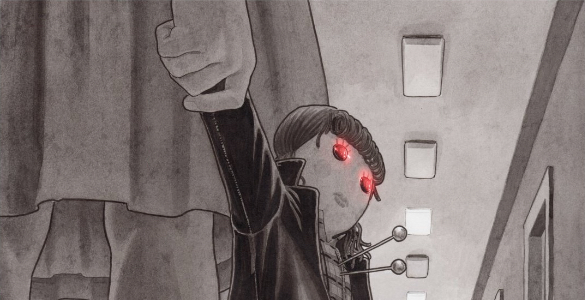
Fluid Stakes Keep Hawkeye 15 Breezy

By Drew Baumgartner

Hawkeye 15

This article contains SPOILERS. If you haven’t read the issue yet, proceed at your own risk!

That’s a dumb joke, but it’s one of my all-time favorites. It doesn’t make any sense — Bender should know that the person he’s talking about is standing directly in front of him — but the reveal to us is just so perfect. It’s the kind of joke that really only works in visual media, taking advantage of the limits of our perspective we all take for granted. We assume we understand who is in the scene because of who we’ve been shown, but anybody could feasibly be lurking just off-camera. That kind of perspective twist is part of what gives Kelly Thompson and Leonardo Romero’s Hawkeye such a distinct voice, as our perspective telescopes to best suit the scene. Indeed, as issue 15 demonstrates, they can shift perspective both literally and figuratively to goose just about anything. Continue reading

Superhero Action Monopolizes Black Lightning: Cold Dead Hands 4

by Drew Baumgartner

Black Lightning Cold Dead Hands 4

This article contains SPOILERS. If you haven’t read the issue yet, proceed at your own risk!

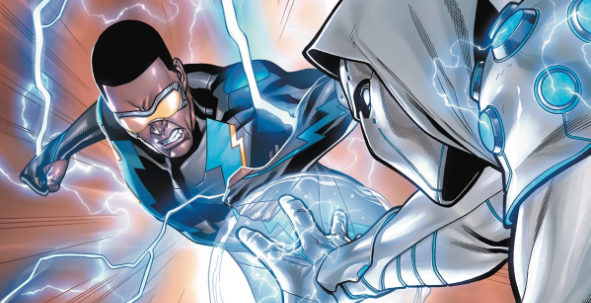
Is there a limit to how subtle a superhero story can be? I’m certainly not of the mindset that tights and flights have to be bombastic or simple, but it seems obvious to me that, say, “being able to punch really hard” isn’t a solution that can be applied to every problem. Creators have found countless was to get subtler beats into their superhero work, but at some point, “being able to punch really hard” must come up, or the story might as well not feature a superhero. I’ll often regret that necessity when stories jerk away from compelling subtleties for generic action, which is unfortunately what Black Lightning: Cold Dead Hands 4 is all about. Continue reading

Different Kinds of Powers and Responsibilities in Incognegro Rennaisance 1

by Drew Baumgartner

Incognegro Renaissance 1

This article contains SPOILERS. If you haven’t read the issue yet, proceed at your own risk!

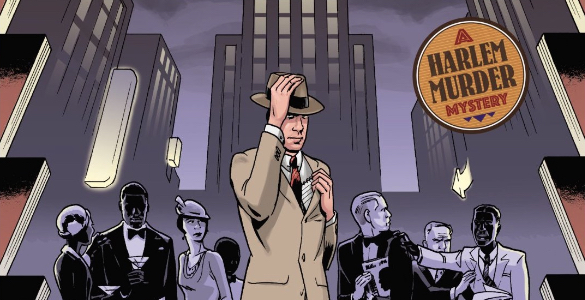
Way back in August of 1962, Peter Parker learned that with great power must also come great responsibility. It’s an important lesson, though the fact that Peter’s “power” manifests as literal superhuman abilities seems to leave some readers confused about what their own responsibilities are. In the intervening years, our discourse on power has gotten a lot more nuanced than whether someone can or can’t stick to walls, which has in turn changed our expectations of individual responsibility. Of course, the predominantly white, predominantly male world of superheroes might not be the best place to explore the more subtle (but no less powerful) issues of power and responsibility that come along with race and gender, which is exactly what made Mat Johnson and Warren Pleece’s Incognegro so remarkable when it hit stands in 2008. Indeed, the obvious differences between Incognegro and the superhero genre may make the comparison seem absurd — and it may well be — but their prequel series, Incognegro: Renaissance, takes on the familiar (and appropriate) form of the superhero origin story, complete with its own call to action about power and responsibility. Continue reading

It’s All a Game in Avengers 679

by Drew Baumgartner

Avengers 679

This article contains SPOILERS. If you haven’t read the issue yet, proceed at your own risk!

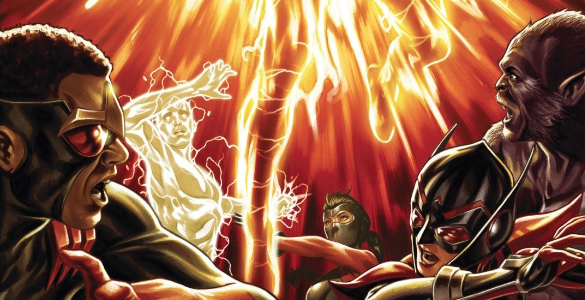
We’ll often chide middle chapters for failing to maintain dramatic momentum while setting up the climax — when he actions in those middle chapters feel motivated more by what the climax needs than what came before. We refer to that phenomenon as “putting the pieces in place,” as it reduces the dramatic interest of a story to setting up a board game. It’s an unfortunate tendency that tends to crop up in event series with huge casts, and has already led to some consternation with “No Surrender,” but Avengers 679 hangs a lampshade on its game-iness, zooming out from the game board to focus on the real players. Continue reading

Teenage Mutant Ninja Turtles Universe 19: Discussion

By Taylor Anderson and Drew Baumgartner

This article contains SPOILERS. If you haven’t read the issue yet, proceed at your own risk!

Ninja: noun \  nin·ja  \ ˈnin-jə \ a person trained in ancient Japanese martial arts and employed especially for espionage and assassinations

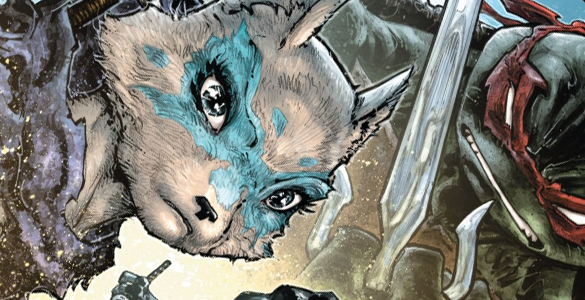
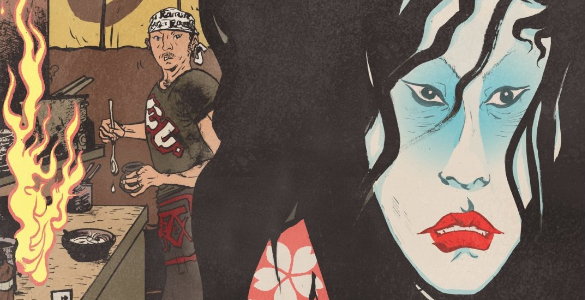
Taylor: After all the numerous battles the Teenage Mutant Ninja Turtles have been through, it’s become easy to forget one fourth of their namesake. No, it’s not that they’re teenagers — Raphael’s temper and Michelangelo’s lightheartedness remind us of that every issue. The part of their name that’s easy to forget, rather, is the “ninja.” Even though each turtle knows ninjitsu and uses shurikens, they frequently eschew one of the fundamental traits of being ninja — stealth — and this makes them more akin to warriors than ninja. So what happens when they’re called out on not being the thing they were trained to become since birth? Continue reading

Hungry Ghosts 1: Discussion

By Drew Baumgartner and Ryan Desaulniers

Hungry Ghosts 1

This article contains SPOILERS. If you haven’t read the issue yet, proceed at your own risk!

They found her body sprawled across the grave. Without realizing it, she had plunged the knife through her skirt and had pinned it to the ground. It was only the knife that held her. She had died of fright.

Alvin Schwartz, Scary Stories to Tell in the Dark

Drew: Like every kid who grew up in the ’90s, I’m intimately familiar with Alvin Schwartz’s Scary Stories books — the perfect camp fire/slumber party fodder. But “The Girl Who Stood on the Grave” (sometimes known as “The Dare”), whose punchline I spoiled above is the only one that ever actually scared me. Even as a kid, I never believed in ghosts, so stories of long-dead apparitions leaving their sweaters behind or whatever felt more like jokes than anything. But the thought of scaring oneself to death felt all too real when watching my friends get spooked by the other nonsense in the book. I doubt I knew who FDR was at that point, but even then I understood that the only thing we have to fear is fear itself. Which is to say, I’m far more interested in the telling of ghost stories than I am in the stories themselves. And I suspect we’re all a little that way — it’s why Tales from the Crypt had the Crypt Keeper and Are You Afraid of the Dark? had those terrible child actors — the ritual of telling scary stories is just as important as the scary stories themselves. It’s a notion that Hungry Ghosts taps into twofold, offering a framing story within a framing story, as a Crypt Keeper type tells us the story of people sitting around telling ghost stories. Continue reading

Relishing the Details in Outcast 33

by Drew Baumgartner

Outcast 30

This article contains SPOILERS. If you haven’t read the issue yet, proceed at your own risk!

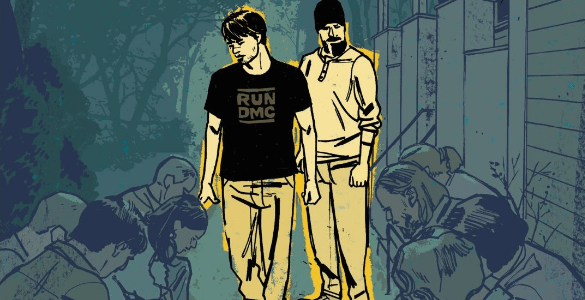
One of the most distinctive stylistic choices of Outcast has always been its use of small insert shots, inset into larger panels. Early in the series, those inserts were largely used to capture small scene details and gestures, but as the cast has grown, they’ve increasingly focused on faces, offering us the emotional state of several characters at a glance — especially those who might not be actively participating in the action/conversation of the scene. We might understand that as reflective of Kyle’s own shift in priorities, focusing less on the textural trappings of his life and more on the people he loves, but the effect is a series that now has an audience surrogate on virtually every page, reflecting our own shock and horror back at us. Continue reading

Bucky Takes Center Stage in Tales of Suspense 101

by Drew Baumgartner

Tales of Suspense 101

This article contains SPOILERS. If you haven’t read the issue yet, proceed at your own risk!

I like spy stories enough, but I’d never claim to be a connoisseur of the genre. I’m sure there are countless subtle subgenres, but to my lay eyes, the most obvious division is between the sensationalized high adventure of, say, James Bond films, and the more grounded stories of intrigue and espionage of John le Carré’s novels. And I recognize that that’s a gross oversimplification, but the actual point I want to talk about is tone — while the later category takes itself super seriously, the former is much lighter and more fun (more recent Bond films notwithstanding), savoring terrible one-liners and groan-inducingly punny names. The Bond franchise has recently eschewed that lightness of tone in pursuit of something more serious, but Tales of Suspense 101 represents another approach; one where everyone agrees the situation is very serious, but the characters can’t help but be funny, anyway. Continue reading

Black Magick 10 Defines its Allegory

by Drew Baumgartner

Black Magick 10

This article contains SPOILERS. If you haven’t read the issue yet, proceed at your own risk!

[W]e conceive the Devil as a necessary part of a respectable view of cosmology. Ours is a divided empire in which certain ideas and emotions and actions are of God, and their opposites are of Lucifer. It is as impossible for most men to conceive of a morality without sin as of an earth without ‘sky’. Since 1692 a great but superficial change has wiped out God’s beard and the Devil’s horns, but the world is still gripped between two diametrically opposed absolutes. The concept of unity, in which positive and negative are attributes of the same force, in which good and evil are relative, ever-changing, and always joined to the same phenomenon — such a concept is still reserved to the physical sciences and to the few who have grasped the history of ideas.

Arthur Miller, The Crucible

I don’t think I fully appreciated The Crucible until this last year. Or, more precisely, without any direct reference for McCarthyism, I couldn’t fully appreciate the allegory that underpins The Crucible. That we once again live in a world where problems can be made up and pinned on innocent individuals gives The Crucible an unfortunately renewed relevance, suggesting once again that we haven’t come as far from 1690s Salem as we might like to think. Black Magick 10 carries a similar allegorical weight, also centering around the persecution of witches, with the obvious difference that the witches in Black Magick actually exist. In this way, the parallels to our modern political climate (and, heck, that of McCarthyism) might be stronger — the persecuted class does actually exist, they just aren’t the scapegoats society has made them out to be. It reflects the attitudes that politicizes someone’s very identity, suggesting that peace and happiness should only be reserved for those who conform to society’s norms. Continue reading

Narrative Distance in The Wild Storm 11

by Drew Baumgartner

Wild Storm 10

This article contains SPOILERS. If you haven’t read the issue yet, proceed at your own risk!

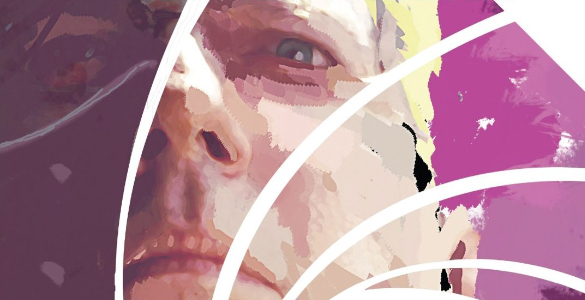
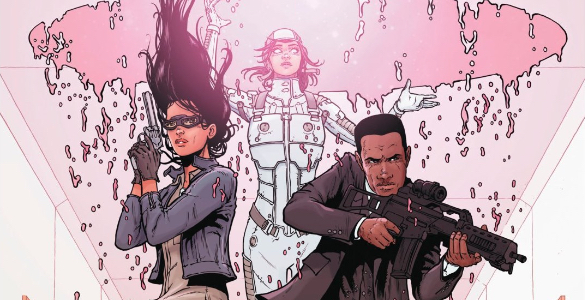
As readers, we’re all duly familiar with the narrative modes — third person omniscient, first person, objective observer, etc — we’re taught them from an early age, and are aware of them in basically all narrative writing. We’re far less aware of the narrative modes in visual storytelling, and lack the kind of common nomenclature to identify them that we have for literary narrative modes. But there’s no doubt that they profoundly influence our perceptions of visual media — there’s a profound difference between a camera shooting from over a character’s shoulder to one that is meant to literally represent their point of view, and we can feel that difference, even if we don’t have precise language to describe it. It allows visual storytelling to be much more visceral and subtle than prose, as we’re not necessarily consciously aware of its effects. With The Wild Storm 11, Warren Ellis and Jon Davis-Hunt exploit this feature of visual narrative for all its worth, keeping us at a distance from any of the events of the issue. Continue reading