Secrets Don’t Stay Secret for Long in Dead Hand 3

By Spencer Irwin

This article contains SPOILERS. If you haven’t read the issue yet, proceed at your own risk!

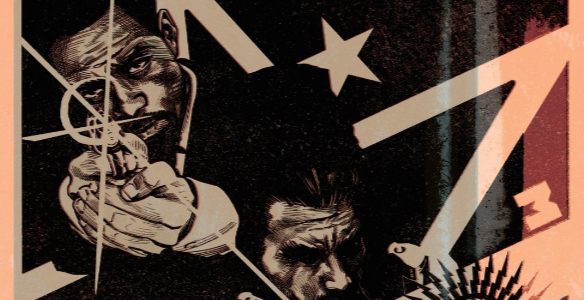
Secrets rarely stay secret for long, but this is especially true when kids are involved. Younger children will repeat anything and everything to anybody, while older children and teenagers tend to be naturals at sniffing out lies and seeing through bullshit. What this means for the cast of Kyle Higgins and Stephen Mooney’s Dead Hand is that the secret of Mountain View is coming closer and closer to being revealed — unfortunately for them, the loss of that secret could very well mean the end of the world in a fiery nuclear holocaust.  Continue reading

Doom’s Secret Origin in Marvel Two-In-One Annual 1

By Drew Baumgartner

Marvel Two-in-One Annual 1

This article contains SPOILERS. If you haven’t read the issue yet, proceed at your own risk!

Each is described as being the strongest man in the world and each as battling against “evil and injustice.”

Judge Augustus Hand (writing for the majority)
Detective Comics, Inc. v. Bruns Publications, Inc.

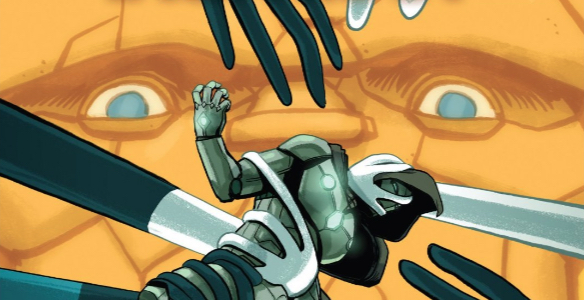
Augustus Hand served on the United States Court of Appeals for the Second Circuit from 1928 to his death in 1953, and just might be the most quoted judge when it comes to the definition of the superhero, owing to the decision he wrote when the Second Circuit ruled that Wonder Man did indeed constitute copyright infringement on Superman. His decision provided a revealing definition for the genre, insisting not just on superpowers, but a selfless, pro-social mission. Indeed, it’s not until after that decision that you see superheroes whose superpowers and pro-social mission are seen as separate things, with perhaps separate origins. That is, while Superman fought crime because he could, and Batman became a superhero specifically to fight crime, Spider-Man only picked up his pro-social mission after Uncle Ben died, well after he’d been using his powers for decidedly less selfless purposes. In that way, we might understand Marvel Two-In-One Annual 1 as a key part of Victor Von Doom’s superhero origin; it’s the story of how he became a good guy. Continue reading

Plastic Man 1: Discussion

by Spencer Irwin and Michael DeLaney 

This article contains SPOILERS. If you haven’t read the issue yet, proceed at your own risk!

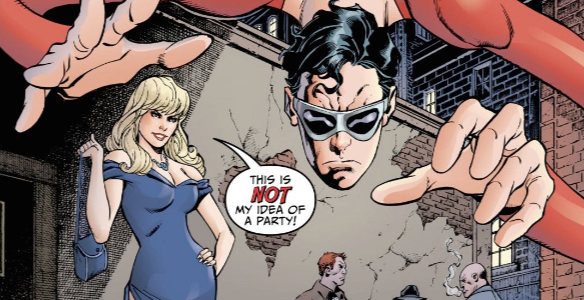
Spencer: The first JLA comic I ever read was an issue from Joe Kelly’s early 2000s run. The story found Martian Manhunter corrupted and turned against a hopelessly outmatched League. The only hero who could stand up to him was, surprisingly, Plastic Man, whose shapeshifting skills were on par with J’onn’s and whose elastic brain resisted his telepathy entirely. Plastic Man was also an interesting contrast to the rest of the uber-serious League, a walking visual gag who cracked wise even as he fought the most powerful being on Earth one-on-one. That issue impressed on me the value of Plastic Man and the unique charm he adds to the DC universe. Gail Simone and Adriana Melo clearly understand the character’s appeal, and it’s ultimately Plastic Man’s charisma that carries Plastic Man 1 in its shakier moments. Continue reading

The Fix 12 is a Perfect Revenge Fantasy Parody

by Patrick Ehlers

This article contains SPOILERS. If you haven’t read the issue yet, proceed at your own risk!

“When I woke up, I went on what the movie advertisements refer to as a roaring rampage of revenge. I roared. I rampaged. And I got bloody satisfaction.”

The Bride, Kill Bill

I tend to struggle with revenge fantasies. The objective of the protagonist is too prescribed for me, as though the sentiment “I want the people who made me suffer to feel what I feel” is a universal impulse. That is, of course, part of the genius of Kill Bill: the revenge fantasy is challenged the second Beatrix Kiddo sees the life she’s sworn to ruin. It’s a twist on the formula, just like Nick Spencer and Steve Lieber’s The Fix 12. The motivation remains the same, but our hero’s efficacy is the variable. Roy’s complete inability to get revenge for Mac’s death makes this issue a borderline genre spoof, and it’s just so perfect. Continue reading

The Tantalization of Other Timelines in Peter Parker: the Spectacular Spider-Man 305

by Taylor Anderson

This article contains SPOILERS. If you haven’t read the issue yet, proceed at your own risk!

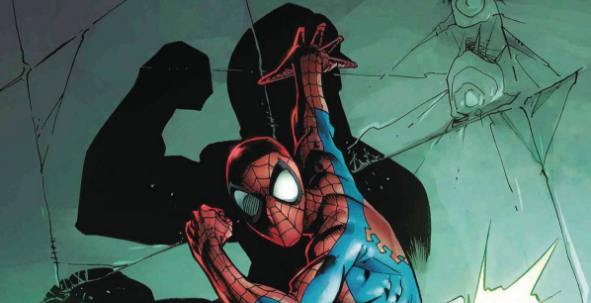
Every time I read a news story about a tweet our current commander in chief sends out, I can’t help but think how his predecessor or opponent in the election wouldn’t debase themselves in such a way. This inevitably leads me to wonder what an alternate timeline might look like where the current president didn’t win the election. What would the country look like? Would the oval office still be dignified and one that engenders respect and appreciation? I have some ideas about that, but I can never be sure exactly what that timeline holds. This idea, of other timelines, is tantalizing and one all people think about, and as such, it dominates the narrative of the Spectacular Spider-Man 305. Continue reading

Indifference is the Enemy in Analog 3

by Patrick Ehlers

This article contains SPOILERS. If you haven’t read the issue yet, proceed at your own risk!

“Oona can handle herself…”

Analog 3

We find ourselves in a wholly irrational place in history — a swing away from progressive ideals. Regressive. Part of what makes this era so fucked up is that we believed ourselves to be beyond history. The concept of the “end of history” is contingent on society having reached a perfect state of civility. There would be no war, no famine, no racism, no inequality, no income disparity if only we reached this civil equilibrium. Here’s the problem: we never got close to perfection before white America declared that we were living in a post-racial world. And why would they? We are Americans and we are exceptional! We saved the world from the most obvious evil history has ever seen, and everything since 1945 has been a victory lap. Essentially, the belief has been that the system would find justice, or that society can “handle itself.” Gerry Duggan and David O’Sullivan’s Analog 3 explores the dangers of expecting a situation to fix itself. Continue reading

The Man of Steel 3 Highlights Superman’s Great Compassion and Guilt

by Michael DeLaney 

This article contains SPOILERS. If you haven’t read the issue yet, proceed at your own risk!

slim-banner

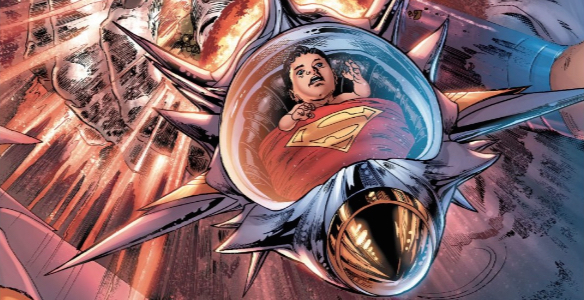
Any seasoned comic book reader — or really anyone who knows their pop culture — should know that you can never be sure that a character is dead unless you find their body. And even when they do find a body there’s the chance that it’s a clone, robot, time traveler, impostor, etc. While we haven’t found any bodies per se, in Man of Steel 3 it seems that Brian Michael Bendis has just killed…The Bottle City of Kandor. Continue reading

The Social Media Nightmare in Nightwing 45

by Michael DeLaney 

This article contains SPOILERS. If you haven’t read the issue yet, proceed at your own risk!

slim-banner

I try to ignore how attached I am to social media, my smart phone and the like, because the reality of the matter is both frightening and depressing. Benjamin Percy taps into that real fear in Nightwing 45 with his villain Wyrm. Wyrm is literally a computer virus, but what he represents may be the targeted marketing and social media manipulation. Continue reading

Good vs. Evil in Astonishing X-Men 12

by Patrick Ehlers

This article contains SPOILERS. If you haven’t read the issue yet, proceed at your own risk!

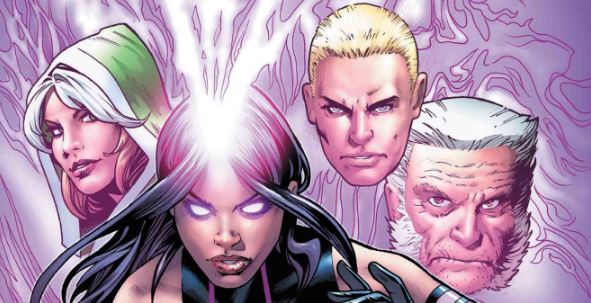
“Good vs Evil” implies that there are two sides — two warring factions — battling for the fate of the world. It’s a compelling image: a battlefield with good guys on one side and bad guys on the other. Good and evil are separate forces, and in our imaginations, represented by two different groups of people. While Charles Soule and Gerardo Sandoval’s Astonishing X-Men 12 still gives the reader avatars of light and darkness in the forms of X and The Night King, the armies fighting for each side are made up of all the same players. Old Man Logan is both a reformed ally-murderer and an irredeemable death machine; good and evil waging war within one mind. Continue reading

A Mid-Issue Shift Elevates Hunt for Wolverine: Weapon Lost 2

By Drew Baumgartner

Hunt for Wolverine Weapon Lost 2

This article contains SPOILERS. If you haven’t read the issue yet, proceed at your own risk!

Listen, I know there were crime procedurals before Law & Order (and there have been plenty since), but that show was such a mainstay of my formative pop-culture years that I can’t help but think of it every time I encounter a new fictional criminal investigation. What’s remarkable to me about that show is how entertaining it could be in spite of having an entirely rote structure (it was so set in stone, in fact, that they decided to enshrine it in the very title of the series). That is, the drama was never in whether they caught the culprit (they always did), or whether they would be convicted (they were found guilty or pled out the vast majority of the time), but in how they did it — or more precisely who was doing it. Individual details of the case might be interesting, but only inasmuch as they prompted quips from Briscoe or righteous indignation from McCoy. The procedural is an excuse to watch detectives do what they do best, so giving those detectives big, distinct personalities makes or breaks the whole exercise. In this way, Charles Soule has truly stacked the deck in his favor, cramming four larger-than-life investigators into tight quarters and giving them a hard case to chew on. Continue reading