Bodies Are Weird in Come Into Me 1

By Taylor Anderson

This article contains SPOILERS. If you haven’t read the issue yet, proceed at your own risk!

It doesn’t take much to read into the allegory of Come Into Me. We are a society that increasingly shares every aspect of our private lives with the world. Some would argue that this is a great way of connecting people, but others, like writers Zac Thompson and Lonnie Nadler, would contend that it violates our privacy at worst and is used as a money making scheme at best. In the first issue of Come Into Me, the creators offer an intriguing look into the possibilities of sharing your personal experience, even if it comes accompanied with certain amounts of horror. Continue reading

Existential Fears in Marvel Two-In-One 4

By Taylor Anderson

This article contains SPOILERS. If you haven’t read the issue yet, proceed at your own risk!

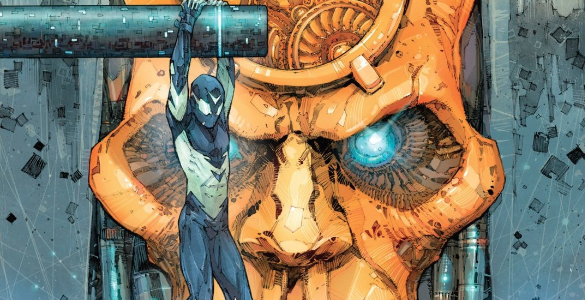
There are times deep in the night, and always at night, where I am plagued by existential fears. It’s the curse of the modern age, I guess, knowing about problems that are too great for any one single human to do anything about. Climate change, the meaning of life in a godless universe, and death (just to name a few) frequently wrack my brain. Of course, this is to say nothing of the eventual heat death of the universe, which, while possibly a googol years away, still worries me because it basically means the end of anything living (as we know it) in the entire universe. That’s sad and troubling! This fear of nothing being left is hard to fathom, but it’s made easier when it happens all at once, as in Marvel Two-In-One 4. Continue reading

It’s Manga’s Greatest Hits in Betrothed 1

By Mark Mitchell

This article contains SPOILERS. If you haven’t read the issue yet, proceed at your own risk!

If you like reading manga you will probably enjoy Betrothed 1, and if you like Betrothed 1 you will probably enjoy reading manga.

That’s obviously a broad generalization, since manga is a medium, not a genre, and there are many different stories told within that medium, but as a lapsed Weekly Shonen Jump subscriber, I’ve read enough breezy meet-cutes and hastily staged fight sequences to comfortably state that Sean Lewis and Steve Uy’s Betrothed 1 is a solid effort at a Manga Tropes Greatest Hits Collection. Continue reading

Order in the Slow Chaos of Secret Weapons: Owen’s Story 0

by Patrick Ehlers

This article contains SPOILERS! If you haven’t read the issue, proceed at your own risk.

January’s Secret Weapons 0 was all about Nikki’s growth from high school senior to effective super heroine. It’s a straight line of dissolving relationships and withering opportunities, a chain of events where one cause naturally leads to the next effect. That’s moving, effective storytelling. But that’s not always reflective of life, is it? Secret Weapons: Owen’s Story 0 takes a similar concept and muddles it up, making Owen’s saga less like a line and more like a web of trivial connections. Writer Eric Heisserer and artists Raúl Allén and Patricia Martín lean on the oddly symmetric structures present in a series of seemingly unrelated stories, and though they arrive at a slight conclusion, it is all the more meaningful for being fully earned. Continue reading

Characters Revise Their Own Histories in Darth Vader 13

by Michael DeLaney

This article contains SPOILERS. If you haven’t read the issue yet, proceed at your own risk!

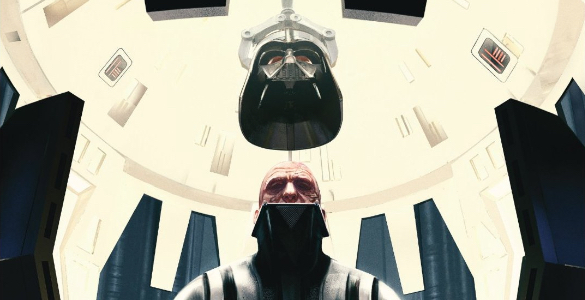
When Star Wars comics relaunched under Marvel in 2015, Kieron Gillen and Salvador Larroca’s Darth Vader was far and away the best title. Charles Soule and Giuseppe Camuncoli have continued that tradition with their latest incarnation of the book. Darth Vader 13 is the latest example of how the comics can flesh out characters and concepts in a way that the movies never really did. Continue reading

Eternity Girl 1: Discussion

by Mark Mitchell and Spencer Irwin


This article contains SPOILERS. If you haven’t read the issue yet, proceed at your own risk!

Mark: People who suffer from chronic depression are often very good at putting up facades of happiness; it’s part of why suicide can be surprising to the friends and family of the person who took their life. These facades are a coping mechanism for a depression sufferer in a number of ways, including stopping people from inquiring about their happiness. If you look happy — if you act “normal” — then people are more apt to leave you alone. But keeping up appearances for the benefit of others is exhausting, and sometimes the facade breaks down at inopportune moments — at a friend’s wedding, the night before a big paper is due, in front of your co-workers at the office.

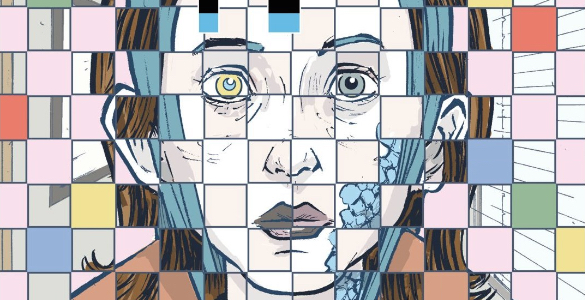
The performative aspect of keeping up appearances is made literal in Magdalene Visaggio and Sonny Liew’s Eternity Girl 1, a new title in DC’s Young Animal line. Continue reading

Culminating Repercussions in Despicable Deadpool 296

by Drew Baumgartner

Deadpool 296

This article contains SPOILERS. If you haven’t read the issue yet, proceed at your own risk!

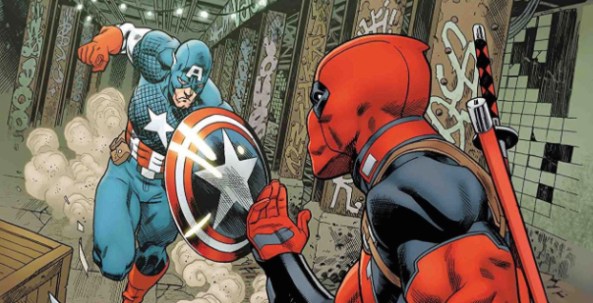
Are reverence and irreverence mutually exclusive? Linguistically, we might understand these words as opposites, but practically, we recognize that they coexist all around us. This is especially true in standup comedy, a field that both finds humor in what we take seriously and takes what we find funny very seriously. It’s no coincidence, then, that Gerry Duggan’s Deadpool run has had such a rich mix of reverence and irreverence, adopting some of the “sad clown” stylings of his comedic friends and collaborators, lending an otherwise goofy character real pathos. Indeed, one of the most distinctive features of Duggan’s work with this character was in crafting a tragic (but nonetheless joke-filled) backstory that could lend itself to reverence. With issue 296, Despicable Deadpool aims to cash in on much of that reverence, drawing on everything from Duggan’s earliest work with the character to some of his most recent. Continue reading

Dumbass Details in Sideways 2

By Patrick Ehlers

This article contains SPOILERS. If you haven’t read the issue yet, proceed at your own risk!

Last month, I praised Sideways 1’s hyper-specificity. Writers Dan DiDio and Justin Jordan crafted an excruciatingly detailed world for the would-be superhero Derek and his geek-culture-obsessed best friend Ernie. Artist Kenneth Rocafort dutifully filled the pages with visual details, whether painstakingly realizing the Gotham City skyline or Ernie’s shrine to cosplay and video games. The high I was feeling from that issue has all but evaporated during the second issue as the details began to feel awkward, forced, or generic. Continue reading

Strange Continues to Damn Himself in Doctor Strange 387

by Spencer Irwin

This article contains SPOILERS. If you haven’t read the issue yet, proceed at your own risk!

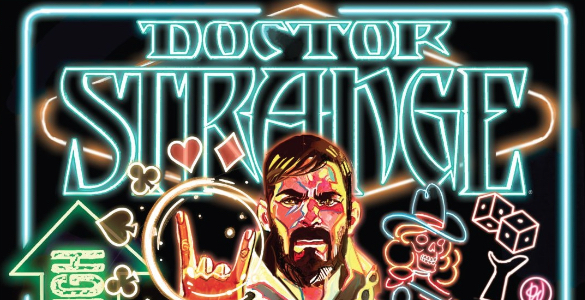
Spencer: Damnation is an appropriate title for this event in several ways. The entire city of Las Vegas was damned to Hell when it was destroyed during Secret Empire, and its revival has damned the soul of anyone who dares get near the city. Perhaps most significant, though — especially in the Doctor Strange tie-in issues — is the damnation the Sorcerer Supreme himself, Stephen Strange, faces. There’s the literal damnation courtesy of Mephisto, of course, but Donny Cates and Niko Henrichon seem much more interested in the self-damnation Strange has put himself through, the way he’s driven away his friends and allies, and the increasingly desperate and toxic ways he’s attempting to cope with this fact. Continue reading

Mister Miracle 7: Discussion

by Michael DeLaney and Drew Baumgartner 

This article contains SPOILERS. If you haven’t read the issue yet, proceed at your own risk!

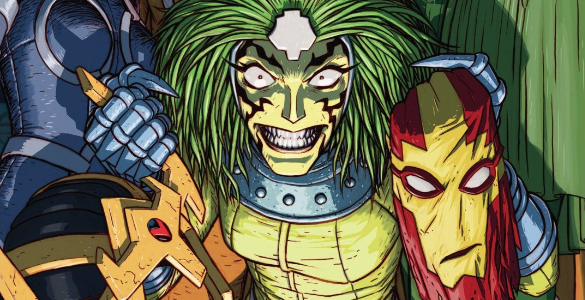
Michael: A “realistic approach” to comic book superheroes is sometimes successful (often with Batman comics). But most of the time, when you bind the mythic origins of superheroes to real world science and logic, you lose something from the original incarnation. However there’s a difference between a realistic approach and a serious approach to superheroes, like Tom King’s exploration of Jack Kirby’s Fourth World in Mister Miracle 7. This isn’t to say that King’s script is grim and humorless, but that he takes all aspects of Scott Free’s otherworldly life at face value, no matter how “silly” or “outrageous” they might sound in the context of the real world. Continue reading