Balance in the Space Between in Batman 27

by Patrick Ehlers

This article contains SPOILERS. If you haven’t read the issue yet, proceed at your own risk!

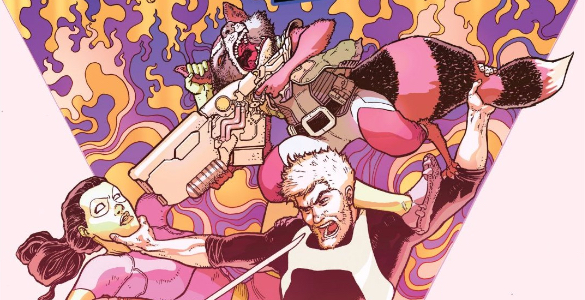
What’s the difference between camp and genre fiction? How about the difference between parody and pastiche? All of these categorical distinctions share the same powerful feature — exploiting tropes to elicit involuntary emotional reactions. And usually, that reaction is a laugh. A knowing chuckle, a boisterous guffaw, rolling chortles — what’s the difference? Is one form ridiculous while the other form is cool? Is one form important while the other form is base? And is there any space between them? Tom King and Clay Mann’s Batman 27 answers that question with the simultaneously ludicrous and tragic origin story of Chuck Brown: The Kite Man. Continue reading
A Generation Defined in Generation Gone 1

by Patrick Ehlers

This article contains SPOILERS. If you haven’t read the issue yet, proceed at your own risk!

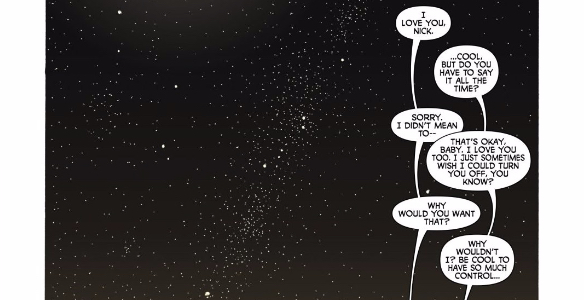
Aleš Kot and André Lima Araújo’s Generation Gone is arrestingly open about its central theme: the existential peril of disaffected youth. Hell, the name of the series gives it away. Kot is seemingly not content with even that level of obviousness, as he starts to reveal the stunted social lives of his main characters right on the cover of the issue, before we know who they are or even what they look like. Comics are a visual medium, and 999 times out of a thousand, the first thing we know about a character is what they look like. These kids are hackers — their skills, personalities, values and identities most likely forged online where text invariably acts as the vanguard for a digital persona. We’re meeting these people the same way you would in a forum: expressing something deeply vulnerable and hurtful, with no faces to associate with their comments. Continue reading

Astonishing X-Men 1: Discussion

by Taylor Anderson & Patrick Ehlers

This article contains SPOILERS. If you haven’t read the issue yet, proceed at your own risk!

slim-banner

Taylor: About a month ago, the Golden State Warriors won the NBA  championship with ease. So easy was their win, in fact, that many pundits are calling them a super team that practically has the next several championships already won. It’s tempting to think that building such a dominant team is the result of careful planning and deep pockets. In actuality, what brought so many talented players together was a series of fluke accidents and coincidental timing that amount to little more than dumb luck. In much the same way, another super team is also being built, albeit this one on the pages of Astonishing X-Men. That might sound like a haphazard way to build a team — maybe it is — but it’s also a refreshing take on the typical team-up concept.  Continue reading

Purpose and Sacrifice in Wonder Woman 26

by Patrick Ehlers

This article contains SPOILERS. If you haven’t read the issue yet, proceed at your own risk!

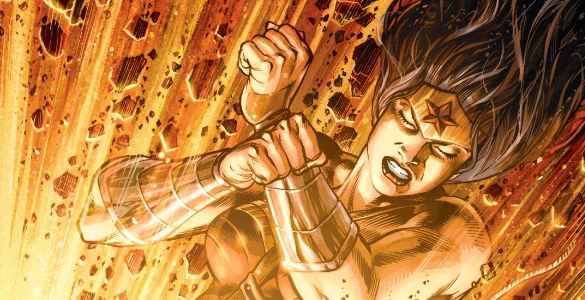
Servitude is a crucial part of the soldier’s identity. They don’t just fight for abstract concepts like truth, and justice and the American way, but so the people they serve can experience those abstractions. There’s a virtue in that sacrifice, but it remains a sacrifice. Perhaps more than most superheroes, Wonder Woman is a traditional soldier, trained in both the art and etiquette of war, but her sacrifice has always been a bit ill-defined. She gives up paradise, but only so her fellow Amazons can continue to experience it. Writer Shea Fontana finds a new angle on Wonder Woman’s sacrifice in Wonder Woman 26: Diana’s childhood. Continue reading

Chilling Adventures of Sabrina 7: Discussion

by Ryan Mogge and Patrick Ehlers

This article contains SPOILERS. If you haven’t read the issue yet, proceed at your own risk!

slim-banner

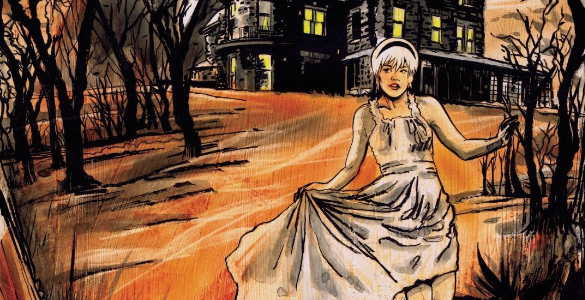
Ryan M: Writing in the point of view of a sociopath creates a set of problems. They will never have the kind of human connection or emotional growth that ground most stories. It’s why most serial killer stories are from the perspective of the detective on the case. It’s easy to alienate the audience when you allow a sociopath to tell the story. When these characters express an earnest truth about themselves, rather than make them more sympathetic, it emphasizes what’s “wrong” with them. Often, weaving in an undercurrent of irony or dark humor can make the character easier to take. Bret Easton Ellis’ American Psycho breaks up graphic tales of murder with pop music critiques. A tale of horror must offer the reader a break from the evil or suffer a tediousness that lessens the impact of the darkest moments. In Chilling Adventures of Sabrina 7, Roberto Aquirre-Sacasa and Robert Hack use humor to give release as Edward Spellman tells his life story.

Continue reading

Diablo House 1 is Anger Fuel and Little Else

by Patrick Ehlers

This article contains SPOILERS. If you haven’t read the issue yet, proceed at your own risk!

The first time I heard Rage Against the Machine, it was on a tape my friend Leann popped into the stereo of my 1989 Toyota Tercel. She played “Killing In The Name” and I just straight up didn’t understand what I was hearing. The song is so angry, wearing resentment and outrage as an outfit instead of as an accessory. There’s very little nuance or subtlety to the refrain “fuck you, I don’t do what you tell me,” and at 16 I thought the song was emotionally immature. Twenty years later, I may still agree with that evaluation, but I also recognize the importance of expressing a single emotion so clearly, so singularly, and so powerfully all at once. Diablo House 1 is very much like “Killing In The Name,” a story singularly focused on expressing the evils of greed and ambition. Continue reading

The Page Becomes the Prison in Black Bolt 3

by Patrick Ehlers

This article contains SPOILERS. If you haven’t read the issue yet, proceed at your own risk!

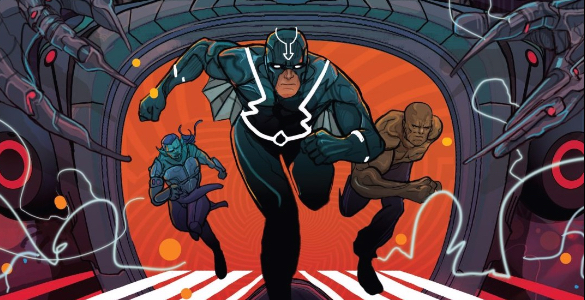
Black Bolt is trapped in a sci-fi prison so trippy, I’m not sure how to refer to it. Is it a a prison out of time and space? Oooh! Maybe some kind of psychic labyrinth! It’s a space between dimensions or beyond death or beside reality — anywhere you can’t quite describe without feeling like a huge dork. But as tough as it is to describe the space, the physicality of it is massively important. It’s a prison, after all; if the readers don’t have a sense of the jail being broken, what the fun in a jail break? That’s where artist Christian Ward steps in and grants every indescribable room a stunning clarity. I may never be able to tell you what this space is, but there’s never any confusion about what the room-to-room experience is for Black Bolt and his new friends. Continue reading

Who To Protect and Who to Serve in Hal Jordan and the Green Lantern Corps 23

by Patrick Ehlers

This article contains SPOILERS. If you haven’t read the issue yet, proceed at your own risk!

“To Protect and to Serve.”

LAPD motto

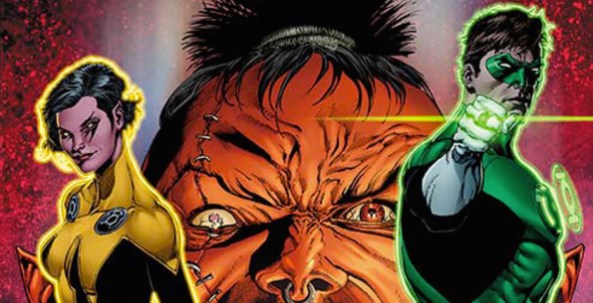
The motto above (or some variation thereof) is so commonplace among police forces that it’s easy to forget that the saying originated from a contest the Los Angeles Police Department held in 1955. They were gathering submissions for slogans for the police academy, and Officer Joseph P. Dorobeck submitted the now-famous five-word phrase. By the end of 1963, the motto was officially adopted by the LAPD. Less than two years later, the Watts Riots pitted police against civilians, in a role that was neither serving nor protecting them. The Los Angeles Police have had a rough history with the people they’re meant to protect, often revealing the population they serve to be themselves. In this week’s Hal Jordan and the Green Lantern Corps, writer Robert Venditti reminds us that the Green Lanterns are just cops, with all the same failings as the LAPD. Continue reading

Secret Weapons 1: Discussion

by Patrick Ehlers and Drew Baumgartner

This article contains SPOILERS. If you haven’t read the issue yet, proceed at your own risk!

slim-banner

Patrick: Thwip! Bamf! Snikt! You know those sound effects: respectively, they mean a) Spider-Man shooting some web fluid, b) Nightcrawler teleporting away, and c) Wolverine deploying his claws. It is perhaps illustrative of the predictability of their superpowers that there are immutable sound effects that accompany them. You know exactly what it sounds like when Wolvie pops his claws, but you also know exactly what he can do with them. These powers are used in unsurprising ways to save the day, but what happens when the superheroes have powers that aren’t so easy to understand? Well, then you’ve got the residents of The Willow and the cast of Secret Weapons. Continue reading

Secrets, Surprises and Criminality in All-New Guardians of the Galaxy 4

by Patrick Ehlers

All-New Guardians of the Galaxy 4

This article contains SPOILERS. If you haven’t read the issue yet, proceed at your own risk!

Liars. Thieves. Con men. They’ve all got secrets. It’s no wonder that the Galaxy’s rascally Guardians, who are more criminals than they are heroes, have a whole host of surprises and secrets up their collective sleeve. Writer Gerry Duggan and artist Aaron Kuder keep the reader in the role of the mark, setting us up to be as surprised as everyone else in their story. It’s a little frustrating to be kept at such a distance, but it is perfectly in-line with what it must be like to know these guys. Continue reading