Doctor Strange 381: Discussion

By Taylor Anderson and Patrick Ehlers

Doctor Strange 381

This article contains SPOILERS. If you haven’t read the issue yet, proceed at your own risk!

Taylor: There’s a scene in the excellent new Thor movie where the titular character comes face to face with Dr. Stephen Strange. At the time, the scene struck me as kind of weird, even if I enjoyed it greatly. What seemed odd to me at the time was the idea of Norse gods meeting a sorcerer who seemingly hails from a completely different mythology. But as the rest of the movie showed me with its zany and fun plot, there’s no reason why the two mythologies shouldn’t meet. At the end of the day, both Thor and Dr. Strange have super powers, and whether one is or isn’t magic doesn’t seem to really matter. Once I crossed the cognitive divide that these two characters shouldn’t interact, I was totally hooked. The same is true of Doctor Strange 381, because it operates in much the same way. Continue reading

Star Wars 38: Discussion

By Mark Mitchell and Spencer Irwin

This article contains SPOILERS. If you haven’t read the issue yet, proceed at your own risk!

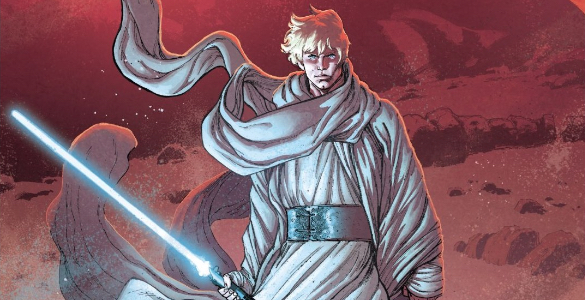
Mark: As a Star Wars fan, the 2015 release of Star Wars: The Force Awakens was exciting for a lot of reasons, but, in hindsight, perhaps the best thing to come out of the buzz surrounding the franchise’s cultural relaunch was the reemergence of Carrie Fisher into the public consciousness. Look, Mark Hamill seems delightful, and Harrison Ford’s turn into Curmudgeon With a Heart of Gold has become more tolerable with time, but Fisher was uniquely witty and genuine. Even if you’ve seen it before, please take a moment to watch her December 2015 interview on Good Morning America. Has there been a more perfect promotional tour interview? Fisher’s ability to simultaneously fulfill her corporate mandate and lampoon the absurdity of the situation while also being charming and warm illustrates just how much of a pro she was. She’s effortlessly charming in a way that immediately puts the lie to the transparently vacuum-sealed “Stars — They’re Just Like Us!” celebrities usually foisted upon viewers in the overenunciating hours of daytime television.

I don’t know how Fisher viewed her return to the role of Leia Organa, but I hope she was pleased. And if her likeness is going to be the property of the Walt Disney Company in perpetuity, than I’m glad she was able to portray General Organa in her later years, and that both versions of the character can continue to exist in the Star Wars comics going forward. Continue reading

Batman Lost 1: Discussion

by Patrick Ehlers & Michael DeLaney

This article contains SPOILERS. If you haven’t read the issue yet, proceed at your own risk!

slim-banner

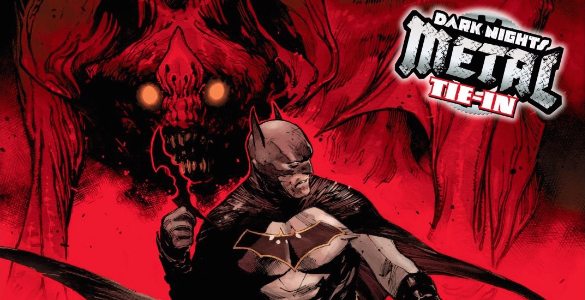
Patrick: For as much mythological importance as we place on origin stories, the question of how a superhero came to be very seldom adds up to his or her actual origin. Batman is the example in question, so let’s use him: a random mugging in crime alley, a broken string of pearls, two shots fired, an orphan. That’s quintessential, primordial Batman — the very stuff of which he is made. But that’s incomplete. A DC Comics murderers’ row of artists and writers set out to remind readers just how strange Batman’s origins really are in Batman Lost 1. In so doing, they also remind us how infinite and unpredictable Batman’s future truly is. It’s a dizzying collage of what-ifs and secret histories, all presented as true with unflinching authority. Continue reading

Teenage Mutant Ninja Turtles/Ghostbusters II 2 is Like Childhood Fun

by Taylor Anderson

This article contains SPOILERS. If you haven’t read the issue yet, proceed at your own risk!

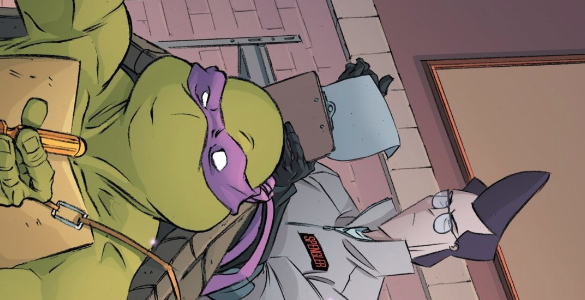
As a kid, I had a lot of action figures. Ninja Turtles, Ghostbusters, G.I. Joe, Star Wars — you name the franchise, I probably had at least one figurine from it. Part of the fun of having such a large collection was that I could mix and match the toys in any way that made sense to my imagination (which means it required little sense at all). This meant that sometimes Donatello would drive the Millennium Falcon or Peter Venkman might drive the Pizza-Cycle. This spirit of boundless play has been all but beaten down in me by society, but luckily it lives on in TMNT/Ghostbuster II 2. Continue reading

She-Hulk 159: Discussion

by Drew Baumgartner and Spencer Irwin

She-Hulk 159

This article containers SPOILERS. If you haven’t read the issue yet, proceed at your own risk!

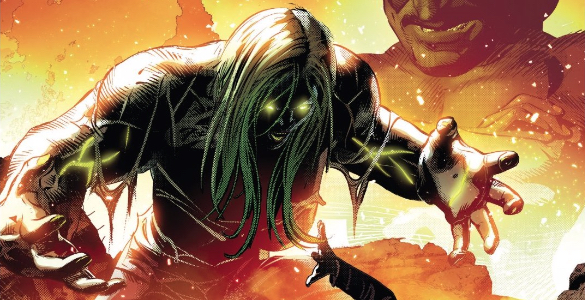
Drew: Why do we like superheroes? For some, the appeal might be whiz-bang action or modern mythologies, but I’ve personally always been drawn to the genre for its ability to comment on everyday life (albeit by blowing it up to epic proportions). It’s not a feature of every superhero story — far from it — but there’s a certain type of superhero story that manages to scale up relatable conflicts and struggles to matters of life and death. Mariko Tamaki’s work with Jen Waters (formerly on Hulk, now retitled and renumbered as She-Hulk) has always fit into this category with ease, using Jen’s Hulk-outs as a stand-in for PTSD-fueled anxiety attacks. It’s an approach that served the character and the story beautifully, creating a series decidedly unlike any other superhero story on the shelves. This issue is at its best when it focuses on those relatable elements, though the introduction of a bona fide supervillain might just blow the parallels out of the water. Continue reading

Teenage Mutant Ninja Turtles/Ghostbusters II 1

by Taylor Anderson and Patrick Ehlers

This article contains SPOILERS. If you haven’t read the issue yet, proceed at your own risk!

Taylor: There’s something about a Teenage Mutant Ninja Turtles and Ghostbusters crossover that just works. There are the obvious reasons why, like both groups being made up of four dudes with similar personalities, or the fact that they both live in New York. While that explains why the crossover is convenient, it’s not why it works. No, the reason that the Turtles and ‘Busters can merge stories so well is that both groups routinely deal with strange shit. That, and that alone, might just be why there is a second crossover event for these two franchises, and if the first issue is any indication, it is also reason enough for it existing. Continue reading

Green Lanterns 34: Discussion

by Michael DeLaney and Mark Mitchell

This article contains SPOILERS. If you haven’t read the issue yet, proceed at your own risk!

slim-banner

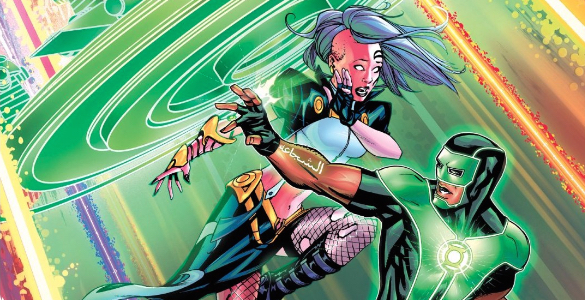
Michael: Sam Humphries has passed the Green Lanterns torch but the flame still burns strong. Green Lanterns 34 marks Tim Seeley’s second issue with Simon Baz and Jessica Cruz and explores how hard it is to maintain a steady job while you’re on call to save the universe 24/7. More importantly, it highlights the ugly truth that no matter how heroic you are, if you’re brown in America you’re still seen as second-class citizens. Continue reading

Paper Girls 17: Discussion

by Drew Baumgartner & Patrick Ehlers

Paper Girls 17

This article contains SPOILERS. If you haven’t read the issue yet, proceed at your own risk!

slim-banner

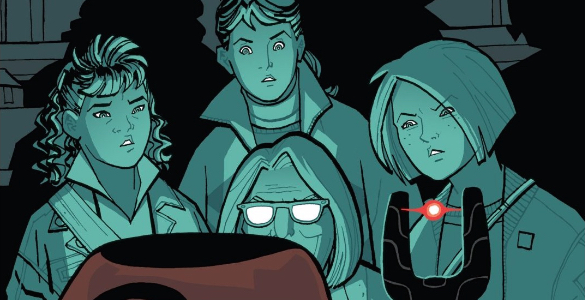
Drew: Brian K. Vaughan series are hard to pin down, generically. I mean, they obviously fall into big capital-G genres like “sci-fi” or “space opera,” but the list of specific influences — which Vaughan often name-checks — can shift from issue to issue. Case in point, Paper Girls has sprinted through dozens of generic touchstones in its 17 issues. And yet, I’ve been holding onto its starting point in the Spielberg/Columbus-style suburbia of the late ’80s as some kind of essential component of its DNA, even as the series hasn’t been in that setting since its very first arc. While some of the girls may still be in that head-space (Mac sure seems to be), they’re traversing worlds that have entirely different points of reference (both for the people who live in those worlds, and the stories we tell about them), which seems to be leaving an impression on them. Continue reading

Glitterbomb – The Fame Game 2: Discussion

by Patrick Ehlers & Drew Baumgartner

This article contains SPOILERS. If you haven’t read the issue yet, proceed at your own risk!

slim-banner

Patrick: What are we doing here? I mean, here, reading (or in my case, writing) a piece critical of a work of art? The art itself, issue two of Glitterbomb The Fame Game, is an exploration of emotional voyeurism, and is openly critical of the people profiting off the vulnerability of others. The risk associated with saying anything about this issue is always going to pale in comparison to the risk the creators take in actually expressing the story therein. Writer Jim Zub and artists Djibril Morissette-Phan and K. Michael Russell lay their own fears of fame out on the page in naked, sometimes groaningly obvious, ways. I can point this out and say “look how obvious this is”, but this is always going to be a weaker product than the story that actually says something. Continue reading

Ghostbusters: Answer the Call 1: Discussion

by Ryan Mogge and Taylor Anderson

This article contains SPOILERS. If you haven’t read the issue yet, proceed at your own risk!

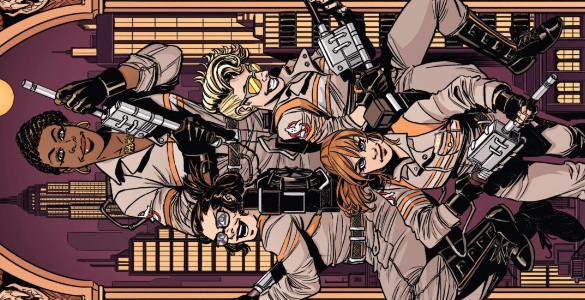
Ryan M: Beginnings have a sense of weight to them. Readers expect that the moment has been chosen with care, to best set up the story that follows. When readers enters the world, they are especially sensitive to the status of the characters. This is the point where a creator can offer a lifeline in the form of a point of view character. Alternatively, we can begin in a state of flux, so that the reader naturally finds the “new normal” along with the plot. Ghostbusters: Answer the Call 1 starts the series with the main characters in a comfortable rhythm with each other and their world. By not challenging their status quo, Kelly Thompson and Corin Howell let the Ghostbusters remain entertaining but not affecting. Continue reading