There’s Beauty in Letting Go in Hadrian’s Wall 8

by Spencer Irwin

This article contains SPOILERS. If you haven’t read the issue yet, proceed at your own risk!

Letting go — of grudges, of hatred, of resentment — is one of the hardest things a human being can do. It feels good to nurse a grudge, yet it can feel even better to finally let go — there’s beauty, there’s true catharsis in it. With the incomparable Rod Reis on art, it’s impossible for Hadrian’s Wall 8 not to find the literal beauty in letting go, even as writers Kyle Higgins and Alec Siegel emphasize how truly difficult this action is for their characters. Continue reading
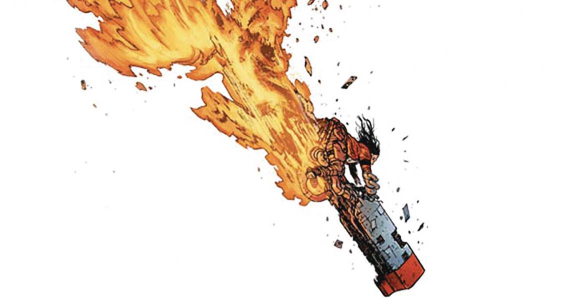
Things Get Bleaker, but Never Hopeless in Extremity 6

by Mark Mitchell

This article contains SPOILERS. If you haven’t read the issue yet, proceed at your own risk!

Creator Daniel Warren Johnson has managed to top himself with every issue of Extremity, and in Extremity 6, he plumbs new depths of horror and heartache. Last issue, I wondered if Jerome could ever be redeemed after ruthlessly crossing the line into needless murder, and while it’s still possible he will eventually see the errors of his way, Extremity 6 finds Jermone sinking even deeper, and it’s his bloodthirst that brings his clan to its knees. Continue reading

Saga 45: Discussion

by Ryan Desaulniers and Patrick Ehlers

This article containers SPOILERS. If you have not read the issue yet, proceed at your own risk!

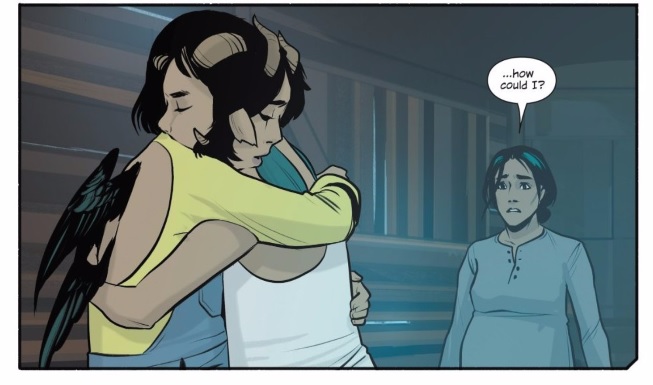
Ryan D: Since last issue’s final splasy page reveal — which Brian K. Vaughn and Fiona Staples love doing to us — my friends and I have been theorizing what the heck is happening with this male-looking version of Hazel who appears to Alana. The easy explanation would be that Alana is sick with her stillborn child and hallucinating. I find myself extremely pleased now, after reading this issue, that the approach the creative team took here is much more dramatically interesting than a mere hallucination. Having this apparition be a side-effect of the magical abilities which Alana temporarily sports due to her miscarriage helps to further the lore of the Horns’ magical abilities and the context in which they were used, and the fact that Marko, Alana, and Hazel all share sight of this magical illusion-child offers us crushing moments like this:

Continue reading

Pacing Reveals in Cannibal 7

by Drew Baumgartner

Cannibal 7

This article contains SPOILERS. If you haven’t read the issue yet, proceed at your own risk!

This sentence has five words. Here are five more words. Five-word sentences are fine. But several together become monotonous. Listen to what is happening. The writing is getting boring. The sound of it drones. It’s like a stuck record. The ear demands some variety. Now listen. I vary the sentence length, and I create music. Music. The writing sings. It has a pleasant rhythm, a lilt, a harmony. I use short sentences. And I use sentences of medium length. And sometimes, when I am certain the reader is rested, I will engage him with a sentence of considerable length, a sentence that burns with energy and builds with all the impetus of a crescendo, the roll of the drums, the crash of the cymbals–sounds that say listen to this, it is important.

Gary Provost

Pacing is the silent artistry of every medium, the kind of essential element that you only ever notice when it’s either poorly or remarkably well done. As such, pacing is not the kind of thing we always get to talk about around here — beyond the fact that the bulk are paced competently, comics pacing usually takes several pages to really sink in, so is a difficult point to illustrate in a short essay. But then there are comics that do it so well, they almost demand that effort. Cannibal 7 is one of those comics. Continue reading

The Spectacular Status Quo in Godshaper 4

by Ryan Desaulniers

This article will contain SPOILERS. If you haven’t read the issue yet, proceed at your own risk!

Godshaper weaves a tale of discrimination with gorgeous parallels to our current day within a new universe. Period. While parallels exist here between the “Dark Materials” series, the comic lives in its own plane, dealing with social issues in a novel, resonating way. While issue four does not break down any new walls in this series, the base-line for this comic is so consistent and lovely and revealing that I don’t even mind. Continue reading

Lazarus X+66 1: Discussion

By Drew Baumgartner and Ryan Desaulniers

Lazarus X+66 1

This article contains SPOILERS. If you haven’t read the issue yet, proceed at your own risk!

Some are born great, some achieve greatness, and some have greatness thrust upon ’em.

William Shakespeare, Twelfth Night

Drew: This quote often comes up when discussing historical figures, but to my eye, it’s really all about the narratives we build around people. That is, this describes fictional heroes — from “chosen ones” destined for greatness to utterly reluctant nobodies that rise to the occasion — stories so familiar to us, we can’t help but project them on the world around us. But, like, what does it mean to be “born great,” and how do we distinguish that from someone having greatness thrust upon them? Those kinds of distinctions might make sense in stories where deities and magic put concepts like destiny in play, but the real world is much messier than that. Such is the case with Casey Solomon, whose greatness is anticipated by Forever Carlyle. Is her greatness inborn, or is it something she only achieved in order to live up to expectations? Continue reading

Descender 22 and the Art of the Opening

by Ryan Desaulniers

This article contains SPOILERS. If you haven’t read the issue yet, proceed at your own risk!

The curtains rise in Descender 22 on a stage which is nearly bare.

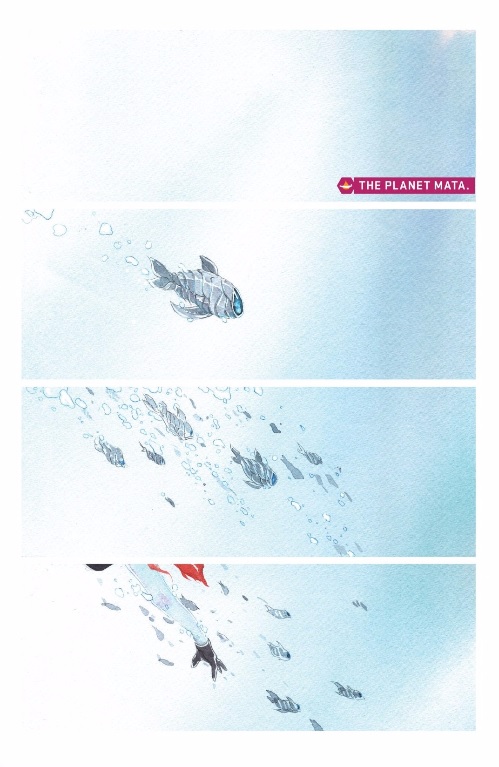
The only indication in the first panel that the comic has begun is the indication of the location, the planet Mata. A gentle blue irises on the right-hand side of the panel, and as your eye travels down the page, it’s difficult to tell that there even are panels. A fish glides into view, adding context to the first panel, then the next panel brings a flurry of fish and introduces an element of direction and movement, down and to the right. The gutters between the panels become more distinct here, before artist Dustin Nguyen, in the last image of the page, gives us the gloved hand, bare wrist, and a touch of the signature red of Telsa’s hair. The reader barely has time to think “oh shit!” before the page turn smashes us into a two-page spread of Telsa, floating and limp, wrapped in a hard layer of bubbles, hopeless. Continue reading

The Banality of Magic in Curse Words 6

by Drew Baumgartner

Curse Words 6

This article contains SPOILERS. If you haven’t read the issue yet, proceed at your own risk!

There are countless diagnoses for the success of Harry Potter, but I have to think at least part of the appeal is that the stories embraced both the pleasant and unpleasant extremes of fictional magic. On the one hand, there are enchanting magical novelties — everything from candies to sports to boarding schools — and on the other, there are evil characters that practice corrupted magic in order to kill their adversaries and gain power. While plenty of fiction has embraced one or the other of those extremes in their depiction of magic, few took on the whole spectrum, treating the world of magic as if it were every bit as messy and nuanced as the real world. Curse Words has gladly taken up that cause, and indeed takes it several steps further, exchanging Harry’s naive wonderment for more mundane complacency, emphasizing how commonplace and banal magical acts are in Hole World. Continue reading

A Generation Defined in Generation Gone 1

by Patrick Ehlers

This article contains SPOILERS. If you haven’t read the issue yet, proceed at your own risk!

Aleš Kot and André Lima Araújo’s Generation Gone is arrestingly open about its central theme: the existential peril of disaffected youth. Hell, the name of the series gives it away. Kot is seemingly not content with even that level of obviousness, as he starts to reveal the stunted social lives of his main characters right on the cover of the issue, before we know who they are or even what they look like. Comics are a visual medium, and 999 times out of a thousand, the first thing we know about a character is what they look like. These kids are hackers — their skills, personalities, values and identities most likely forged online where text invariably acts as the vanguard for a digital persona. We’re meeting these people the same way you would in a forum: expressing something deeply vulnerable and hurtful, with no faces to associate with their comments. Continue reading

Women Become Commodities in Bitch Planet Triple Feature 2

by Spencer Irwin

This article will contain SPOILERS. If you haven’t read the issue yet, proceed at your own risk!

One of the primary causes of the discrimination and harassment women face is the attitude that women are objects. Many men only see women as a commodity, as something that cleans their house and makes their food and gives them children, as something to ogle, as a source of pleasure and nothing else. It’s an indescribably harmful concept, and one society enforces in practically uncountable ways. The patriarchal dystopia of Bitch Planet, of course, takes this concept to the extreme, quite literally turning its women into commodities to be bought, sold, and used however men please. Continue reading