Nameless 2

Alternating Currents: Nameless 2, Drew and MichaelToday, Drew and Michael are discussing Nameless 2, originally released March 4th, 2015.

Dave Bowman: Open the pod bay doors, HAL.
HAL 9000: I’m sorry, Dave. I’m afraid I can’t do that

2001: A Space Odyssey

Drew: Arthur Miller called betrayal “the only truth that sticks,” and it’s hard to deny the visceral power of a betrayal. Betrayals are at the center of every great tragedy, from Euripides to Shakespeare, and are still very much a driver of drama today. In it’s simplest form, a betrayal is simply someone acting differently than we expect, but “acting differently” can have dire consequences in a life-or-death situation. That’s what makes HAL 9000’s turn in 2001 so compelling — a computer with a sense of self-preservation is shocking enough, but because the story is set in outer space, there’s a lot more at stake than when your laptop decides to auto-update. Grant Morrison and Chris Burnham’s Nameless 2 clearly draws a lot of inspiration from that betrayal, as the crew remains unaware of a mutiny brewing back at the base. Continue reading

Descender 1

descender 1

Today, Spencer and Patrick are discussing Descender 1, originally released March 4th, 2015.

Spencer: Descender is a title that piqued my interest the moment it was announced. With creators like Jeff Lemire and Dustin Nguyen at the helm it’s easy to see why, but what actually caught my attention was its premise; Descender follows a child robot named Tim-21 as he attempts to survive in a world out to annihilate all artificial life. Just the synopsis alone tugs at my heartstrings, but it’s Nguyen’s adorable design for Tim-21 that seals the emotional deal; I bonded with this kid the moment I laid eyes on him. This holds true for the rest of the issue, as well; Lemire’s introduced some fun concepts and all the trappings of a compelling sci-fi universe, but it’s Nguyen’s unique, stunning art that makes this universe a place worth visiting. Continue reading

Lazarus 15

Alternating CurrentsL Lazarus 15, Drew and Patrick

Today, Drew and Patrick are discussing Lazarus 14, originally released February 18th, 2015.

…poetry is a short story missing 99 percent of the words.

Greg Rucka

Drew: I really wish I had the rest of the above quote, made by Rucka at the New York Comic Con in 2013, but to paraphrase, Rucka was suggesting that an intimate understanding of the form of short stories would prepare writers for every kind of writing except poetry. I’ve always seen a resemblance between Rucka’s taut comic work and great short stories, but what truly struck me about that quote was how it seemed to contradict the oft-quoted axiom that the required efficiency of short stories aligns them more closely with poetry than novels. This seeming contradiction may boil down to the inadequacy of our definition of “poetry”, but I couldn’t help but think of this quote as I read Lazarus 15, one of the most poetic comics I’ve ever read. Continue reading

Velvet 9

velvet 9

Today, Spencer and Drew are discussing Velvet 9, originally released February 4th, 2015.

Spencer: Who can you trust? This can be a hard question for anyone to answer — how many of us have trusted someone who didn’t end up being worthy of it? — but for a spy, whose entire life revolves around secrets and lies, it’s practically impossible. Velvet Templeton is a spy on the run, further minimizing the list of people she can trust — even those she knows aren’t against her can’t necessarily be trusted to keep secrets from her employers. So far Velvet’s wise choices when it comes to trust have kept her one step ahead of her pursuers, but Ed Brubaker and Steve Epting’s Velvet 9 may find her making her first mistake by trusting Damian Lake even just a little — and in doing so, Velvet may have just found herself an opponent who can finally keep up with her. Continue reading

Nameless 1

nameless 1

Today, Michael and Drew are discussing Nameless 1, originally released February 4th, 2015.

Michael: Back to the Future, The Wizard of Oz, Wife Swap: popular pieces of film, literature and even reality TV. Besides being engaging pieces of fiction (reality TV burn!) they all have an essential plot element that draws us in as an audience: they are all “fish-out-of-water” stories. Marty McFly isn’t familiar with the culture of the ’50s, Dorothy doesn’t understand the strange land of Oz, and one wife doesn’t know how to live in a drastically different home. Since Nameless is a Grant Morrison story, it is over-the-top bonkers and full of heady ideas. At its core though, it is also a story about a fish out of water. Continue reading

Saga 25

saga 25

Today, Ryan and Patrick are discussing Saga 25, originally released February 4th, 2015.

Ryan: Pop culture loves rebels. We hang posters of them in our dorm rooms, whether they have a cause or not. We wear red graphic t-shirts emblazoned with their likeness, not very concerned about some of the more morally ambiguous acts this person committed. Luke Skywalker played figurehead for the Rebel Alliance and may be the most popular and beloved rebel of all time, despite the fact that the blood of 322,951 Death Star personnel (not to mention the oil of 400 thousand plus droids) stains his non-synthetic hand. Saga 25 adds another variable into the mix with the introduction of a third side to the outstanding war between Landfall and Wreath, while also providing another complication to the Dengo child-heist. Continue reading

East of West 17

east of west 17

Today, Drew and Taylor are discussing East of West 17, originally released February 4th, 2015.

A long time ago in a galaxy far, far away…

Star Wars

Drew: Myths are almost all told from a third person omniscient perspective in the past tense; not only do we get a glimpse into the separate actions of both the Tortoise and the Hare, we understand that this race already happened. That second part is natural to storytelling in general — everything from personal anecdotes to the high-flyingest science fiction is told as if the events already happened. Curiously, both tense and narrative mode tend to disappear when working in a visual medium — the illusion that these actions are actually playing out in front of us is strong enough to override any confusion about who is telling this story, and when. To give visual storytelling a mythic quality requires making the past tense nature and omniscient narrator explicit, perhaps with a framing device a la The Princess Bride, or perhaps just with that innocuous introduction I included above. East of West 17 finds writer Jonathan Hickman slipping his narrator in, lending the proceedings the mythic qualities they rightly deserve. Continue reading

Sex Criminals 10

sex criminals 10

Today, Patrick and Ryan are discussing Sex Criminals 10, originally released January 28th, 2015.

Patrick: I think we’re slowly starting to emerge on the other side of the age of the anti-hero: when your Tony Sopranos and Walter Whites and Don Drapers were the coolest guys on TV. If there’s one thing these guys all have in common — other than your suspicion that you couldn’t be friends with them in real life — it’s that they all know what they want. The means and methods by which they achieve their goals can be questionable, but as long as they continue to express an honest desire, the audience never goes away. It’s strong, and somehow morally correct. Even when their worlds are crashing down around them, we have faith in the anti-hero’s unwavering need to get what they want. So where does that leave us with characters that don’t know or can’t articulate what they want? That’s a relatable trait, probably more relatable than any of us would like to admit. Continue reading

Zero 14

zero 14 Today, Drew and Taylor are discussing Zero 14, originally released January 28th, 2015. Art and Social Function

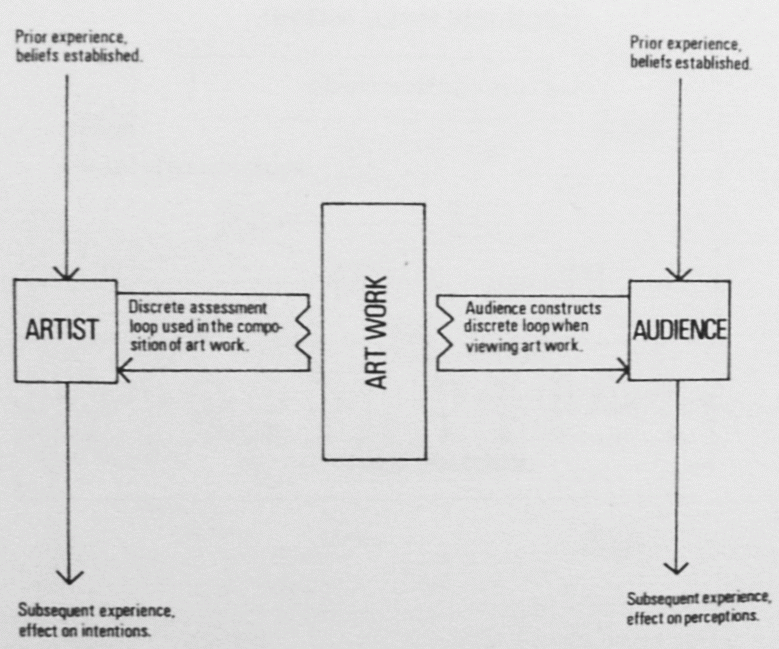
Two fundamental discrete cognate loops are shown, which are isolated from each other by the artwork. There is no form of interaction between the two which could generate mutual understanding as would be the case in a successful conversation. In the absence of such a procedure both the audience and the artists become locked in their own perceptual biases.

Stephen Willats, Art and Social Function

Drew: Where does meaning happen? I was brought up on the postmodern ideals outlined in the epigraph, but it seems that a great deal of modern society still clings to romantic notions of artistic intention. We celebrate and scorn artists based on their intentions, forgetting that the value of their art may not have anything to do with the artist. Indeed, we’re so obsessed with intention that we conflate it with meaning, minimizing the audience’s role — a role I might argue is the whole point of art in the first place. It’s because of this climate that I enjoy art that obscures its artist’s intentions. It’s easy to assume the moral is the “point” of one of Aesop’s fables, but it’s decidedly harder to draw such a clean line in something like Zero 14, where ambiguity and sheer density of ideas makes any meaning we can parse decidedly our own. Continue reading

The Wicked + The Divine 7

Alternating Currents: The Wicked and The Divine 7, Drew and Spencer

Today, Drew and Spencer are discussing The Wicked + The Divine 7, originally released January 21st, 2015.

Drew: Religion is such a weird thing in comics. Both of the Big Two feature actual gods in their publishing line, which opens up a whole host of ontological questions — Did these gods play a role in the creation of the universe? How did they come to exist? — but these characters largely aren’t designed to answer religious questions. Just like Superman isn’t really about the existential questions raised by alien societies, the likes of Thor and Wonder Woman aren’t really about mythology — goddom is just another avenue to explain why your characters would have superpowers. It was easy for me to confuse The Wicked + The Divine with this type of story — neither is ultimately interested in the religious implications of having gods up and walking around — but as the series’ themes continue to solidify, it’s become ever more apparent that the powers don’t matter, either. “God” is just an exaggerated stand-in for “teen idol,” and given the way our society treats celebrities, it’s not that much of an exaggeration. Continue reading