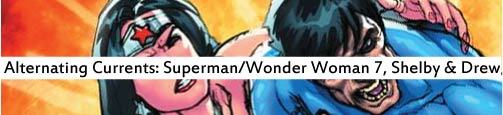
Superman/Wonder Woman 7

superman wonder woman 7

Today, Shelby and Drew are discussing Superman/Wonder Woman 7, originally released April 9th, 2014.

Shelby:  I’m pretty bad at talking about my feelings. I’ve gotten better, because I have realized the value in just stating how I feel or what I want plainly, but I still sometimes have a hard time with it. Talking to dreamy men is still my biggest challenge; there’s just something about the simple phrase, “You are cute and cool, want to grab a drink?” that causes my brain to just completely melt down. I recognize it’s pretty silly, but am at the same time powerless to stop it. Maybe it’s an extreme fear of rejection? Or maybe I’m worried I’ll end up in a awkward situation like Clark and Diana, who have an unspoken, “I love you, too” hanging between them (not to mention nuclear fallout).

Continue reading

Weekly Round-Up: Comics Released 4/2/14

round upLook, there are a lot of comics out there. Too many. We can never hope to have in-depth conversations about all of them. But, we sure can round up some of the more noteworthy titles we didn’t get around to from the week. Today, Drew and Patrick discuss Pretty Deadly 5, Private Eye 6, Red Sonja 8, Red Sonja and Cub Magneto 2, Black Widow 5, and Swamp Thing 30.

slim-banner4Drew: We like thinking about comics on this site — it’s literally the only reason it exists — which often predisposes us to patience. We’re willing to put the time in to unpack a dense work of art or give creators the benefit of the doubt that this will all pay off because we know how rewarding those experiences can be. That patience means we may be willing to wait a little longer for answers — heck, it may mean we actually like waiting for answers — but there’s a point of diminishing returns on ambiguity. Indeed, the bliss of ignorance can obscure the conflict necessary to drive a narrative. Or, put another way: is it possible to appreciate a solution if we never understood the problem? Continue reading

She-Hulk 3

she-hulk 3Today, Spencer and Drew are discussing She-Hulk 3, originally released April 2nd, 2014. 

slim-bannerSpencer: She-Hulk is a superhero lawyer. What does that mean? Well, she’s a superhero who is also a lawyer, but that’s obvious. Does it mean she takes on cases involving superpowered individuals? No doubt they’re a huge part of her clientele, but I think there’s more to it. Charles Soule and Javier Pulido’s She-Hulk 3 finally gives us a chance to see Jennifer Walters, attorney-at-law, in action, and she’s every bit as great at the job as we’ve been told. What stood out to me the most, though — and what truly makes her a “superhero lawyer” in my eyes — is that she tackles the case with the same kind of enthusiasm and dedication that she devotes to fighting crime. Continue reading

Chat Cave: Captain America: The Winter Soldier

Marvel continues to grow its movie universe with its second installment of our favorite super soldier in Captain America: Winter Soldier. Naturally, we all want to talk about it. Probable spoilers after the break: welcome to the Chat Cave.
Continue reading

Veil 2

veil 2Today, Greg and Patrick are discussing Veil 2, originally released April 2nd, 2014.

Greg: I see a therapist regularly, and while it may be unhealthy to view therapy in a win/lose sports binary, I feel like I scored a big “victory” at my last session. She told me I seemed to be good at “living in the present,” that all-encompassing mantra that, to me, means the healthiest choice is to let go of what you can’t control in the “then,” and instead, find peace in the “now.” It’s something I’ve struggled with my whole life, which might explain why I responded so positively to the newest issue of Veil.

Basically what I’m saying is, if Dante needs to talk to someone, I can give him a number to call.  

Continue reading

Loki: Agent of Asgard 3

loki 3Today, Patrick and Shelby are discussing Loki: Agent of Asgard 3, originally released April 2, 2014. 

slim-bannerPatrick: I remember seeing a featurette on Kill Bill, Vol. 1 in anticipation of Vol. 2. In it, Quentin Tarantino mentioned a few of the storytelling accomplishments of the first movie. For the most part, Vol. 1 is an emotionally satisfying episode in and of itself: an emotionally and physically devastated woman finds the means, the will and strength to fight back. But Tarantino points out the importance of establishing the mythology of a Hattori Hanzo sword. By the time the second flick rolls around, they’re legendary, and their legacy adds an almost supernatural element to the fight between The Bride and Elle. I mean, it’s Hanzo Sword vs. Hanzo Sword for crying out loud! The thing is, the only way to communicate how powerful these blades are is to tell us stories about them. Al Ewing continues to explore the power of myth by having his antagonist craft his own mythical sword, not by forging the blade, but by forging the story of the blade. Continue reading

Moon Knight 2

Alternating Currents: Moon Knight 2, Drew and Spencer

Today, Drew and Spencer are discussing Moon Knight 2, originally released April 2nd, 2014.

Drew: When I talk about “density” in a piece of art, I’m usually referring to its meaning — the way themes and symbolism is laid over the plot to give us something more than a sequence of events. The notion that a work of art is greater than the sum of its parts is our working assumption here at Retcon Punch, but Moon Knight 2 posits that exactly the sum of those parts can be incredible in its own right. Indeed, while this issue features only the thinnest wisp of a plot, it introduces and retraces the scene with such thoroughness to create an entirely different kind of density. It’s an awe-inspiring object, featuring an intricate clockwork of pieces that aspire to exactly what they are: an utterly brief moment in time examined from every conceivable angle.

Continue reading

Green Arrow 30


green arrow 30Today, Shelby and Drew are discussing Green Arrow 30, originally released April 2nd, 2014.

Shelby: Because I like to stay on top of pop culture trends, I recently discovered the TV series Legend of the Seeker. It’s a pretty straight-forward magic-based fantasy, based on Terry Goodkind’s series The Sword of Truth. You know, right up my alley. Anyway, there are two groups of magical women in this universe: Confessors and Mord-Sith. The Confessors’ power is based on love and truth; they can see when someone is lying, and as a last resort force them to tell the truth by causing people to fall desperately in love with them. The Mord-Sith, however, get their power from hate; all love, kindness, and compassion is burned out of them from youth until all they know is how to cause pain and hatred. While neither situation is ideal, it’s made clear that the love for a Confessor can elicit positive change in a person, whereas “training” from a Mord-Sith can only breed more hate. So, what do you get when someone is motivated by both love AND hate? By quiet dignity and unbelievable cruelty? Maybe we should ask Green Arrow.

Continue reading

Action Comics 30

action comics 30
Today, Scott and Patrick are discussing Action Comics 30, originally released April 2nd, 2014.

Scott: Segues: you either love ’em or you hate ’em. I’ve listened to enough standup comedy to know that I’m a fan of the clean break, the abrupt change of topic. Lengthy transitions are just a waste of time. In longer storytelling formats, such as monthly comic books, there’s more of a virtue in spinning many plates at once. Even though stories are broken into defined arcs, some elements carry over from one arc to the next, making the clean break impossible. It results in issues like Action Comics 30, where writer Greg Pak’s first major arc comes to an end while also introducing important pieces of the story to come. The issue looks fantastic, but the story gets a little messy as it tries to connect the old with the new, making me wonder if Pak might have been better off nixing the segue.

Continue reading

Punisher 4

punisher 4Today, Patrick and Taylor are discussing Punisher 4, originally released April 2nd, 2014. 

slim-bannerPatrick: I can’t think of a superhero with a more troubling psychological origin story than Frank Castle. The circumstances are as cliche as they come: Frank’s family is murdered, driving him to take revenge on those responsible. But Frank’s able to abstract that responsibility and extend it to All Criminals. Very pointedly, he is not an agent of justice, and he’s not looking to make anything right — his goals and his ideology are so neatly wrapped up in his code name. Punisher. Obviously, his approach requires a horrifically oversimplified view of criminals, there’s no room for mercy or subtlety. But that also means there’s no room for complication: Frank’s MO is too pure for corruption. The world around Punisher isn’t so simple, and as issue four simultaneously focuses in Frank’s character and broadens out to illuminate his world, it’s clear that he’s up against threats on a scale totally inappropriate for a street-level executioner.

Continue reading