IvX 0

ivx-1

Today, Spencer and Drew are discussing IvX 0, originally released November 30th, 2016. As always, this article contains SPOILERS.

Spencer: I don’t know much about my ancestry or heritage other than the fact that I’ve got blood from at least six or seven different European countries in me (I’ve been known to describe my ethnicity as “White Mystery”). Combine that with a family that’s never been all that worried about tradition and you get a guy who just doesn’t care about his culture (if I could even be considered as having one). This is absolutely not the case with the mutants or the Inhumans, though; although the two groups’ concepts of culture and tradition differ greatly, they’re absolutely vital to both camps. That’s something Charles Soule and Kenneth Rocafort make abundantly clear in IvX 0 — the conflict that’s been brewing between them isn’t really about the literal deaths of individuals anymore, but about the possible figurative death of their very ways of life. Continue reading

Death of X 4

death-of-x-4

Today, Patrick and Michael are discussing Death of X 4, originally released November 23rd, 2015.

Patrick: At the risk of making a statement that’s been made a million times already: 2016 has been a hell of a year for high-profile deaths. Calling them “celebrity deaths” would be underselling it — figures like Muhammad Ali, Fidel Castro and Prince virtually changed the fabric of reality simply by existing in it. But for all their earth-shifting influence, their deaths were all quiet, ultimately meaningless affairs. These revolutionaries did not die they way they lived, which is to say, their deaths made no specific statement. Bucking the trend, was David Bowie, who had released an eerie, melancholy record in the final weeks of his life. Bowie knew that his life was performance – it was challenging and honest – and that his death should be the same. In Death of X 4 Jeff Lemire and Charles Soule close the book on the life of Scott Summers, insisting that he die the way he lived, a revolutionary, even if that’s a performance he was never putting on.

Continue reading

The Uncanny Inhumans 13

Alternating Currents: Uncanny Inhumans 13, Drew and Patrick
Today, Drew and Patrick are discussing The Uncanny Inhumans 13, originally released September 14th, 2016. As always, this article contains SPOILERS.

Most people believe that the 20th century was a death struggle between Communism and Capitalism, and that Fascism was but a hiccup. But today we know better. Communism was a fool’s errand. The followers of Marx gone from this earth, but the followers of Hitler abound and thrive. Hitler, however, had one great disadvantage. He lived in a time when Fascism, like a virus… like the AIDS virus… needed a strong host in order to spread. Germany was that host. But Germany did not prevail. The world was too big. Fortunately, the world has changed. Global communications, cable TV, the internet. Today the world is smaller and a virus does not need a strong host in order to spread. The virus… is airborne. One more thing. Let no man call us crazy. They called Hitler crazy. But Hitler was not crazy. He was stupid. You don’t fight Russia and America. You get Russia and America to fight each other… and destroy each other.

Dressler, The Sum of All Fears

Drew: I’m not sure if the above quote appears in Tom Clancy’s novel, but it sure plays a key role in its film adaptation, where a group of fascists run a false flag operation in hopes of pitting Russia and the US against one another. The narrative of a neo-nazi faction gaining by pitting the two powers that be against one another certainly has real-world resonance in the rise of the alt-right during this election cycle, which I suppose highlights the danger of steamrolling any narrative into a simple dichotomy. The US and Russia may have been the only superpowers left, but they were far from the only interests that could benefit from their antagonism. Unfortunately, international relations aren’t always subtle enough to fully understand those smaller interests. The same could be said of superheroes, which, even when they’re fighting with one another, tend to be almost entirely two-sided. The Inhumans already represent a kind of third party to Captain Marvel and Iron Man’s “Civil War,” but an even subtler point is how even smaller factions might exploit that conflict to their own ends. It’s The Sum of All Fears, but with superpowers in place of, well, superpowers. Continue reading

The Uncanny Inhumans 5

uncanny inhumans 5Today, Spencer and Drew are discussing The Uncanny Inhumans 5, originally released February 17th, 2016.

Spencer: I can’t even begin to imagine how much fun Charles Soule is having with the Inhumans. Despite their decades-long existence as characters, Soule’s been able to rebuild their status quo within the Marvel Universe nearly from scratch; that’s an assignment full of amazing possibilities, but it’s also one that comes with a daunting level of responsibility. The amount of thought Soule has put into these characters’ place in their world (and how they’ve worked to define it) is clear throughout Uncanny Inhumans 5, which not only introduces a new layer to their society in the form of the Quiet Room, but then makes it explicit how this works to further their agenda. Continue reading

Uncanny Inhumans 2

uncanny inhumans 2Today, Patrick and Michael are discussing Uncanny Inhumans 2, originally released November 18th, 2015.

un·can·ny
ˌənˈkanē/
adjective
 1. strange or mysterious, especially in an unsettling way.


Patrick: In light of the recent nuking and un-nuking (or possibly re-nuking) of the Marvel Universe, readers are reasonably expecting some straightforward adventure storytelling. What better way to get back to the basics of these characters than by comfortably setting them in a familiar world? But writer Charles Soule seems to be after anything but “comfortable” — only two issues in and it looks like he just wiped most of the Inhumans out of existence. The series is possessed by this insane confidence, with little regard to how strange, mysterious or even unsettling it becomes. They’re not joking around when they call this thing “uncanny.” Continue reading

Uncanny Inhumans 1

uncanny inhumans 1Today, Mark and Spencer are discussing Uncanny Inhumans 1, originally released October 21st, 2015.

Mark: Black Bolt is having a terrible, horrible, no good, very bad day. He, Triton, and Reader travel back 13,000 years to Attilan in hopes of retrieving Black Bolt’s son and heir Ahura. But in doing so Black Bolt breaks his word to Kang the Conqueror, and Kang doesn’t take very kindly to the betrayal. He transports the Inhumans to an island where a hydrogen bomb is about to be dropped, and then beams in some dinosaurs and WWI troops for good measure. You do not want to cross Kang the Conqueror. And if that weren’t bad enough, moments after Reader is able to get them back to their time by the skin of his teeth, Black Bolt walks in on Medusa making out with the Human Torch. Today is just not Black Bolt’s day. Continue reading

Avengers 40

Alternating Currents: Avengers 40, Drew and Mark

Today, Drew and Mark are discussing Avengers 40, originally released January 14th, 2015. 

The more I love humanity in general, the less I love man in particular

Fyodor Dostoyevsky, The Brothers Karamazov

Drew: I think it would be fair to say that Dostoevsky’s polyphonic style — one built upon the perspectives of an array of characters — is antithetical to the notion of the hero’s journey. Indeed, Dostoyevsky’s philosophies (as articulated in the quote above) suggest that there’s an active tension between caring about an individual and caring about humanity at large. I’ve always been partial to the depth of understanding achieved by sticking with one protagonist — especially when it comes to comics — which has made me wary of the kind of expansive, Dostoyevskian scope of Jonathan Hickman’s Avengers. In my mind, a tight focus on a single character more accurately reflects how we experience the world, but with Avengers 40, Hickman makes a compelling case for how his dense interconnectedness reflects how the world actually is. Continue reading

New Avengers 19

new avengers 19Today, Spencer and Patrick are discussing New Avengers 19, originally released June 11th, 2014. 

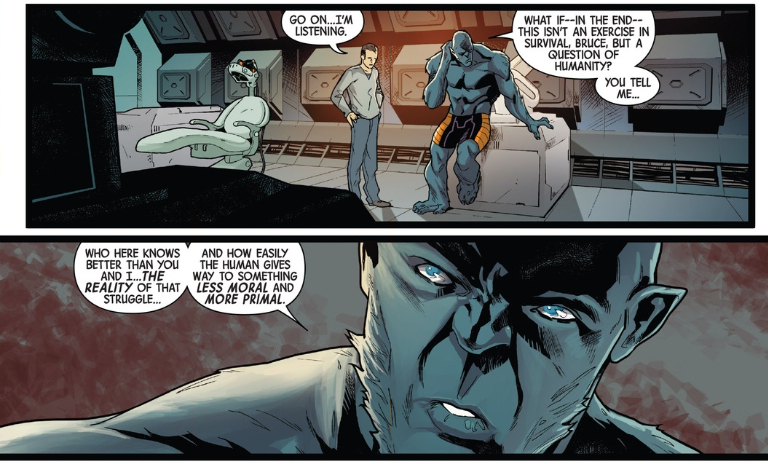
slim-bannerSpencer: The more I look at the following panels, the more I realize how succinctly they sum up the primary conflict of Jonathan Hickman and Valerio Schiti’s New Avengers 19.

Are we monsters, or are we DEVO?The Illuminati are no longer concerned about whether they can stop the Incursions without destroying inhabited worlds (spoiler alert: they can’t), nor are they any longer concerned about their mission turning them into monsters (they seem to have realized that it’s all but inevitable, and the title of this issue is even “We Are All Monsters Now,” as if to dissuade the reader of any hope otherwise); instead, the million dollar question now seems to be whether it’s better to die with one’s morality intact or to save the universe, but at the cost of one’s own soul.

Continue reading

Inhuman 2

inhumanity 2Today, Shelby and Patrick are discussing Inhuman 2, originally released May 28th, 2014

Shelby: Serialized media has it’s pros and cons. I rather like having to wait a bit between installments; as long as the wait isn’t too long, and I know when I’m going to get my next chunk of the story, that waiting period adds delicious tension to the tale. I think it also makes things more special, having to wait for them; anticipation can definitely make things sweeter. But, like everything, there’s a downside to dragging a story out over months; when the reader wonders, “wait, is this still happening?” when we’re only on issue 2 of the book, you know there’s a problem.

Continue reading

New Avengers 18

new avengers 18Today, Spencer and Patrick are discussing New Avengers 18, originally released May 14th, 2014. 

slim-bannerSpencer: As I’m sure most of us do, I love the big, climatic final battles that usually come at the end of superhero stories. That said, I’m perhaps even more fond of the moments before the final battle, the calm before the storm, the time where the heroes prepare and steady themselves for the horrors to come. Many heroes use this as an opportunity to reflect on what they’ve lost or to visit with their loved ones, but the Illuminati — as pragmatic as ever — mainly use it to steel their resolve and to prepare to do the unthinkable. After all, for them this is only the final battle if they lose; if they win, they get to continue on dealing with an infinite number of Incursions. No wonder they’re so grumpy. Continue reading