History as a Weapon (and a Motivation) in America 8

by Spencer Irwin

This article will contain SPOILERS. If you haven’t read the issue yet, proceed at your own risk!

When I was first introduced to America Chavez in the pages of Young Avengers, she was a bad-ass, taciturn woman of mystery. As time has passed, though, we’ve come to learn far more about her personality, her methods, and — especially within the pages of Gabby Rivera and Joe Quinones’ America — her history. She still has the qualities that made me fall in love with her in the first place, but she’s also become more predictable and easier to sum-up.

For example, I took one look at this panel — of America explicitly breaking the rules the moment they’re announced — and thought ‘Yup, that’s America in a nutshell.’ Oubliette the Exterminatrix — the evil who’s been recently stalking America, and who finally makes her move in America 8 — has been paying as much attention to America’s history as readers have, and it gives her just the ammunition she needs to take America down. Continue reading
Silver Surfer 14: Discussion

by Spencer Irwin and Drew Baumgartner

This article containers SPOILERS. If you haven’t read the issue yet, proceed at your own risk!

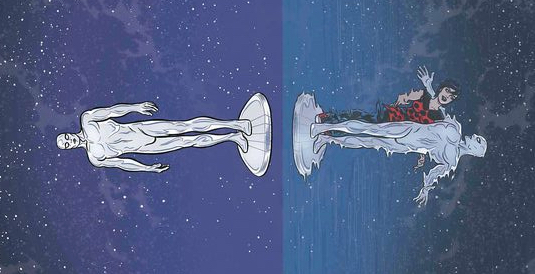
Spencer: When it comes to weaving together long-term plots and storylines spanning years and years, Dan Slott might just be the best there is right now — if not in all of comics, then almost certainly in mainstream superhero books. Silver Surfer 14 is Slott (and Michael and Laura Allred) firing on all cylinders, bringing two volumes’ worth of stories to an immensely satisfying ending. It not only resolves and honors everything that’s come before, but continues to put all the qualities that have made Silver Surfer such a quality read on full display: wonder, adventure, joy, love, and pure emotion — oh, and some metatextual fun, too. Continue reading

The Universal Immigrant Experience in Daredevil 28

by Taylor Anderson

This article contains SPOILERS. If you haven’t read the issue yet, proceed at your own risk!

For a long time, America celebrated the fact that it was a country made up of immigrants. People pointed to visionaries such as Albert Einstein, John Muir, and Hakeem Olajuwon to show that immigrants not only contributed to our country, but led it. However, the narrative around immigrants has changed lately, and, like all things these days, has been politicized. The result of this is that America has forgotten the value of immigrants, and with that has forgotten to care about them as human beings. This, in turn, is what drives Sam Chung to betray Daredevil, but it’s also why it’s so easy to understand why he did it. Continue reading

The (Re)Introduction of Klaw in Black Panther 166

By Drew Baumgartner

Black Panther 166

This article contains SPOILERS. If you haven’t read the issue yet, proceed at your own risk!

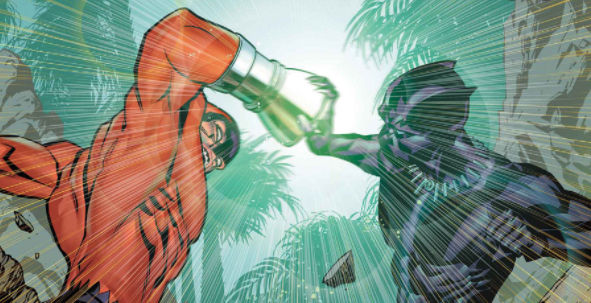
There’s a lot to be excited by in Ta-Nehisi Coates’s Black Panther run, but one we rarely comment on is that it’s bringing in new readers. As an already popular author and journalist, Coates has an established audience that is much, much larger than the typical comics creator. For evidence, we need look no further than his twitter followers, which number 1-3 orders of magnitude more than most comics creators — heck, he has more followers than most comics publishers. And, importantly, the vast majority of those followers (and Atlantic and Between the World and Me readers) aren’t comics readers. I’ve covered plenty of comics in our 7 years as a site, but tweets about Coates’s Black Panther represent the only times I’ve been asked “where can I buy this comic?” And that’s happened multiple times. Coates is bringing new people to the medium, and that’s something special.

Of course, it also puts him in a bit of an unusual place as a writer. T’Challa is a character with a rich, half-century-long history, and comicdom is notorious for fans who know every bit of that history. How do you reconcile the interests of those fans with those of total neophytes? From the start, Coates has struck an elegant balance, acknowledging many specific beats of that history while also creating entirely new mythologies for the character and his world. No one element represents that better than Ulysses Klaw, whose introduction at the end of last month’s issue crashed one of T’Challa’s oldest enemies into that new mythology. Continue reading

Clever Twists Make Bitch Planet: Triple Feature 5 a Standout

by Drew Baumgartner

Bitch Planet Triple Feature 5

This article will contain SPOILERS. If you haven’t read the issue yet, proceed at your own risk!

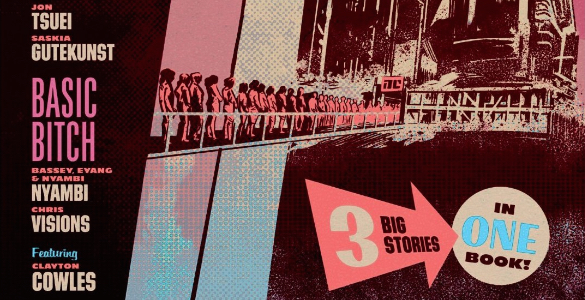
As an anthology series, Bitch Planet: Triple Feature seems to offer a fairly open brief to its contributors: tell an eight-page story set somewhere in the world of Bitch Planet, examining how its entrenched gender and racial biases affect everyday life. But, of course, exactly how those biases manifest in the world of Bitch Planet often needs to be defined in the moment, as these short stories are often venturing into areas yet unexplored by the main series. For these, creators seem to have three primary approaches: 1) present the biases as they appear in the real world with little embellishment, 2) heighten or exaggerate the biases (or their enforcement) that we see in the real world, or 3) invert the biases that we’re familiar with, creating a bizarre reflection of the real world. Issue 5 features all of these approaches, and makes a strong case for each. Continue reading

Purity of Tone in Batman 33

by Patrick Ehlers

Batman 33

This article contains SPOILERS. If you haven’t read the issue yet, proceed at your own risk!

Catwoman: He’s right, you know. There are rules.

Batman: I know. I wrote them.

Batman 33

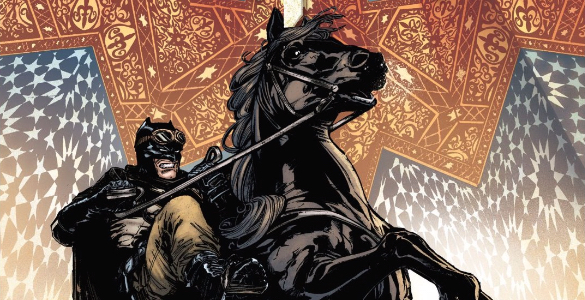
Of course Batman wrote the rules; he’s Batman. But the infallible detective isn’t nearly so authoratative as the creators that have used Batman to repeatedly define both genres and mediums. Is there a better demonstration of superhero camp than Batman ‘66? Is there a purer gritty reboot than Batman: Year One? Within the stories, Batman may be writing the rules of non-interference in Khadym, but from the reader’s perspective, he’s demonstrating writer Tom King’s realignment of Batman’s tone. Continue reading

Generation Gone 4: Discussion

by Ryan Desaulniers and Mark Mitchell

This article contains SPOILERS. If you haven’t read the issue yet, proceed at your own risk!

Ryan D: In the premiere issue of this series, Mr. Akio uses the image of the ouroboros as the symbol for his Project Utopia during his pitch to General West. While this motif appears without much fanfare, it hasn’t been until issue four of Generation Gone that the significance of the serpent eating its own tail begins to fulfill its own inherent meanings. Originally seen as iconography from an ancient Egyptian Book of the Dead, the ouroboros survived through medieval mysticism until finding its home in Renaissance alchemical texts and beyond. Throughout its tenure, it’s represented many things, with the common denominator being duality, and Ales Kot infuses this issue with a multitude of cyclicality and layered recurring through-lines. Continue reading

Tim-21 Goes Full Hero in Descender 25

by Spencer Irwin

This article contains SPOILERS. If you haven’t read the issue yet, proceed at your own risk!

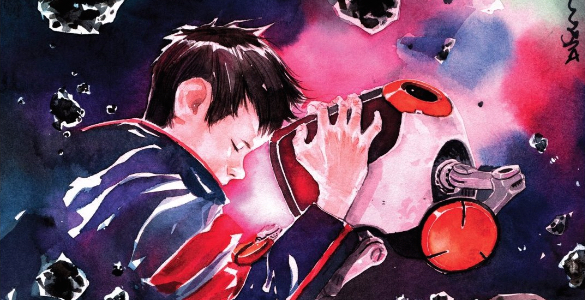
I’ve come to love Descender for a number of reasons: the vast universe and mythology Jeff Lemire and Dustin Nguyen have created, Nguyen’s lush, gorgeous backgrounds and designs, Lemire’s complex characters and intricate web of events. The very first thing that drew me to this series, though, was Tim-21 himself. The concept of a young robot on the run for his life, combined with Nguyen’s adorable design for Tim, immediately made me want to follow this series simply because I felt protective of Tim-21. As the series progressed it found Tim-21 slipping into the background, but Descender 25 serves not only as a grand spotlight for Tim-21, but a testament to what makes him great — and what he may be able to accomplish in the future. Continue reading

Shifting Motives in Kill Or Be Killed 13

By Drew Baumgartner

Kill or be Killed 13

This article contains SPOILERS. If you haven’t read the issue yet, proceed at your own risk!

This time, it’s personal.

Tagline, Jaws: The Revenge

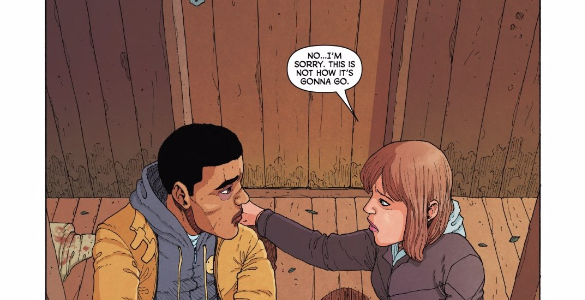
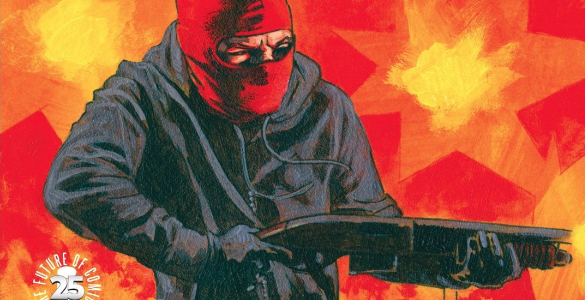
It’s easy to deride “this time, it’s personal” — even without the association with the fourth Jaws movie, the sentiment has always carried with it a kind of self-parody. Or, I should say: that particular articulation of the sentiment has always felt that way. But the notion of a narrative escalating because of personal stakes is essential to virtually all drama (though, admittedly, not every drama has an impersonal/personal threshold that needs to be crossed). Which makes the implied sneer that goes with saying “this time, it’s personal” somewhat unfortunate — otherwise, it would be the perfect way to express Dylan’s newfound motivation for his war on the Russian Mafia. Continue reading

Mythology Bites in Lumberjanes 43

by Taylor Anderson

This article contains SPOILERS. If you haven’t read the issue yet, proceed at your own risk!

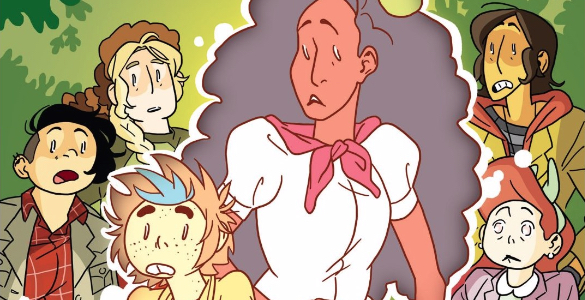
I recently read an article which argued the point that serialized tv is a “disease.” Perhaps a bit hyperbolic, but the author had a good point. In some cases, TV shows forgo quality in the name of developing mythology. My ever-treasured LOST was cited as a prime example of this, and I had a hard time disagreeing with it being so characterized, as I remembered scenes of a church filled with the dead spirits of the show’s main characters. This got me thinking: I’ve always treasured mythology building in my narratives, but does that mean its always good for the story or content? As if to answer this question, Lumberjanes 43 was published and the answer seems to be a mighty, no.

Continue reading