The Poetry of Days of Hate 6

by Drew Baumgartner

Days of Hate 6

This article contains SPOILERS. If you haven’t read the issue yet, proceed at your own risk!

en·jamb·ment
/inˈjambmənt, enˈjam(b)mənt/
noun

  1. (in verse) the continuation of a sentence without a pause beyond the end of a line, couplet, or stanza.

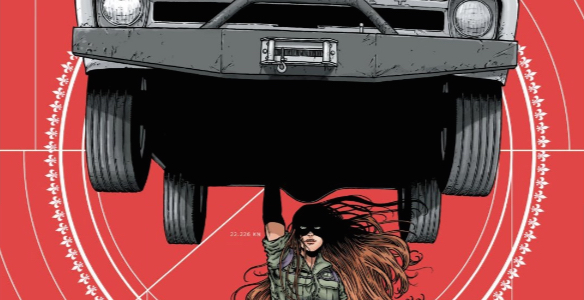
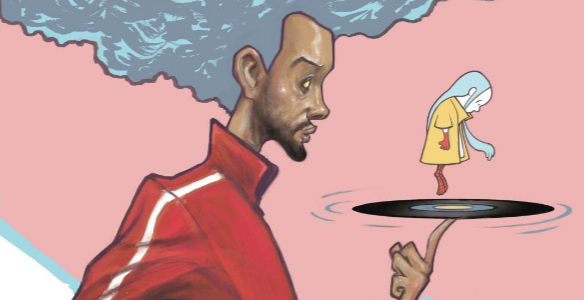
Comics has its share of unique jargon, but much of the vocabulary we use when analyzing it is borrowed. More often than not, we’re borrowing language from the world of film and photography, where we might understand issues of the relative location and sizes of images within the panel as matters of placing a camera in a physical space. We’ll also draw parallels to prose, as the language — and especially narrative modes — of comics can often resemble that of a novel. But prose isn’t the only literary media, and while it’s lamentably rare, comics can draw from the world of poetry, as well. Aleš Kot and Danijel Žeželj’s Days of Hate has always lent itself to elegant turns of phrase, but canny use of the decidedly poetic device of enjambment turns issue 6 into a goddamn love poem. Continue reading

Reaching a Fever Pitch in The Wild Storm 14

by Drew Baumgartner

Wild Storm 13

This article contains SPOILERS. If you haven’t read the issue yet, proceed at your own risk!

I’ve spent plenty of write-ups of The Wild Storm praising Jon Davis-Hunt’s diagrammatic approach to action AND connecting that aesthetic to the interconnected world Warren Ellis is crafting. It’s a remarkably unified vision that has the power to keep even the wordiest talking-head pages engaging (though admittedly, I tend to use big action sequences to illustrate its efficacy). And to be sure, there are definitely some talking-head sequences in this issue, but as the central conflict between Skywatch and IO heats up, the slow simmer that defined the first year of this series is quickly becoming a rolling boil, meaning pretty much every scene is going to feature some action, too. Continue reading

Narrative Efficiency in Captain America 704

by Drew Baumgartner

Captain America 704

This article contains SPOILERS. If you haven’t read the issue yet, proceed at your own risk!

Superhero stories are high-concept endeavors. Beyond the origin of the hero’s powers and commitment to justice, there are villains and supporting characters that might require just as much explanation. Monthly comics tend to smooth this over by taking our knowledge of those high concepts for granted, cramming all of that exposition into a logline on the cover page in order to make room for actual action. It’s a popular solution, so ubiquitous that explaining it in this way feels almost unnecessary. But then we encounter those superhero stories — perhaps it’s a miniseries with a new character or an alternate universe — that have to fit that logline into the story itself, forcing us to recognize just how much explaining really is necessary in the genre. Captain America 704 is one such story, catching us up with (and ultimately thwarting) a multi-generational plan and addressing some long-standing Cap mythology. Continue reading

Peter Parker: the Spectacular Spider-Man Annual 1 Offers a Secret History for J. Jonah Jameson

by Drew Baumgartner

Peter Parker The Spectacular Spider-Man Annual 1

This article contains SPOILERS. If you haven’t read the issue yet, proceed at your own risk!

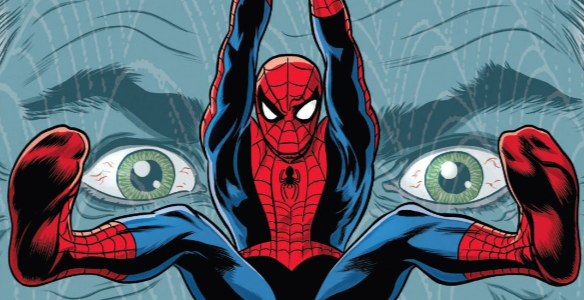
All fictional characters — especially in the compressed world of superhero comics — start as types. It’s only as we spend more time with them that they can be fleshed out into more fully-realized, nuanced characters. But, of course, being a type is often all a given character may need to be. And so, for decades, J. Jonah Jameson was little more than the irritable, muckraking editor of the Daily Bugle. That’s not a failure — it’s all he really needed to be to move the story forward, and he was still plenty entertaining. But as with any character that’s around for the better part of a century, those little glimpses we got of him started to add up, and creators started exploring who he was behind all of that bluster, giving us the JJJ we all know and love. He’s still that irritable muckraker, but we understand that there’s more too him. Indeed, there’s enough there that Jameson can anchor a story himself every now and then, as he does in Peter Parker: The Spectacular Spider-Man Annual 1. Continue reading

Moonshine 11: Discussion

by Patrick Ehlers and Drew Baumgartner

This article contains SPOILERS. If you haven’t read the issue yet, proceed at your own risk!

Patrick: Hey, how fast is a comic? I’ve read twenty-page comics that take me over half an hour to get through, and there are some issues I can breeze through in less than 10 minutes. Some comics take place over the course of 60 in-universe seconds, while others stretch on to tell stories that take entire lifetimes. So the answer to my question is: variable. Brian Azzarello and Eduardo Risso’s Moonshine 11 masterfully commands pacing to create breathless swings between compression, tension and release. Continue reading

Misplaced Trust in Coda 2

by Drew Baumgartner

Coda 2

This article contains SPOILERS. If you haven’t read the issue yet, proceed at your own risk!

There’s a scene in Coda 1 where our protagonist hesitates to smell the wine he’s just been handed — he knows his host too well to trust them. It’s a revealing moment that also cleverly sets up a spiked wine gag a few pages later, driving home the point that nobody in this world can be trusted, least of all the characters we know. And it’s a point Simon Spurrier and Matías Bergara reemphasize towards the start of this issue, revealing their glowing wizard’s tower to be little more than a dank cave. The protagonist’s senses may be as difficult to fool as ever, but now we have to know not to trust our own eyes. And yet, the rest of the issue lulls us into putting our guards down, allowing us to believe we’ve found a refuge from the violence and deceit of the outside world. Which makes it all the more shocking when we learn all of those assumptions were bad, and that there really is no honesty left in this world. Continue reading

Character Drives the Drama in Marvel Rising Alpha 1

by Drew Baumgartner and Ryan Mogge

Marvel Rising Alpha

This article contains SPOILERS. If you haven’t read the issue yet, proceed at your own risk!

Drew: For most of my mid-20s, I worked for an academic summer program — basically, summer camp for nerds. As with most work with youth, the job was both rewarding and frustrating, with unexpected problems often interrupting the flow of what we might imagine a “normal” day to be. Indeed, those unexpected problems came up so regularly, that my boss’s regular refrain was “don’t let the urgent crowd out the important” — that is, don’t forget the part of the job that isn’t putting out fires. It’s straightforward advice, insisting that every part of the job is important, but I think it’s particularly salient when dealing with kids — you don’t want the loudest, most poorly-behaved students to command all of the attention, as the quiet, well-behaved students might be struggling just as much. It’s a hard balance to strike, especially for the college-aged students we hired as instructors, so I understand exactly why Doreen Green makes the missteps she does in Marvel Rising: Alpha 1. Continue reading

Eternity Girl 4 Skips Through the Comics Multiverse

By Drew Baumgartner

Eternity Girl 4

This article contains SPOILERS. If you haven’t read the issue yet, proceed at your own risk!

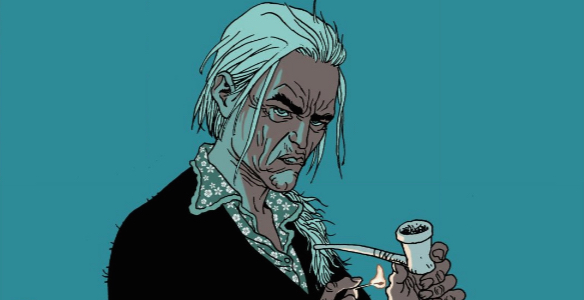
Comics critics are bad at talking about art. I suspect there are a few overlapping causes — some critics are diehard fans of specific characters, so are more invested in what happens to those characters than they are acknowledging that they live in a fictional world created by real human beings; others are (nominally) writers, so are have an affinity towards writing, which doesn’t leave much room (or knowledge) for anything else. And to be clear, I’m not suggesting that I’m any better. As a non-artist, it’s easy for me to get caught up in the most superficial elements of a given artist’s style. Defying that tendency has always been what excites me about artist Sonny Liew. My first exposure to Liew’s work was his original graphic novel The Art of Charlie Chan Hock Chye, which is part biography, part retrospective on a fictional comics artist, requiring that Liew modulate his style between the docudrama and epistolary elements. The effect was downright magical, creating the sense that there truly was a second artist creating all of the diegetic comics. It effectively defies my tendency to pigeonhole an artist based on “their” style. It’s that skill that Liew taps into with Eternity Girl 4, offering us multiple iterations (and styles) of the life and times of Caroline Sharp. Continue reading

Doom’s Secret Origin in Marvel Two-In-One Annual 1

By Drew Baumgartner

Marvel Two-in-One Annual 1

This article contains SPOILERS. If you haven’t read the issue yet, proceed at your own risk!

Each is described as being the strongest man in the world and each as battling against “evil and injustice.”

Judge Augustus Hand (writing for the majority)
Detective Comics, Inc. v. Bruns Publications, Inc.

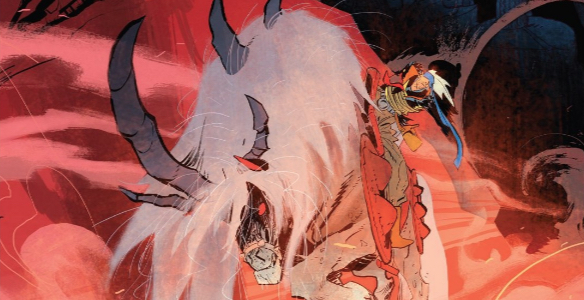
Augustus Hand served on the United States Court of Appeals for the Second Circuit from 1928 to his death in 1953, and just might be the most quoted judge when it comes to the definition of the superhero, owing to the decision he wrote when the Second Circuit ruled that Wonder Man did indeed constitute copyright infringement on Superman. His decision provided a revealing definition for the genre, insisting not just on superpowers, but a selfless, pro-social mission. Indeed, it’s not until after that decision that you see superheroes whose superpowers and pro-social mission are seen as separate things, with perhaps separate origins. That is, while Superman fought crime because he could, and Batman became a superhero specifically to fight crime, Spider-Man only picked up his pro-social mission after Uncle Ben died, well after he’d been using his powers for decidedly less selfless purposes. In that way, we might understand Marvel Two-In-One Annual 1 as a key part of Victor Von Doom’s superhero origin; it’s the story of how he became a good guy. Continue reading

A Mid-Issue Shift Elevates Hunt for Wolverine: Weapon Lost 2

By Drew Baumgartner

Hunt for Wolverine Weapon Lost 2

This article contains SPOILERS. If you haven’t read the issue yet, proceed at your own risk!

Listen, I know there were crime procedurals before Law & Order (and there have been plenty since), but that show was such a mainstay of my formative pop-culture years that I can’t help but think of it every time I encounter a new fictional criminal investigation. What’s remarkable to me about that show is how entertaining it could be in spite of having an entirely rote structure (it was so set in stone, in fact, that they decided to enshrine it in the very title of the series). That is, the drama was never in whether they caught the culprit (they always did), or whether they would be convicted (they were found guilty or pled out the vast majority of the time), but in how they did it — or more precisely who was doing it. Individual details of the case might be interesting, but only inasmuch as they prompted quips from Briscoe or righteous indignation from McCoy. The procedural is an excuse to watch detectives do what they do best, so giving those detectives big, distinct personalities makes or breaks the whole exercise. In this way, Charles Soule has truly stacked the deck in his favor, cramming four larger-than-life investigators into tight quarters and giving them a hard case to chew on. Continue reading