Knowing Your Opponent in Batman 42

By Spencer Irwin

This article contains SPOILERS. If you haven’t read the issue yet, proceed at your own risk!

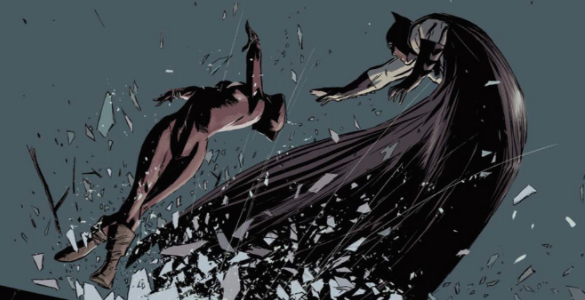
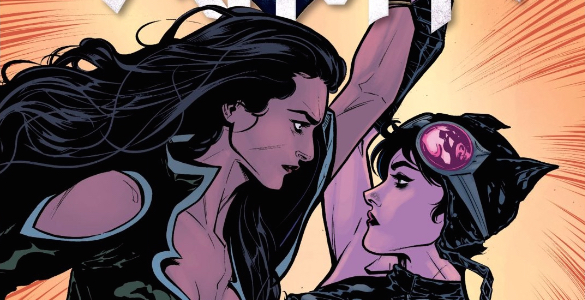
About halfway through my first read of Batman 42, as Poison Ivy (through her minions) dangled Catwoman upside-down from a skyscraper, I suddenly remembered that the two characters are supposed to be friends. As if reading my mind, a few pages later Tom King and Mikel Janin addressed this head-on, with Selina appealing to their friendship and Ivy claiming that Selina doesn’t know the first thing about her. Apparently Ivy’s bid at world domination is meant to be benign, charitable even — a genuine attempt from her to fix the world, to redeem for past crimes. Apparently there was a rock of regret inside her that not even her closest friends and allies knew about — but Batman knows. His entire plan, and his eventual, inevitable victory, revolves around him having nailed down Ivy’s motives and methods. Continue reading

Batman 41: Discussion

by Michael DeLaney and Ryan Mogge

This article contains SPOILERS. If you haven’t read the issue yet, proceed at your own risk!

Michael: The traditional superhero narrative can boil down to “hero is on top, villain arrives and takes over, hero defeats villain and the status-quo is restored.” There will be a period — however long or brief — where the villain has won and all hope is lost. Instead of showing a gradual build to that moment of defeat, Batman 41 starts us off there. Instead of opening with the first act optimism of A New Hope, Batman 41 goes right for the bleak Empire Strikes Back act break. Continue reading

Apologies in Batman 40

By Patrick Ehlers

This article contains SPOILERS. If you haven’t read the issue yet, proceed at your own risk!

Batman: This is new, but I’m trying.
Catwoman: Yes, well, try harder.

Batman 40

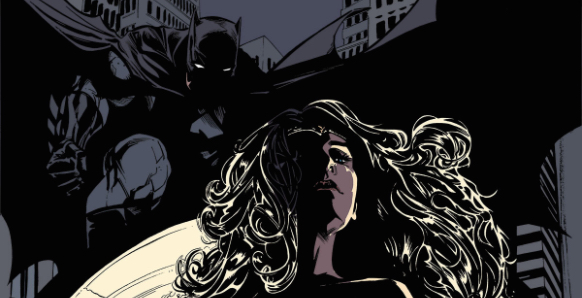
How do we admit our failings? The #MeToo movement is bringing a lot of stories of abuse to light, which means there have also been scores of written apologies. Some don’t use the word “sorry,” some make excuses, some try to deflect with their own surprise admissions. No matter how carefully crafted these statements are, they are all bound to fuck up and fall short. Words do no erase actions. Batman 40 sees creator and creation in similar roles, trying to explain they way they botched handling Wonder Woman. It’s messy, it’s riddled with mistakes, and it’s a genuine expression of how it feels to put your foot in your mouth. Continue reading

Batman 39: Discussion

By Drew Baumgartner and Mark Mitchell

Batman 39

This article contains SPOILERS. If you haven’t read the issue yet, proceed at your own risk!

Drew: Hey, so what is fidelity? I think we all understand the general concept, but the exact borders of the definition are not entirely well defined. If your significant other dies, for example, very few people would classify moving on to another relationship as “cheating,” so we might fairly define “death” as one of the hard edges of fidelity. But what if they’re just presumed dead — say, on a desert island for years and years? Do we consider Helen Hunt’s marriage in Cast Away to be cheating on Tom Hanks? What if it had been Tom Hanks who forged the new relationship (on the island, somehow) — he knows he’s not dead (and could reasonably assume Helen Hunt isn’t), but do the rules of fidelity extend to seemingly hopeless circumstances of languishing in a remote corner of the world? These are certainly unlikely hypotheticals, but unlikely hypotheticals are what superhero comics are all about, and exactly what Batman 39 needs in order to maybe-kinda-sorta justify Batman and Wonder Woman hooking up. Continue reading

The Weight of Influence in Batman 38

By Patrick Ehlers

This article contains SPOILERS. If you haven’t read the issue yet, proceed at your own risk!

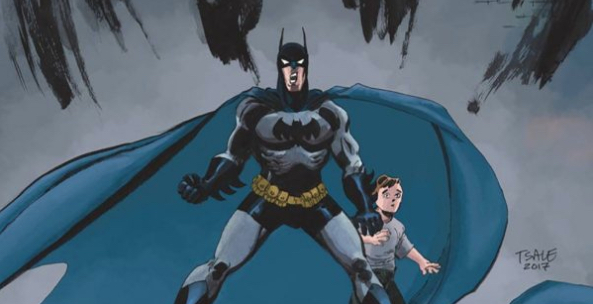
About halfway through Batman 38, Batman discovers a clue that leads him to Dennis O’Neil Avenue. Longtime Batman fans are going to recognize that name, but even relative neophytes are gong to pause at the specificity of that name. Outside of some of the biggest names of the last century — Martin Luther King Jr or John F Kennedy — you’re going to be hard pressed to find a figure who’s full name is up on a street sign. Hell, Chicagoans love Casimir Pulaski, but the north-south thoroughfare that bares his name is simply called “Pulaski Road.” (Though, hilariously, there’s also a brown placard below the street sign designating it “Honorary Casimir Pulaski Road.” It’s a weird town.) But writer Tom King’s use of O’Neil’s full name makes the creators influence on this issue explicit, just as the story itself leans in to one of O’Neil’s pet themes: the psychology of Batman. Continue reading

Batman 37 Knocks it Out of the Park

by Drew Baumgartner

Batman 37

This article contains SPOILERS. If you haven’t read the issue yet, proceed at your own risk!

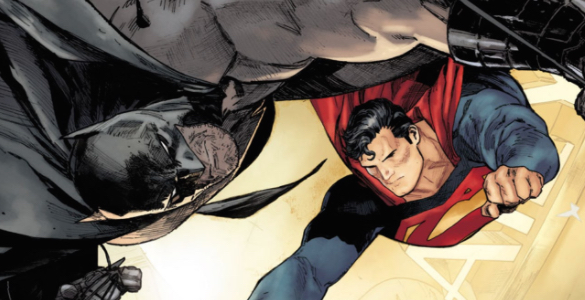
There are lots of reasons to love superhero comics. Maybe you’re in it for the high-wire action or the sci-fi worlds. Maybe you’re in it for the superhuman feats or the super human morals. There are as many reasons to love superheroes as there are superhero fans, but I think at some level, every fan must share some real affection for these characters, and perhaps even a childlike desire to be them. Those aspirations usually exist off the page, taking shape in our minds as we read, but Tom King and Clay Mann have found an elegant way to address the phenomenon in-universe: making Batman and Superman fans of one another. Continue reading

Batman 36: Discussion

By Spencer Irwin and Mark Mitchell

Batman 36

This article contains SPOILERS. If you haven’t read the issue yet, proceed at your own risk!

Spencer: Is Bruce Wayne the mask, or is Batman? Which one is “real”? It’s a long-standing debate amongst the comic book community, and given the myriad of different interpretations of the character, probably one that will never have a definitive answer. My own feelings about this question have shifted and evolved over time, but if you asked me right this second, I’d say that both Bruce and Batman are masks of sorts — the millionaire playboy and the dark knight, respectively. We don’t see him too often, but there’s a real Bruce beneath both those facades, one with real human emotions that often get buried beneath the weight of his own mythology. The best parts of Tom King’s run on Batman have been the moments where he’s let that real Bruce shine through, and more than anything it’s been Catwoman who has allowed this Bruce to do just that. In Batman 36, King adds another tool to his storytelling arsenal that similarly cuts right to Batman’s hidden humanity: his best friend, Superman. Continue reading

Near the Beginning and at the End in Batman Annual 2

by Michael DeLaney

This article will contain SPOILERS. If you haven’t read the issue yet, proceed at your own risk!

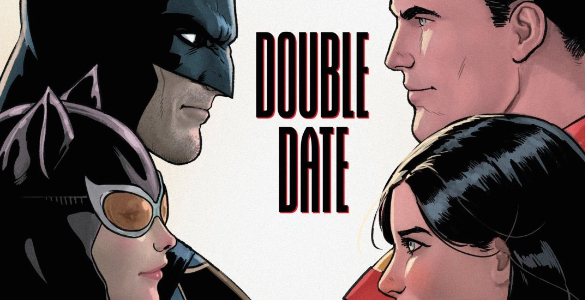
If you haven’t been paying much attention, Tom King is a big shipper of Batman and Catwoman. In Batman Annual 2, King forgoes any direct connection to his current Batman run and instead writes a Batman/Catwoman tale that functions as the first and last word on the couple. Continue reading

DC New Talent Showcase 2017

It’s the 2017 DC Comics New Talent Showcase! To cover it, Retcon Punch has assembled our finest old talent to say something about each of these stories.

slim-banner4 Continue reading

Challenging Batman’s Central Conceit in Batman 35

by Drew Baumgartner

Batman 35

This article contains SPOILERS. If you haven’t read the issue yet, proceed at your own risk!

For all of the impossible technology, the men made out of shapeshifting clay, the resurrection pits, and the shark repellant, the biggest narrative conceit in any Batman story is the idea that an orphan’s single-minded decision to literally fight crime is somehow noble or laudable. For all of the attempts to “ground” Batman over the past few decades, from Batman: Year One to Christopher Nolan’s “Dark Knight” trilogy, none have deigned question that conceit. It’s too central to who Batman is — he arguably wouldn’t work without it. At least, questioning that conceit wouldn’t work with the kind of grim seriousness of those takes seem to take for granted with the character. By contrast, Tom King has always been willing to embrace the absurdity of Batman, the over-the-top everything that makes him fun, but with a self-awareness to admit that it’s also kind of silly. It’s long been the source of solid laughs for King’s run, but issue 35 hinges its most important emotional moments on that silliness. Continue reading