Scaling Back in X-Men Red 2

by Patrick Ehlers

This article containers SPOILERS. If you haven’t read the issue yet, proceed at your own risk.

Last time we wrote about X-Men Red, Spencer and Ryan saw the series as somewhat foundational — asserting the attributes that makes an X-Men comic and X-Men comic. That means both the soapy sci-fi details of the characters’ pasts and the political commentary were turned up to 10. The scale for both was just huge — I mean, Jean addresses the United Nations and was framed for murdering the UK ambassador for crying out loud. X-Men Red 2 continues to engage in the same kind of character- and political-work, while scaling back to considerably more personal levels, and the result is almost intimate. Writer Tom Taylor and artist Mahmud Asrar have such a strong handle on these characters’ voices, the moments don’t need to be huge to make them impactful. Continue reading

Rogue and Gambit 1: Discussion

by Mark Mitchell and Ryan Mogge

This article contains SPOILERS. If you haven’t read the issue yet, proceed at your own risk!

Mark: There’s a thin line between romantic pursuit and creepy, unwanted attention, and fan favorite X-Man Gambit falls too often onto the “creepy” side of that line in Kelly Thompson and Pere Perez’s Rogue and Gambit 1.  Continue reading

The Specificity of Allusions in Deadpool vs. Old Man Logan 3

by Drew Baumgartner

Deadpool vs Old Man Logan 3

This article contains SPOILERS! If you haven’t read the issue, proceed at your own risk.

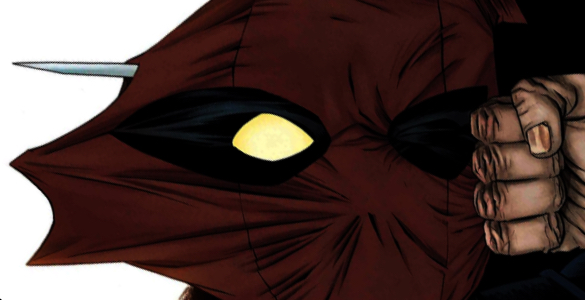
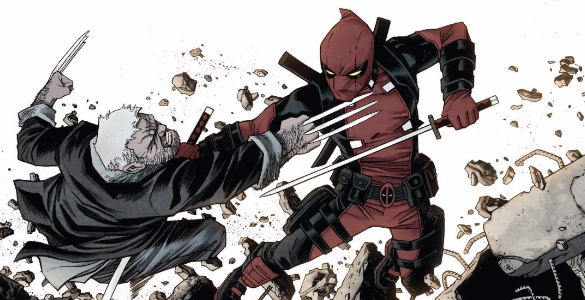
Back in high school english class, I was daunted by the idea that every work of literature alludes to earlier, more foundational works. How could I ever understand the meaning of a novel if I haven’t also read the novels it references, and the novels those reference and so on and so on. I’m still fascinated by the notion that every work of art has an ever-branching family tree of influences, but I’m less concerned about missing them — a work lives or dies on its own merits, so if I don’t “get it,” I’m happy to pin that on the work itself. I have a largely similar attitude to comics, where general familiarity with the character and the world might be a safe assumption, but a given issue can’t take for granted that we’ve read any other comic, let alone one from years ago. And yet, comics also has this rich, ever-growing continuity that can (and some might argue should) inform every character’s identity. Such is the case with Deadpool Vs. Old Man Logan 3, which draws upon writer Declan Shalvey’s own personal history with Wade Wilson in one of the most rewarding ways I’ve seen in years. Continue reading

Cliches and Cutlery in Deadpool vs. Old Man Logan 2

by Michael DeLaney

This article contains SPOILERS! If you haven’t read the issue, proceed at your own risk.

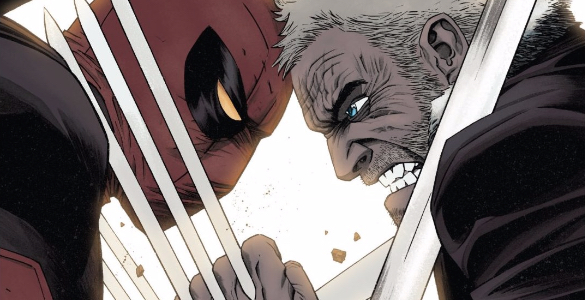
Story models repeat themselves, and that’s not necessarily a bad thing. For me, Deadpool vs Old Man Logan isn’t trying to be anything new or groundbreaking — but then again every comic book is someone’s first. Deadpool vs Old Man Logan 2 uses the X-Men staple of a military organization hunting “the chosen one” while the two mutant former weapons trade quips and shed blood. Continue reading

Deadpool vs. Old Man Logan 1: Discussion

by Michael DeLaney and Spencer Irwin

This article contains SPOILERS. If you haven’t read the issue yet, proceed at your own risk!

slim-banner

Michael: A common criticism of a piece of fiction is “nothing really happened.” The meaning of that blanket statement can vary depending on who the critic is and more specifically what they’re expecting. A great example of this is the Season 3 Breaking Bad episode “The Fly.” Critics praised the bottle episode as a brilliant character study while it left many audiences unimpressed with the fact that “nothing really happened.” While I try to appreciate the deeper meaning of a piece of work, I must say that in Deadpool vs. Old Man Logan 1…nothing really happens. Continue reading

Generations: Wolverine & All-New Wolverine 1: Discussion

by Drew Baumgartner and Michael DeLaney

Generations Wolverine & All-New Wolverine 1

This article contains SPOILERS. If you haven’t read the issue yet, proceed at your own risk!

slim-banner

Drew: Superhero comics have always been about wish fulfillment. We might think of a lot of those wishes (from flying to standing up to bullies) as childish, but adults are far from immune from impossible fantasies. While the wealth and power of many superheroes is certainly appealing, I’m thinking more of the more existential wishes adults may have, at once more fantastical and easier to imagine than leaping tall buildings in a single bound. The most elemental of these wishes might be to have just one more conversation with a deceased loved one. This is exactly the fantasy Tom Taylor and Ramon Rosanas mine in Generations: Wolverine & All-New Wolverine, giving Laura Kinney one last chance to interact with her father. Continue reading

Marvel Round-Up: Comics Released 3/29/17

We try to stay up on what’s going on at Marvel, but we can’t always dig deep into every issue. The solution? Our weekly round-up of titles coming out of Marvel Comics. Today, we’re discussing Inhumans Prime 1, Old Man Logan 20 and X-Men Prime 1. Also, we’ll be discussing Black Widow 12 on Monday and Spider-Woman 17 on Wednesday, so come back for those! As always, this article contains SPOILERS.

slim-banner4 Continue reading

Inhumans v X-Men 6

Today, Patrick and Drew are discussing Inhumans v X-Men 6, originally released March 8th, 2017. As always, this article contains SPOILERS.

“You guys… who are the good guys?”

Ms. Marvel, IvX 4

Patrick: Kamala’s rhetorical question at the end of issue 4 might have been meant to highlight the idea that there are no “good guys” in war, just people living out of various levels of desperation. And that’s definitely true of both the I and X Camps — these are peoples who believe that their survival is contingent on the destruction of the other. What they’re willing to do to each other is resultant entirely from the treat they perceive from their enemies. In effect, everyone is retaliating, acting in self-defense, and therefore the answer to Ms. Marvel’s question is “everyone.” But that’s not true, is it? There is one agent of aggression who has been manipulating all players, X-Men and Inhuman alike. And that person — the sole “bad guy” — is Emma Frost, who defines her identity by the fear she experiences as a mutant.  It’s a heartbreaking fall from grace as the long-suffering White Queen finally succumbs to paranoia and unequivocally cedes the moral high ground. Continue reading

IvX 1

ivx1

Today, Spencer and Patrick are discussing IvX 1, originally released December 14th, 2016. As always, this article contains SPOILERS.

Spencer: Last month’s IvX 0 did a fantastic job of summing up the conflict between the Inhumans and the X-Men and showing why their going to war was only a matter of time. Charles Soule, Jeff Lemire, and Leinil Francis Yu’s IvX 1, though, is the issue where that powder keg finally ignites into all-out war, and war…well, war is ugly. IvX 1 plays up the fun of watching these two groups duke it out, but also the pain and sadness inherent in its scenario. Continue reading

IvX 0

ivx-1

Today, Spencer and Drew are discussing IvX 0, originally released November 30th, 2016. As always, this article contains SPOILERS.

Spencer: I don’t know much about my ancestry or heritage other than the fact that I’ve got blood from at least six or seven different European countries in me (I’ve been known to describe my ethnicity as “White Mystery”). Combine that with a family that’s never been all that worried about tradition and you get a guy who just doesn’t care about his culture (if I could even be considered as having one). This is absolutely not the case with the mutants or the Inhumans, though; although the two groups’ concepts of culture and tradition differ greatly, they’re absolutely vital to both camps. That’s something Charles Soule and Kenneth Rocafort make abundantly clear in IvX 0 — the conflict that’s been brewing between them isn’t really about the literal deaths of individuals anymore, but about the possible figurative death of their very ways of life. Continue reading