The Futility of Definition in Inhumans: Judgment Day 1

By Patrick Ehlers

This article contains SPOILERS. If you haven’t read the issue yet, proceed at your own risk!

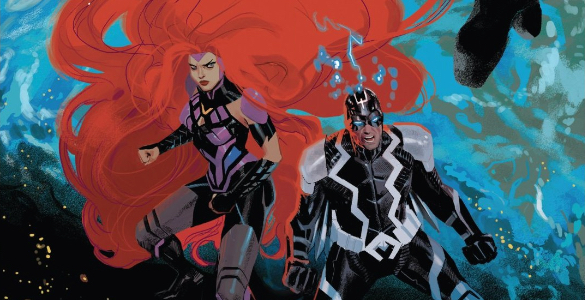
Reading any on-going comic is an exercise in accessing memory. If a writer, or an editor, is feeling particularly generous, there might be a note on the page to jog that memory a bit. Can’t remember what’s up with Karnak? Don’t worry, an editorial note has that addressed. Can’t remember what Swain’s power is? A narration box has your back with a one-word explanation: “Empath.” But these characters are too complex for that, right? Al Ewing’s Inhumans: Judgment Day 1 explores the limits of definition as it applies to a cast of characters that is both constantly changing, and constantly changing back. Continue reading
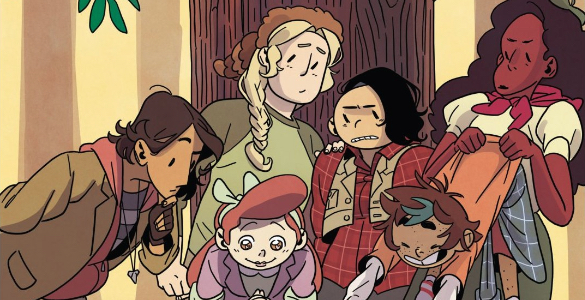
Japanese Influences in Lumberjanes 46

by Taylor Anderson

This article contains SPOILERS. If you haven’t read the issue yet, proceed at your own risk!

Being a middle school teacher helps me keep my ear to ground when it comes to trends that the young folk are into these days. Of these trends, one that seems to be the most popular is manga. Manga isn’t new to American and it certainly isn’t new to pop-culture. However, it has now become a mainstay in youth culture, or are least middle school culture. Most kids have read at least one manga by the time they’re in 7th grade, and it’s safe to say more have read this version of pictoral stories than their American (or European) counterparts. As such, it’s no surprise Ayme Sotuyo is the chosen artist of the Lumberjanes series, as it’s the perfect style for a comic written with young readers in mind.

Continue reading

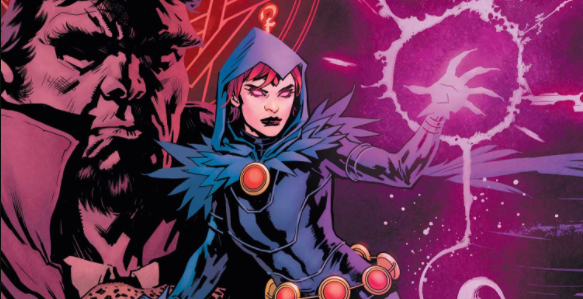
Tapping Into the Raven of Old in Raven: Daughter of Darkness 1

by Spencer Irwin

This article contains SPOILERS. If you haven’t read the issue yet, proceed at your own risk!

When talking about the three new characters he co-created at the outset of The New Teen Titans, writer Marv Wolfman has said that, while he’d probably eventually run out of ideas for Cyborg and Starfire, he felt like he could continue on writing Raven stories forever. I find it sweet and admirable to see how Wolfman has stuck to that nearly 40 years later, continuing to pen the occasional new Raven story even as the character has changed so much from the one he originally conceived.  Continue reading

Abbott 1: Discussion

by Patrick Ehlers and Mark Mitchell

This article contains SPOILERS. If you haven’t read the issue yet, proceed at your own risk!

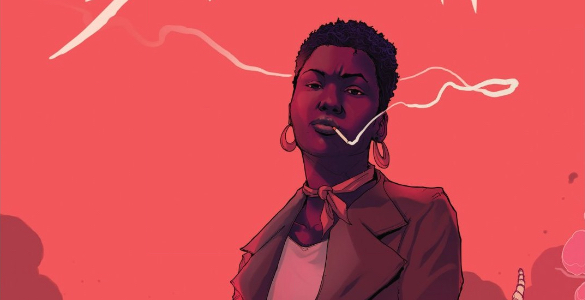
Patrick: I love the moment in every episode of X-Files or Buffy the Vampire Slayer where whatever otherworldly threat our heroes are facing reveals itself to be alarmingly similar to some current societal ill. Sometimes it comes late to the story, and it’s not until two episodes into a three-episode arc that you realize these demons are riffing on toxic masculinity. I suppose that’s been the M.O. for science- and genre-fiction forever: lure the reader in with the hook and then gradually reel them in to the message. Writer Saladin Ahmed and illustrator Sami Kivelä work that formula in reverse in Abbott 1. The setting, a racially divided Detroit in 1972, and the supernatural mystery are slowly collapsed into one cohesive experience. Continue reading

Monster Magic in Marvel Two-In-One #2

by Taylor Anderson

This article contains SPOILERS. If you haven’t read the issue yet, proceed at your own risk!

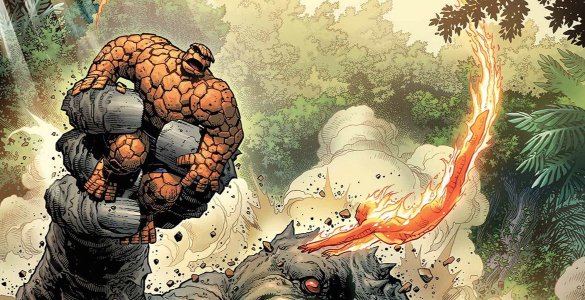
As I read Marvel Two-In-One #2 I realized that I’ve never read a Fantastic Four comic before, which is surprising given how much I love Marvel and their universe. But when I consider it, a Fantastic Four comic is actually somewhat of rarity. It’s been published on and off now for awhile, with its last issue coming out in 2015. This probably has something to do with the Fantastic Four movies, which have done more harm than good to the franchise with their general terribleness. I was prepared for anything in this issue and I’m happy to say I liked it, given the way it hearkens to the roots the series is steeped in (I think). Continue reading

Villains Done In By Their Own Mistakes in Star Wars: Poe Dameron 23

by Michael DeLaney 

This article contains SPOILERS. If you haven’t read the issue yet, proceed at your own risk!

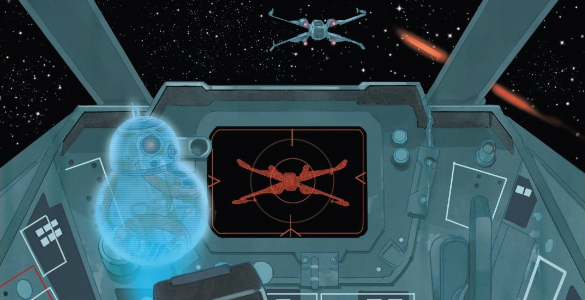
In the battle of good vs. evil, two things are usually true about the bad guys: they are stupid and they are crazy. In Star Wars: Poe Dameron 23, writer Charles Soule gives us some examples of both of these in the First Order agents Malarus and Terex.  Continue reading

Doomsday Clock 3: Discussion

by Spencer Irwin and Michael DeLaney 

This article contains SPOILERS. If you haven’t read the issue yet, proceed at your own risk!

Spencer: What’s the most controversial element of the original Watchmen? For my money, it’s the pirate comics. I understand and appreciate the in-universe reasons for choosing pirates, and I understand their function in reflecting the themes of the story in a sort of parallel narrative, but I’ll admit that, while many readers consider them sacred, I’ve skipped them in all my subsequent Watchmen rereads. To me, those segments have always felt tantamount to the supplemental material in the back of each issue, something extra and non-essential, important more as an intellectual exercise than as an interesting narrative, or an interesting part of the overall Watchmen narrative, in their own right. Issue three of Geoff Johns and Gary Frank’s Doomsday Clock introduces this semi-sequel’s own version of the pirate comics: the noir movie. I have similar issues with these segments as well. Continue reading

Camp, Parody, and Political Edge in Batgirl 19

By Mark Mitchell

This article contains SPOILERS. If you haven’t read the issue yet, proceed at your own risk!

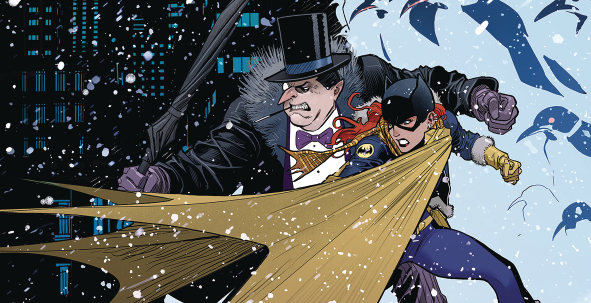
Last July, I wrote at length about Batgirl 13’s full-armed embrace of the campy spirit emblematic of the Batman TV show of the 1960’s, and with Batgirl 19 Hope Larson, Chris Wildgoose, and Jose Marzan Jr. continue to lean into that care-free aesthetic. Continue reading

A New Perspective Benefits Avengers 677

by Spencer Irwin

This article contains SPOILERS. If you haven’t read the issue yet, proceed at your own risk!

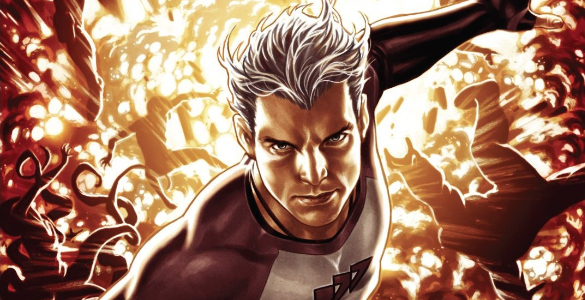
The nice thing about team books is the wide and varied casts that allow the creative team to explore each story from multiple perspectives. The nice thing about weekly series is the sheer amount of space they have to work with, giving them all the time in the world to explore even the most wide and varied of casts. That seems to be the idea behind Avengers: No Surrender. Thus far Mark Waid, Al Ewing, and Jim Zub (with Pepe Larraz on art) have used each issue to explore the perspective of a different Avenger. While the first issue largely used Lightning as an outside POV and the second didn’t lean enough into Falcon’s unique perspective, Avengers 677 digs deep into its spotlight Avenger, Quicksilver. Continue reading

Mighty Thor 703: Discussion

by Taylor Anderson and Spencer Irwin

This article contains SPOILERS. If you haven’t read the issue yet, proceed at your own risk!

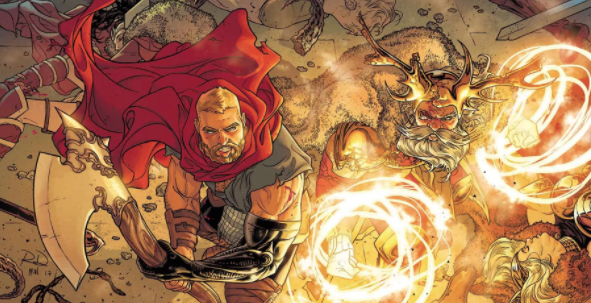
Taylor: One of the hardest lessons to learn growing up is that everything has a cost. This is a particularly difficult lesson to learn because when we’re young, things tend to not really cost all that much, if anything at all. It’s only once we become adults and begin to age that literally everything has some cost associated with it. Want to go out and drink all night? The cost is a hangover. Want to get a master’s degree? The cost is crippling student debt. Heck, even want to find love? The cost is putting in the time and effort to cultivate a meaningful relationship with someone. This isn’t to say that things aren’t worth their cost – love is a good example of something that more than pays for itself. However, the cost of things always has to be collected, as Jane and her friends learn in Mighty Thor 703.

Continue reading