Avengers 1: Discussion

by Taylor Anderson and Drew Baumgartner
This article contains SPOILERS. If you haven’t read the issue yet, proceed at your own risk!

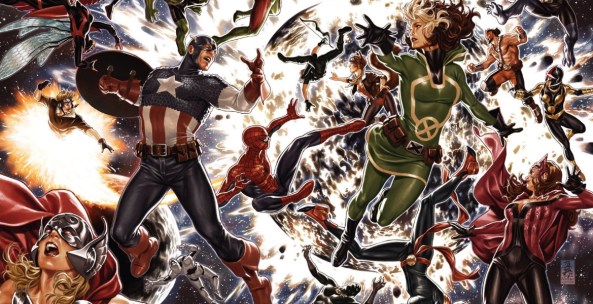
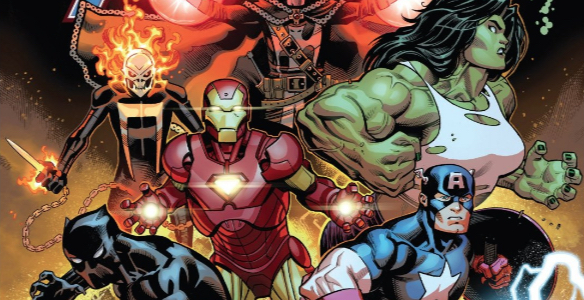
Taylor: In middle school, my favorite book was a archaeology tome titles Ancient Mysteries. The book is exactly what you would think — a survey of all the unsolved mysteries archaeologists have studied such as how the inhabitants of Easter Island made their statues and the relevancy of the Atlantis story. I was entranced by these mysteries because they suggested a history of Earth that was far bigger and far stranger than anything I had imagined up to that point. This was exciting at the time, and to this day my interest is still piqued by random archaeology articles on the BBC. It’s maybe for this reason that Avengers 1 intrigues me so much. It points to a deep, weird history of Earth I want to know more about. Continue reading

The Inevitable in Despicable Deadpool 299

by Patrick Ehlers

This article contains SPOILERS. If you haven’t read the issue yet, proceed at your own risk!

slim-banner

“Always do this. Tell the audience what you’re going to do. Do it. And then tell them it has been done.”

Stan Laurel via Jerry Lewis via Conan O’Brien on Jay Leno’s The Tonight Show

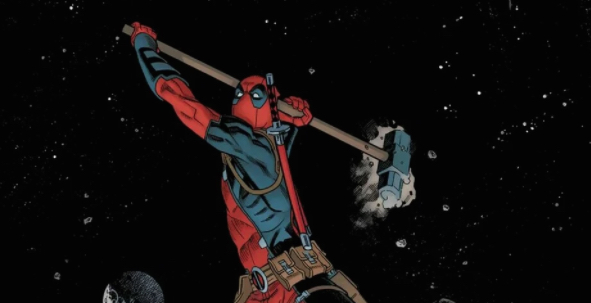
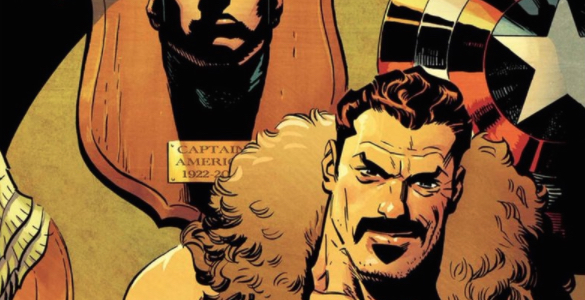
Conan went on to explain, “If anyone knows what the hell he’s talking about, please tell me, because it’s been ringing in my head for years.” It’s a strange piece of advice, especially to be passed down through a line of comedians. Comedy is based on the unexpected, right? But there’s another kind of humor that comes from obviously broadcasting what’s about to happen and then delivering on it. It’s a kind of dramatic irony — the audience knows what’s going to happen only because of their superpower of being an audience. Despicable Deadpool plays into the dramatic irony of the title “The Marvel Universe Kills Deadpool,” and quietly asserts that the creative team intends to deliver on everything it’s been setting up for the last three issues. Continue reading

Hope Springs Eternal in Captain America 700

by Drew Baumgartner

Captain America 700

This article will contain SPOILERS. If you haven’t read the issue yet, proceed at your own risk!

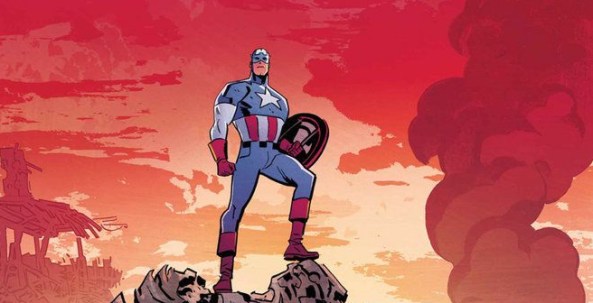
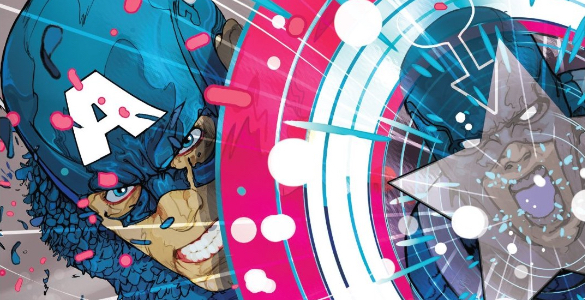
Superheroes don’t get endings. They might die, sure, but are inevitably resurrected months, years, or decades down the line. And they’re brought back for the same reason superheroes don’t get endings: there’s always another story to tell (and another dollar to be made telling it). Fans may sometimes get jaded about this — especially when a hero is killed off for the umpteenth time — but that lack of closure keeps superheroes in a holding pattern in the middle of the hero’s journey. They may have momentary successes, sure, but they never get to kick up their heels at the end of a career well-served. You know, unless you can find some kind of alternate universe/timeline workaround that allows your hero some sense of closure while still allowing him to carry on the fight tomorrow. That’s exactly the kind of workaround Mark Waid and Chris Samnee cook up in Captain America 700, giving Steve the kind of heroic end he can only have if there’s some kind of trick. Continue reading

Culminating Repercussions in Despicable Deadpool 296

by Drew Baumgartner

Deadpool 296

This article contains SPOILERS. If you haven’t read the issue yet, proceed at your own risk!

Are reverence and irreverence mutually exclusive? Linguistically, we might understand these words as opposites, but practically, we recognize that they coexist all around us. This is especially true in standup comedy, a field that both finds humor in what we take seriously and takes what we find funny very seriously. It’s no coincidence, then, that Gerry Duggan’s Deadpool run has had such a rich mix of reverence and irreverence, adopting some of the “sad clown” stylings of his comedic friends and collaborators, lending an otherwise goofy character real pathos. Indeed, one of the most distinctive features of Duggan’s work with this character was in crafting a tragic (but nonetheless joke-filled) backstory that could lend itself to reverence. With issue 296, Despicable Deadpool aims to cash in on much of that reverence, drawing on everything from Duggan’s earliest work with the character to some of his most recent. Continue reading

The Burden and Joy of Public Service in Captain America 699

by Drew Baumgartner

Captain America 699

This article will contain SPOILERS. If you haven’t read the issue yet, proceed at your own risk!

For many superheroes, superheroics are a means of righting some cosmic injustice — the death of a loved one a the hands of a criminal, for example. Indeed, that particular motivation is so ubiquitous, it’s easy to forget that many heroes are motivated not out of some personal vendetta, but because they feel morally compelled to help when they can. We tend to think of Spider-Man (death of a loved one at the hands of a criminal notwithstanding) for that kind of power/responsibility stuff, but I’ll suggest that Captain America might embody those ideals even more thoroughly. For Cap, superheroing is a public service, no different from volunteering at a soup kitchen or picking up trash at your local park. He’s able to make the world a better place by being Captain America, so he has to be Captain America. Again, it’s not an attitude that’s entirely unique to Steve Rogers, but as Mark Waid and Chris Samnee crank that aspect up to eleven in Captain America 699, it’s hard to imagine any other character living that ideal so perfectly. Continue reading

Disposable Supporting Characters in Despicable Deadpool 295

by Michael DeLaney

This article contains SPOILERS. If you haven’t read the issue yet, proceed at your own risk!

In the world of popular fiction, there’s a very low risk of the main characters — or the most recognizable ones — dying. We know that our protagonists are safe in any given story, so there’s a higher likelihood that any supporting cast member will meet their end. As entertaining and touching as Despicable Deadpool 295 is, I can’t help but feel that it’s just another story where the characters we like stay safe while the nameless ones die off. Continue reading

Dystopia in the Not-So-Distant Future in Captain America 698

by Spencer Irwin

This article will contain SPOILERS. If you haven’t read the issue yet, proceed at your own risk!

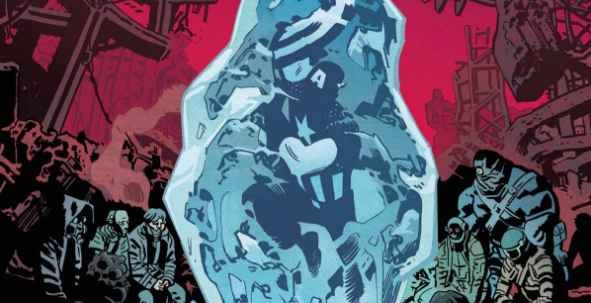
I was raised on classic television, and as a kid I remember always getting a big kick out of the fact that the original Lost in Space series took place in the “distant future” of 1997. As a general rule, ascribing a specific date to your fictional future is a great way to rob it of its power and wonder, but Captain America 698 turns that rule completely on its head, finding its most effective twist in the “when” of its dystopian future. Continue reading

Avengers 675: Discussion

by Drew Baumgartner and Michael DeLaney

Avengers 675

This article contains SPOILERS. If you haven’t read the issue yet, proceed at your own risk!

Drew: The Marvel Universe is big. That much is clear from the very beginning of Avengers 675, which skips across the globe to catch up with Marvel’s countless superhero teams and fictional countries as they deal with the Earth suddenly being transported…somewhere. Characters helpfully repeat each other’s names (and the names of their respective teams) to orient us, but being overwhelmed is kind of the point — these characters are facing down utter chaos, and that chaos is everywhere. Crossover events will often feature these kinds of “cash in all the chips” moments, straining our familiarity with Marvel’s lesser-known characters to really sell the massive scope of the story. But that’s where this issue differs from the standard crossover; where other stories simply revel in the bombast of throwing all of these characters together, Avengers 675 uses it as a cover to inject a new character into the narrative. [Phew, are there SPOILERS to follow.]  Continue reading

The Inelegance of Grief in Black Bolt 9

By Patrick Ehlers

This article contains SPOILERS. If you haven’t read the issue yet, proceed at your own risk!

I just finished reading Who Killed My Daughter?, fiction writer Lois Duncan’s real life account of her daughter’s murder in 1989. It’s less a narrative, and more a collection of interviews with police, transcriptions from psychic readings, re-printed newspaper articles, and half-remembered conversations with loved ones. But the book opens and closes with the saddest, richest, most beautiful and heartbreaking mediations on love, loss and acceptance I’ve ever read. The explicitly stated point of the book was to bring tipsters out of hiding, to provoke someone who knew something to come forward, but for these moments, Duncan nakedly expresses her feelings. The truth is, the mess of primarily source documents that pad WKMD‘s page count add immeasurably to the expression of Duncan’s grief, because that’s what loss is — confusion, contradiction, a mess. Saladin Ahmed and Christian Ward’s Black Bolt 9 embraces that same messiness to say farewell to Crusher Creel.  Continue reading

An Attack on Steve’s Morality in Captain America 697

by Spencer Irwin

This article will contain SPOILERS. If you haven’t read the issue yet, proceed at your own risk!

Mark Waid and Chris Samnee’s take on Captain America is already drastically different from Nick Spencer’s that preceded it, doling out mostly episodic adventures in comparison to the one long story Spencer told, and focusing less on actual politics and more on the idea of Steve Rogers being a good and righteous man, and trying to inspire others to be the same. The return to simpler, more swashbuckling tales has been a nice palate cleanser, especially as readers reacquaint themselves to the original, non-Hydra version of Cap, but I’m hoping we get something a little more substantial sooner rather than later. Continue reading