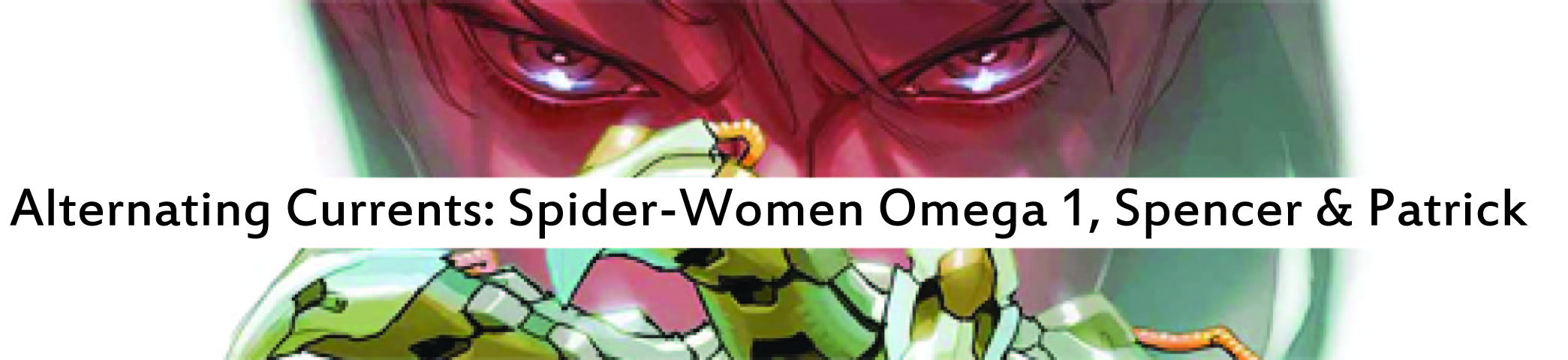
Spider-Women Omega 1

spiderwomen omega 1

Today, Spencer and Patrick are discussing Spider-Women Omega 1, originally released June 1st, 2016.

Spencer: In the letters at the end of Spider-Women Omega, writers Dennis Hopeless, Jason Latour, and Robbie Thompson all touch upon one of the primary elements that has made this crossover so strong: its focus on character-driven storytelling, not spectacle for spectacle’s sake. Spider-Women‘s grand finale sticks with this winning formula, leaving every character in a far different state emotionally than they were at the story’s beginning. Continue reading

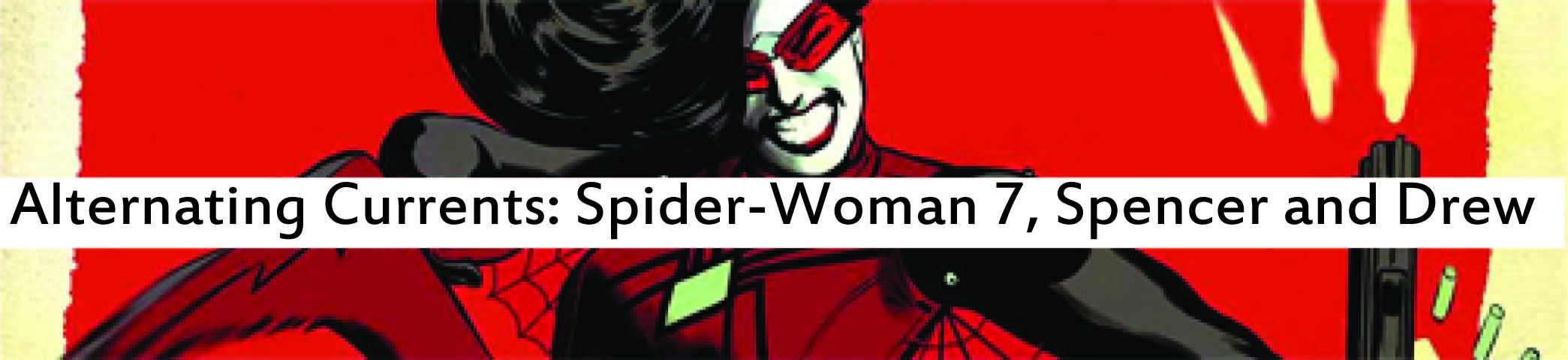
Spider-Woman 7

spiderwoman 7

Today, Spencer and Drew are discussing Spider-Woman 7, originally released May 18th, 2016.

Michael: “What comes before anything? What have we always said is the most important thing?”
George Michael: “Breakfast?”
Michael: “Family.”

Arrested Development

Spencer: Family is a common theme in most works of fiction, but that makes sense — everybody has a family, and for better or for worse, they tend to become inextricably intertwined with our personalities and our view of the world. “Family” has been a major theme of the “Spider-Women” crossover as well, and not just because Jessica Drew’s a new mother. Every single Spider-Woman here — as well as our one kinda-sorta “Spider-Man” — is defined and driven, in one way or another, by their relationship with their family. Continue reading

Silk 6

silk 6

Today, Taylor and Spencer are discussing Silk 6, originally released March 16th, 2015.

Taylor: Many of the stories I’ve encountered in my time reading comics exist in a world that is split into two halves. There are those who are good and those who are bad. S.H.I.E.L.D. vs. Hydra. The Light Side vs. the Dark Side. While these worlds are the setting for compelling stories, they aren’t necessarily a reflection of our own world. It’s rare today that something or someone can be considered entirely good or evil. Silk 6 recognizes this, and in doing so, shows us that sometimes choosing between right and wrong isn’t as easy as most comics would have us believe.

Continue reading

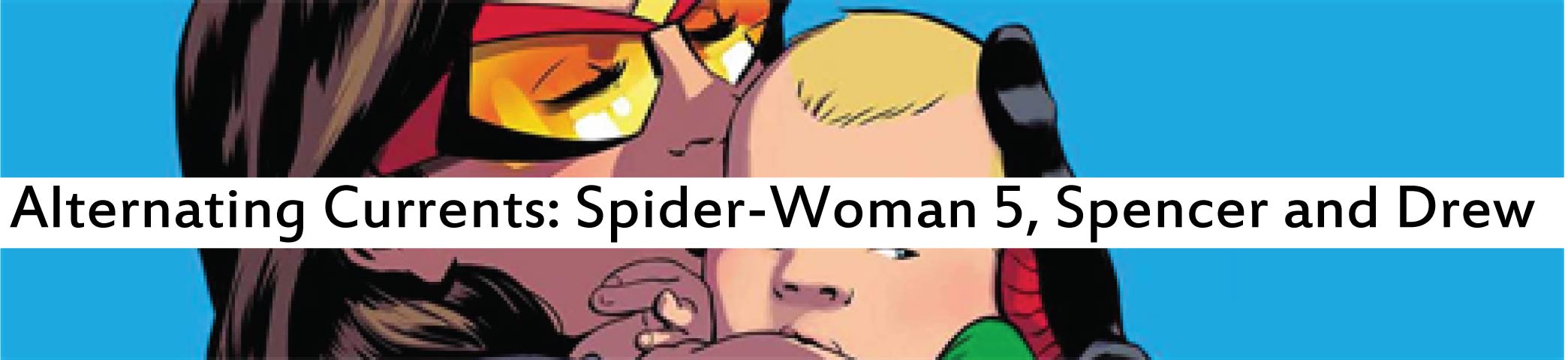
Spider-Woman 5

spiderwoman 5

Today, Spencer and Drew are discussing Spider-Woman 5, originally released March 16th, 2016.

Spencer: I’ll admit that, much like Clint Barton, I never took Jessica Drew for the motherly type — she’s always been such a socially awkward, work-oriented character that it just felt like a poor fit to me. Still, Dennis Hopeless and Javier Rodriguez’s first volume of Spider-Woman was so strong that it seemed likely they could sell me on Jessica Drew as a mother, or at least get a good story out of it. Boy, was that an understatement. This first arc of the rebooted Spider-Woman has been astounding, but this week’s issue 5 is especially powerful. Not only do Hopeless and Rodriguez make a convincing argument for “Jessica Drew as a mother,” but they present such a compelling take on parenthood that their editor actually feels it necessary to include a disclaimer on the letters page! That’s some good stuff, there. Continue reading

Spider-Woman 10

spider-woman 10

Today, Spencer and Taylor are discussing Spider-Woman 10, originally released August 26th, 2015.

Spencer: I’m a suburban kid at heart, but I also really enjoy the city. That makes me a bit of an outlier amongst my extended family, which is filled with farmers and country folk. I dunno, I just enjoy having people and places close to my home — the quiet and sparseness of the country creeps me out big time. No matter which end of the spectrum you fall on, though, it’s obvious that there’s a drastic difference between the city and the country. In Dennis Hopeless and Natacha Bustos’ Spider-Woman 10, those differences have come to represent Jessica Drew’s dual lives. The city — New York City, to be exact — is Jessica’s old life as an Avenger, a complicated life full of chaos, while the strange simplicity of her new life as a P.I. is perfectly — and quite literally — represented by the American Midwest. It’s crystal clear which of those lives Jess prefers, but with the end of the world approaching, she doesn’t really have a choice as to which one she must live. Continue reading

Hawkeye 22


Today, Drew and Jack are discussing Hawkeye 22, originally released July 15th, 2015.

Drew: Endings are hard. Whether they break our hearts or leave us wanting more, even the most satisfying ending must face the bittersweet truth of being the end. “The End” takes on a peculiar meaning in the world of month-to-month comics (especially where the next volume may already be a few issues in), but whatever we’re saying goodbye to — whether its a paradigm or a creative team — can still have an almost hallowed air of significance. This makes talking about comic book endings in a issue-by-issue format particularly difficult, as its tempting to use the final issue as a platform for talking about the series as a whole. I absolutely want to talk about Matt Fraction’s Hawkeye run as a whole, but I want to first give issue 22 its due respect as perhaps the perfect distillation of what made his run so remarkable. Continue reading

The Amazing Spider-Man 14

amazing spider-man 14

Today, Patrick and Drew are discussing The Amazing Spider-Man 14, originally released February 11th, 2015.

Patrick: Were any of you paying attention to Twitter when they announced that Spider-Man would be appearing in the Disney Marvel movies? It was surreal: like a piece of super-fan-fantasy mutated into a news item and enthusiastically expressed itself in the middle of the night. On my feed, no one more more elated by this news than Amazing Spider-Man writer Dan Slott. He filled twitter with all-caps celebrations — not because he had anything to do with negotiating this deal (nor will he have any role in developing Peter Parker’s role in the MCU), but because he’s a goddamn super-fan. As the impresario and master weaver of Spider-Verse, Slott has had the opportunity to shout his love for all the Spiders from the heavens, and in issue 14, he goes out swinging, symbolically ceding his own control over the Spiders back to the characters themselves. Continue reading

Hawkeye 21

Alternating Currents: Hawkeye 21, Drew and Spencer

Today, Drew and Spencer are discussing Hawkeye 21, originally released February 4th, 2015.

I shall not today attempt further to define the kinds of material I understand to be embraced within that shorthand description; and perhaps I could never succeed in intelligibly doing so. But I know it when I see it…

Justice Potter Stewart

Drew: I’ve never been a fan of classifications in art. I could go on at length about how sub-subgenres eventually become too specific to have any utility, while broader classifications face the opposite problem of being to general, but my real issue is that our definitions fall apart under scrutiny. We tend to accept the kind of “I know it when I see it” definition of basically every category we have, from gender to genre, but most working definitions have to allow for so many exceptions that they lose all meaning. Take “superhero” for example. We all have a lose idea of who a superhero is, what they do, how they act, but to try and pin down the definition reveals that none of those things are fixed. Are they heroic (courageous, noble, selfless)? Many are, sure, but there are plenty of antiheroes muddying up any moral definition. What about superpowers? Again, lots do, but with so many non-powered superheroes, it’s hardly a criteria. The closest I can come up with is based on our relationship to superheroes — namely, that we expect their actions to lead to their success. In that way, I’d like to posit Clint Barton — particularly as depicted in Matt Fraction and David Aja’s Hawkeye — as an antisuperhero. Continue reading

Avengers 40

Alternating Currents: Avengers 40, Drew and Mark

Today, Drew and Mark are discussing Avengers 40, originally released January 14th, 2015. 

The more I love humanity in general, the less I love man in particular

Fyodor Dostoyevsky, The Brothers Karamazov

Drew: I think it would be fair to say that Dostoevsky’s polyphonic style — one built upon the perspectives of an array of characters — is antithetical to the notion of the hero’s journey. Indeed, Dostoyevsky’s philosophies (as articulated in the quote above) suggest that there’s an active tension between caring about an individual and caring about humanity at large. I’ve always been partial to the depth of understanding achieved by sticking with one protagonist — especially when it comes to comics — which has made me wary of the kind of expansive, Dostoyevskian scope of Jonathan Hickman’s Avengers. In my mind, a tight focus on a single character more accurately reflects how we experience the world, but with Avengers 40, Hickman makes a compelling case for how his dense interconnectedness reflects how the world actually is. Continue reading

The Amazing Spider-Man 12

Alternating Currents: Amazing Spider-Man 12, Drew and Patrick

Today, Drew and Patrick are discussing The Amazing Spider-Man 12, originally released January 7th, 2015.

Drew: Last week, Patrick and I spent a good ten minutes laughing about The Comic Archive’s “Marvel Movie Omnibus” — that is, all of the Marvel Studios films leading up to and through the end of The Avengers compiled into one mega-movie. Never mind that the thing weighs in at an ungainly 12-hour play-time, what really amused us was the steamrolling of narrative cohesion in favor of what the video description calls “correct story order.” I’ve always been a bit peeved when fans are more concerned with how stories fit together than whether they’re emotionally satisfying, and this struck me as the ultimate manifestation of those priorities. Indeed, flashbacks from Thor: The Dark World and Guardians of the Galaxy are included, even though Malekith and Peter Quill don’t otherwise appear in the movie (remember, this only carries through the end of The Avengers), passing over Chekhov’s gun in favor of boneheaded reportage. The result is a work that is so focused on its whole (however unwatchably long it may be) that it fails to offer satisfying servings, such that any movie-sized chunk of it wouldn’t be a satisfying chapter so much as an arbitrary slice of an indivisible monolith. Unfortunately, that’s exactly how I feel about Amazing Spider-Man 12, a slice of “Spider-Verse” that ends up being mostly connective tissue. Continue reading