New Roadblocks to a Burgeoning Friendship in Super Sons 10

by Spencer Irwin

This article contains SPOILERS. If you haven’t read the issue yet, proceed at your own risk!

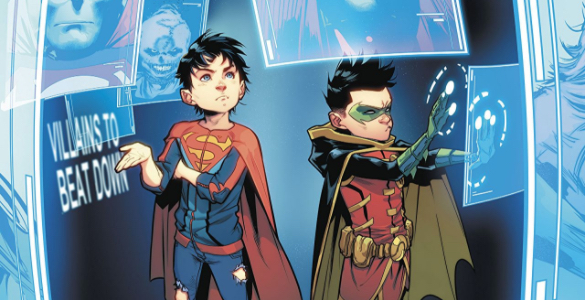
Super Sons 10 is a bit of a breather issue and a “move things into place” issue, neither of which tend to be the most popular installments of any comic series. Personally, though, I feel like this is the mode in which Super Sons operates best — I don’t follow this series because of the plot, I follow it because I love seeing Damian and Jon’s personalities bounce off each other, and that’s 95% of this issue. Peter Tomasi and Jose Luis actually couldn’t have timed this better — with Jon and Damian growing closer and becoming more amicable, it was time to introduce some new challenges for them to overcome and to add a few more hurdles to their burgeoning friendship. Continue reading

Bug! the Adventures of Forager 5: Discussion

By Michael DeLaney and Spencer Irwin

This article contains SPOILERS. If you haven’t read the issue yet, proceed at your own risk!

Michael: Comic book superheroes and their exploits are now more mainstream than ever. We take Kryptonian sun gods, spider-proportionally-strong teenagers, and wise-cracking space raccoons at face value — most likely because they’re presented to us as “real” on the big screen. In the face of this mainstream, watered down mass appeal, I find it important to recognize and celebrate the stories that embrace their truly bizarre and outrageous origins. Case in point: Bug! The Adventures of Forager 5. Continue reading

Challenging Batman’s Central Conceit in Batman 35

by Drew Baumgartner

Batman 35

This article contains SPOILERS. If you haven’t read the issue yet, proceed at your own risk!

For all of the impossible technology, the men made out of shapeshifting clay, the resurrection pits, and the shark repellant, the biggest narrative conceit in any Batman story is the idea that an orphan’s single-minded decision to literally fight crime is somehow noble or laudable. For all of the attempts to “ground” Batman over the past few decades, from Batman: Year One to Christopher Nolan’s “Dark Knight” trilogy, none have deigned question that conceit. It’s too central to who Batman is — he arguably wouldn’t work without it. At least, questioning that conceit wouldn’t work with the kind of grim seriousness of those takes seem to take for granted with the character. By contrast, Tom King has always been willing to embrace the absurdity of Batman, the over-the-top everything that makes him fun, but with a self-awareness to admit that it’s also kind of silly. It’s long been the source of solid laughs for King’s run, but issue 35 hinges its most important emotional moments on that silliness. Continue reading

Intriguing Character Pairings in Teenage Mutant Ninja Turtles/Ghostbusters II 3

by Spencer Irwin

Teenage Mutant Ninja Turtles Ghostbusters II 3

This article contains SPOILERS. If you haven’t read the issue yet, proceed at your own risk!

Crossover stories are meant to be fun, but like all the best stories, they also have the potential to explore and deepen characters in unique ways. Teenage Mutant Ninja Turtles/Ghostbusters II writers Erik Burnham and Tom Waltz take advantage of this opportunity by splitting their two teams up into unique pairings, each with the potential to draw something new out of their characters. Continue reading

Relatable Moments Make For Great Fun in Green Lanterns 35

by Mark Mitchell

Green Lanterns 35

This article contains SPOILERS. If you haven’t read the issue yet, proceed at your own risk!

It’s great to see Tim Seeley having fun again in Green Lanterns 35 after spending so much time in the joy-deprived and muddled world of his Nightwing run, and introducing Bolphunga into the mix lets Seeley cut a little looser than he did in Green Lanterns 34.

Continue reading

Doctor Strange 381: Discussion

By Taylor Anderson and Patrick Ehlers

Doctor Strange 381

This article contains SPOILERS. If you haven’t read the issue yet, proceed at your own risk!

Taylor: There’s a scene in the excellent new Thor movie where the titular character comes face to face with Dr. Stephen Strange. At the time, the scene struck me as kind of weird, even if I enjoyed it greatly. What seemed odd to me at the time was the idea of Norse gods meeting a sorcerer who seemingly hails from a completely different mythology. But as the rest of the movie showed me with its zany and fun plot, there’s no reason why the two mythologies shouldn’t meet. At the end of the day, both Thor and Dr. Strange have super powers, and whether one is or isn’t magic doesn’t seem to really matter. Once I crossed the cognitive divide that these two characters shouldn’t interact, I was totally hooked. The same is true of Doctor Strange 381, because it operates in much the same way. Continue reading

Gwen is Armed with Head Canon in The Unbelievable Gwenpool 22

by Patrick Ehlers

This article contains SPOILERS! If you haven’t read the issue, proceed at your own risk.

Gwen Poole reads comic books; she’s a Marvel fan. This means that she’s held all the conflicting ideas that Marvel fans have been wrestling with for decades — including a bizarre mix of love and hate that comes from a feeling of ownership so many fans carry. In issue 21, Gwenpool proved that she had mastered the medium of comics, but was losing her edge in terms of up-to-the-minute Marvel continuity. Issue 22 furthers that journey, doubling down on her medium mastery powers, while emphasizing the failings of her regressive fandom. Continue reading

Embracing the Strange in Injection 15

by Spencer Irwin

This article contains SPOILERS. If you haven’t read the issue yet, proceed at your own risk!

The Injection’s original purpose was to add some mystery and magic to a boring, mundane world. One could argue whether that’s a good or bad thing all day, but what can’t be denied is that it worked — the world of Injection is far stranger than it was before our protagonists’ original efforts. It takes a special kind of person to not only appreciate that, but to face it head on, and Brigid’s assistant Emma is certainly one of those people. Continue reading

The Burden of “Figuring It Out” in Mister Miracle 4

by Patrick Ehlers

This article contains SPOILERS! If you haven’t read the issue, proceed at your own risk.

There’s really nothing quite like seeing a good close-up magician. As a jaded mega-skeptic, I always convince myself that if I focus hard enough, I can spot the trick. I’m not even sure that I want that–I love being fooled by illusions–but I always try. It feels like a survival tactic: if I can identify the trick, I can rest assured that the universe functions more or less the way I believe it does. If I can’t spot the trick? Well, then how can I ever be guaranteed of what is and is not real? Mister Miracle 4 zeroes in on this idea of focusing harder on what we believe to be a trick. And the truly disquieting thing is, no matter how hard we look, we can’t figure out what’s really happening. Continue reading

Epistolary Irreverence in The Unbeatable Squirrel Girl 26

by Drew Baumgartner

Unbeatable Squirrel Girl 26

This article contains SPOILERS. If you haven’t read the issue yet, proceed at your own risk!

The provenance of epistolary texts are always weird. Actually, it’s probably less weird than traditional narratives, where we might somehow be privy to the private thoughts of the protagonist or even the perspective of an omniscient narrator, but epistolary texts necessarily draw our attention to the weirdness in a way that more traditional narratives don’t. Because we’re reading documents composed within the diegesis of the epistolary narrative, the ostensible writer of those documents are a character, even as the actual writer attempts to become invisible. That tension, between our hyperawareness of the fictional author, and purported obliviousness of the actual author, puts epistolary narratives in this weird netherworld of headspace, embracing the self-awareness of postmodernism in an attempt to produce an entirely un-self-aware story. It’s a concept that already folds in on itself, but writer Ryan North adds a few more wrinkles, confusing the notion of self-awareness enough that the confusion starts to be to point. Continue reading