Action Comics 958

Alternating Currents: Action Comics 958, Drew and Mark

Today, Drew and Mark are discussing Action Comics 958, originally released June 22nd, 2016.

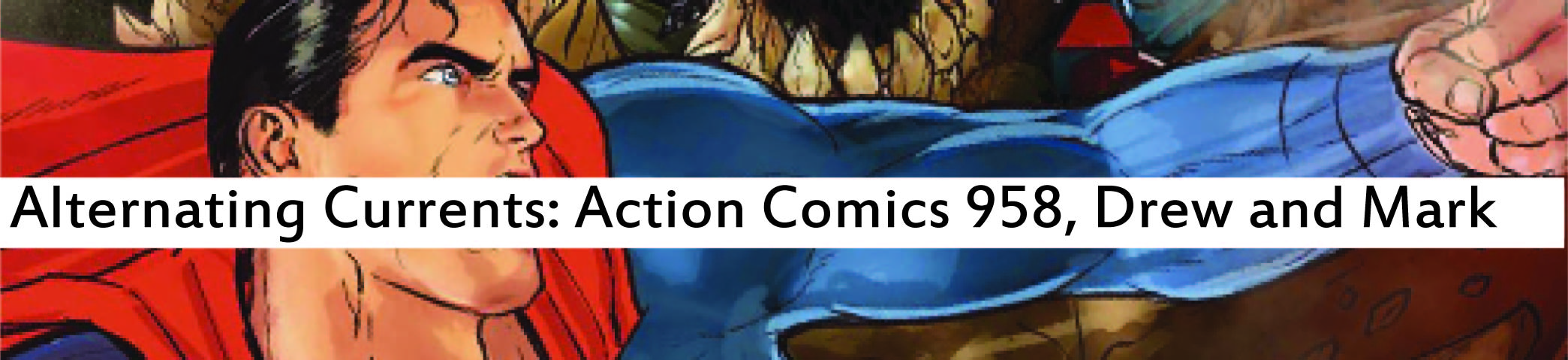
Drew: What kind of themes do you expect of a Superman story? Morality? Alienation? Hope? Love? Over his 75+ year history, Superman has come to represent many ideas beyond that handful of suggestions, but those might serve as a reasonable starting point for the character, describing at least the ballpark he tends to play in. With Action Comics 958 — an issue by its very numbering necessarily recalls a good chunk of Superman stories — Dan Jurgens and Patrick Zircher make a compelling case for voyeurism as a key element of the Superman mythos. Continue reading

Teenage Mutant Ninja Turtles 59

Alternating Currents: Teenage Mutant Ninja Turtles 59, Drew and Patrick

Today, Drew and Patrick are discussing Teenage Mutant Ninja Turtles 59, originally released June 16th, 2016.

Gatsby believed in the green light, the orgastic future that year by year recedes before us. It eluded us then, but that’s no matter — tomorrow we will run faster, stretch out our arms farther. . . . And then one fine morning — So we beat on, boats against the current, borne back ceaselessly into the past.

F. Scott Fitzgerald, The Great Gatsby

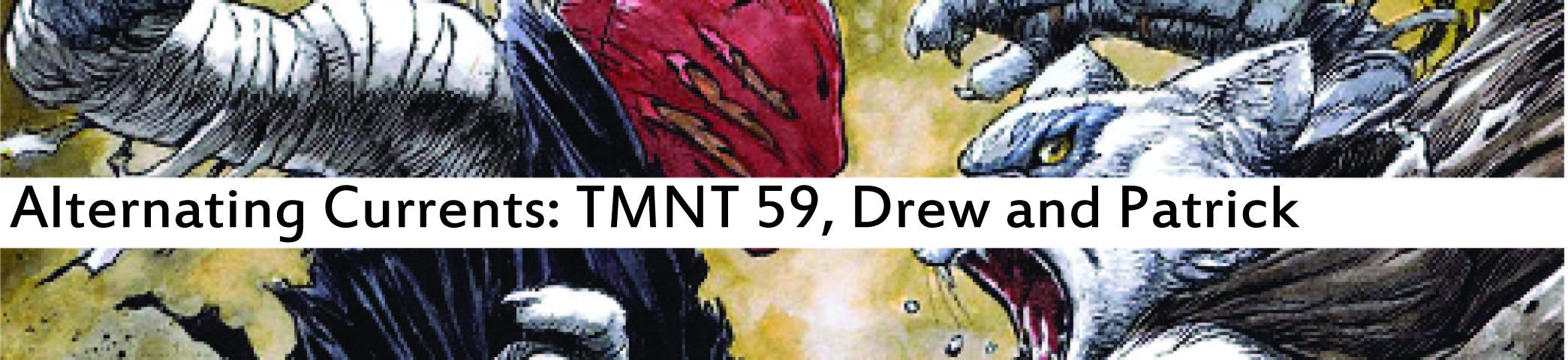
Drew: Symbolism can be a potent tool for any artist, but its easy for a symbol to feel contrived, forcing the audience out of the work. We seek out and create meaning everywhere we look, so there’s no need for a writer to make those symbols too obvious. Curiously, Gatsby’s green light — perhaps the most famous symbol in all of American literature — is explained openly within the text. The reason we don’t reject this explanation as too on-the-nose is that it is Gatsby’s interpretation; that is, he recognizes and interprets the symbolic nature of the green light within his own life. In this way, Fitzgerald isn’t ignoring our ability to create meaning, but celebrating it by giving us a compatriot on the page. We’re looking for meaning, but so is Gatsby. Teenage Mutant Ninja Turtles 59 offers an almost opposite approach to its symbols, emphasizing intention over interpretation, distancing the audience from the text in less-than-flattering ways. Continue reading

Wolf 8

wolf 8

Today, Drew and Patrick are discussing Wolf 8, originally released June 8th, 2016.

Man is a symbol-making and -using animal. Language itself is a symbolic form of communication. The great writers all used symbols as a means of controlling the form of their fiction. Some place it there subconsciously, discovered it and then developed it. Others started out consciously aware and in some instances shaped the fiction to the symbols.

Ralph Ellison

Drew: I distinctly remember asking my high-school English teacher if she really thought writers consciously employ symbolism. In 1963, Bruce MacAllister had a similar question, but rather than pose it to his teacher, he sent a survey to 150 of the most famous living writers asking them about their use of symbolism. I’m less enamored with the emphasis on authorial intent, but I’m absolutely in love with the audaciousness of that move. Or, rather, I’m in love with the fact that so many writers responded — including Ralph Ellison, whose own use of symbolism so frustrated me when I was in high school. Ellison’s comments stood out to me particularly for the allowance he makes for the symbols to take primacy over other elements, turning a literary device into the very point of the work in question. In short, turning prose into poetry. Ales Kot often attains a similar poetic quality, weaving symbols deep into the fabric of his comics. Wolf 8 finds both new and old symbols once again taking the center stage. Continue reading

Bebop and Rocksteady Destroy Everything: Anatomy of Destruction with Sophie Campbell

anatomy of destruction campbell

Bebop and Rocksteady Destroy Everything has a premise that’s just too innately appealing to ignore. There’s something elemental about this pair of boneheads wrecking up the universe, and the pedigree of comics from IDW’s Teenage Mutant Ninja Turtle team suggests that this is going to be some marvelous wreckage indeed. We’re sitting down with five artists that helped contribute to the mayhem to discuss their approach to action.

This week, Drew is talking to artist Sophie Campbell about dinosaur designs, Turtles minutiae, and making demands of her collaborators.  Continue reading

Batman: Rebirth 1

batman rebirth 1

Today, Drew and Mark are discussing Batman: Rebirth 1, originally released June 1st, 2016.

Sometimes a cigar is just a cigar.

Sigmund Freud

Drew: There’s plenty of reasons to believe Freud never said such a thing, but whatever its origin, this quote always helps me keep perspective when attempting to parse the symbolism in a work of art. The last thing I want is to sound like Fred Armesin’s exaggerated (and nonsensical) lyrical analyses, so it always makes me nervous when I find my attention drawn to symbols within a comic. Even with that reticence, though, I couldn’t ignore the deeply symbolic nature of Scott Snyder and Tom King’s Batman: Rebirth, even if I’m not quite sure what all of the symbols mean. Continue reading

The Chilling Adventures of Sabrina 5

Alternating Currents: The Chilling Adventures of Sabrina 5, Drew and Ryan M.

Today, Drew and Ryan M. are discussing The Chilling Adventures of Sabrina 5, originally released May 18, 2016.

…he says that it was a spree, you know? A drifter or “gang of drifters.” You know, like it’s 1942. Like, uh, drifters are a national threat…

Deputy Molly Solverson, Fargo

Drew: That quote isn’t going to make a ton of sense to folks who haven’t seen season 1 of Fargo, but for me, it perfectly illustrates the tension between genre and setting that I’ve come to absolutely love about that series. David Lynch is the undisputed master of this kind of tension, exploiting it to idiosynchratic heights in Twin Peaks and Blue Velvet, but for me, Fargo twists the knife a little further by making the characters explicitly aware of this incongruity. It’s not just about the seedy crime underworld of the seemingly innocent midwest, it’s about how nobody within that setting could conceive of something so dark happening there — they basically believe they’re living in a caricature of 1942.

Archie Comics is notorious for representing a similar caricature of mid-20th-century high-school, which is exactly what writer Roberto Aguirre-Sacasa has played against in Archie’s horror line. That tension carries Afterlife With Archie, which largely plays its genre straight, but is complicated much more in The Chilling Adventures of Sabrina, which freely mixes its 1960s teen comic setting with its modern horror sensibilities, playing those elements off each other in unexpected ways. It’s both genres and neither of those genres, giving it an unpredictability that may just be more vital than anything Lynch or the Coen brothers could cook up. Continue reading

Teenage Mutant Ninja Turtles 57

tmnt 57

Today, Drew and Patrick are discussing Teenage Mutant Ninja Turtles 57, originally released May 4th, 2015.

Drew: Loath as I may be to name-check Tim Burton’s Planet of the Apes remake, it represents the single most recognizable example of “Not His Sled” — the trope where a well-known twist is subverted in a remake, offering an entirely different twist (though they don’t necessarily have to be as perplexing as that Planet of the Apes ending). Less a remake than a freely interpreted riff on all of TMNT history, IDW’s Teenage Mutant Ninja Turtles has mixed familiar elements with totally new ones to create something that is at once respectful of its history without being tied to it. In that way, “Not His Sled” has never quite fit — it’s never followed a specific plot so closely to imply a specific twist, but there are still plenty of expectations that can be thwarted. Issue 56 left us guessing who would have massacred those defenseless Utroms (along with Fugitoid), and while we didn’t have a ton of clues, our familiarity with the characters in play from other iterations of the Turtles seemed like a good indicator. Issue 57 reminds us that, as helpful as that familiarity may be, it is just as likely to be used against us. Continue reading

Silk 8

silk 8

Today, Drew and Spencer are discussing Silk 8, originally released May 11th, 2016.

Drew: I had a bit of an identity crisis when I got to college. Well, “crisis” is an overstatement, but I certainly had to reevaluate how I defined myself. Some of that came down to being in a new place with new people, but the bigger part was that the things that distinguished me in high school, say, my passion and talent for music, were no longer remarkable in a conservatory full of musicians. I suspect this is a common experience for a lot of teens, even if the details change a bit (maybe it’s not college, but a music scene, or space camp, or whatever), which is why identity is such an important subject for them. Of course, for all of our struggles to further define ourselves, our identities are much more stable than those of comic book superheroes, whose identities are managed by numerous writers, artists, and editors, but are often split between costumed and civilian personas, and might even run into alternate versions of themselves. Suffice it to say, Cindy Moon was not in a great place to define (or defend) her personality even before she ran into her evil doppelgänger, which lends every decision she makes in Silk 8 an almost visceral tension. Continue reading

Punisher 1

Alternating Currents: Punisher 1, Drew and Shelby

Today, Drew and Shelby are discussing Punisher 1, originally released May 4th, 2016.

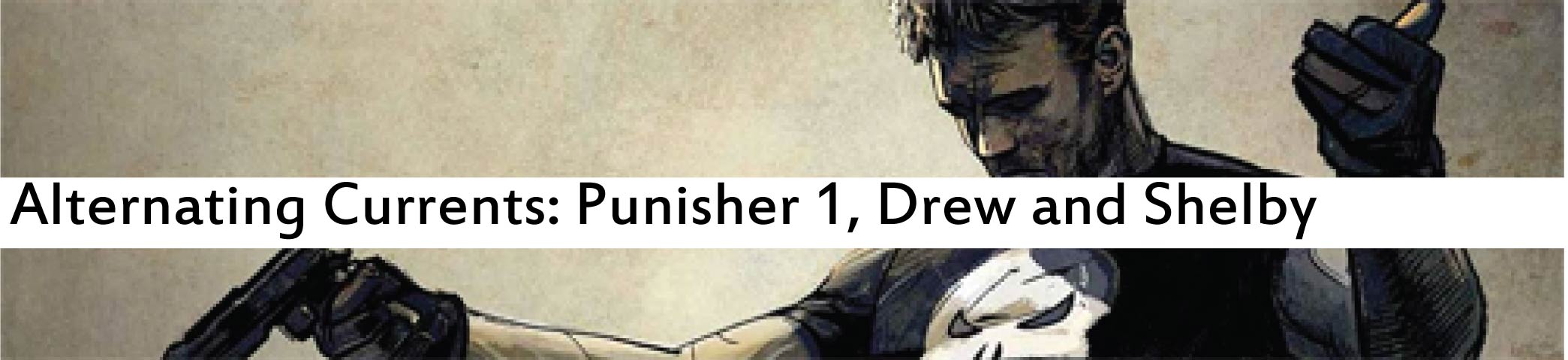
Drew: The intro copy of Punisher 1 reminds us that “Frank Castle died with his family. Now there is only… The Punisher.” It’s a classic premise for a comic series — one that has been used long before and long after the Punisher’s debut (The Spirit and Spawn spring immediately to mind) — but not one that makes for the most compelling central character. Writer Becky Cloonan embraces the vaccuum of Frank’s personality, treating him in this issue more as a rarely-seen force of nature than a human being with real emotions. The result is something closer to Jaws than Kill Bill, but distancing us from Castle forces us to see his actions as truly monstrous, creating a much more unstable lead than could be achieved with a more empathetic approach. Continue reading

Dark Knight III: The Master Race 4

Alternating Currents: Dark Knight III 4, Drew and Michael

Today, Drew and Michael are discussing Dark Knight III: The Master Race 4, originally released April 27th, 2016.

Drew: As much as I enjoy The Dark Knight Returns, I have to admit that it’s a pretty shaggy story — Batman takes on an entirely new foe in every issue (Two-Face, the Mutants, Joker, and the Government, respectively), and most of the conclusions people draw about the book’s maturity comes from parsing only one or another of those battles. How does your neocon reading of part 4 jibe with Bruce Wayne getting his groove back in part 1? How does your psychosexual reading of his relationship with the Joker fit in with the rest of the series (which continues well after the Joker dies)? For all the glib distillations of DKR, none of them actually capture the angularity of what I would argue is a decidedly episodic story. Those terse critics should rejoice, then, over DKIII, which offers a through-line so clear, even literary critics should be able to find it. Continue reading