Batman/Superman 22

batman superman 22

Today, Michael and Patrick are discussing Batman/Superman 22, originally released July 8th, 2015.

Michael: Any given issue of Batman/Superman is a coin toss. The relatively young incarnation of this relatively old idea is more of a companion piece to writer Greg Pak’s other Superman series, Action Comics. It’s an exploration of different avenues for Superman while being grounded by Batman as the constant. What happens when both the constant and the variable of this story-telling formula are changed? Is it the same book?

partners

Continue reading

Archie 1

Alternating Currents: Archie 1, Drew and Spencer

Today, Drew and Spencer are discussing Archie 1, originally released July 9th, 2015.

Drew: Ah, the reboot. Comics have a long history of restarting characters from the beginning (or something resembling it), but new artists reimagining familiar characters can be seen everywhere, from Peter Pan to Macbeth. The recent popularity of rebooting movie franchises, however, has often smacked of a dearth of ideas. Reboots have all of the familiarity of sequels, but without any of the risk of putting characters in new situations. Or, at least, that’s the cynical attitude I tend to bring to reboots. Archie 1 proves to be surprisingly daring, even as it riffs on characters and situations that have been around for decades. Continue reading

Lando 1

lando 1

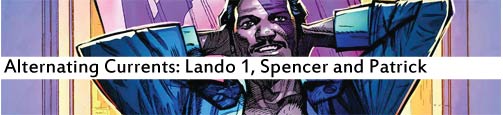
Today, Spencer and Patrick are discussing Lando 1, originally released July 8th, 2015.

Spencer: Maybe it’s just because of the way superheroes dominate the medium, but when I think of comic books, my mind immediately turns to fighting. It’s almost unheard of to find a superhero who doesn’t fight in some capacity, and even in the indie books I read, most of the characters are spies, soldiers, robots wielding built-in weaponry, or kids struggling to survive in the wild — the one thing they have in common is that they all fight. Lando Calrissian, however, does not. Throughout Lando 1, Charles Soule and Alex Maleev depict Lando as someone who may know the value of a good warrior, but prefers to win his battles with cunning. It’s a compelling take on the character, one that helps set him apart from his good buddy (and fellow smuggler) Han Solo, and one which also establishes this mini-series as a heist story through and through. Sure, there’s action, but the twists and turns of Lando’s high-stakes schemes (as well as the schemes hatched against him) are what this series is really all about, and that’s a fun new direction for the Marvel Star Wars books to explore. Continue reading

Detective Comics 42

detective comics 42

Today, Patrick and Michael are discussing Detective Comics 42, originally released July 1st, 2015.

Patrick: Creators on long-running comics are always trying to shake up the status quo. That can be exciting for fans, who love (or love to hate) seeing their favorite properties monkeyed with. And eventually, there’s always the added reward of the return of the original status quo — the status quo ante — which reinstates all our old standards. I try not to be a cynical reader, but sometimes I can’t escape the idea that characters are changed more or less arbitrarily in order to generate conversation and enthusiasm about a series. It’s not like this is bad — change means growth, and I’d love for superhero comics to embrace more growth — but the tendency to revert to a status quo ante makes any attempt at growth feel impotent. Bruce Wayne is dead. Sure. New status quo. He’ll be back. Status quo ante. But what about everyone caught in Batman’s periphery? They have to change too, but there’s nothing forcing them to change back. Detective Comics 42 hovers around this periphery, challenging and pushing characters that may actually be capable of growth. Continue reading

The Wicked + The Divine 12

wicked and divine 12Today, Spencer and Patrick are discussing The Wicked + The Divine 12, originally released July 1st, 2015.

Spencer: In superhero comics, readers get used to seeing characters interpreted in myriads of ways. Everyone from Bill Finger to Frank Miller to Jim Lee has had their hands on Batman, and as a result, we’re able to accept Batman’s characterization in almost any incarnation, no matter how drastic the change. That’s great for accessibility, but much worse for consistency, especially when a character gets saddled with a less-than-stellar creative team. Indie books, on the other hand, allow for finite stories told by a single creative team, with some books (such as Saga) even deviating from a monthly release schedule in order to ensure that no fill-in artists will be needed. Throughout its first 11 issues The Wicked + The Divine stuck with a consistent team (Kieron Gillen, Jamie McKelvie, Matthew Wilson, and Clayton Cowles), but issue 12 features Kate Brown as the series’ first fill-in artist. This artistic switch-up comes in the aftermath of the series’ most turbulent moment, and it’s the perfect way to illustrate how shaken-up the cast still is after last month’s sudden, tragic turn. Continue reading

We Stand On Guard 1

we stand on guard

Today, Taylor and Ryan are discussing We Stand On Guard 1, originally released July 1st, 2015.

Taylor: You don’t have to sort through many comics, movies, or books before you find a story about a war, on earth, set in the relatively near future. A lot of the time, these stories are a good way of capturing the zeitgeist of time in which it was written. Take, for example, much of the sci-fi written during the Cold War. What percentage of that writing focuses on a then-likely war with the Soviet Union and/or nuclear holocaust? Keeping that in mind, some might find it surprising that Brian K. Vaughan’s new series We Stand On Guard is about a future war between the USA and… Canada? Yes, the country known for its benign nature is now the centerpiece for a story about war. But why? As it turns out there are plenty of reasons which make this a promising series premier.

Continue reading

Midnighter 2

midnighter 2

Today, Michael and Spencer are discussing Midnighter 2, originally released July 1st, 2015.

Michael: As it has been said many times on and off the comic book page, superheroes (mutants, meta-humans or otherwise) are the next step in human evolution. The hyperbolic comparison of superheroes to gods is almost as commonplace as any one political party calling the other Nazis or Hitler. The former argument/thesis is probably grounded a little more in reality however. Superheroes’ elevated abilities and roles of authority do necessitate a whole new set of rules. It might not exactly be fair but then again, “fair” is not really a pre-requisite for this life of ours. Midnighter 2 takes a look at how those supergods and corporations look from below – from the human perspective. Continue reading

Batman Beyond 2

batman beyond 2

Today, Mark and Drew are discussing Batman Beyond 2, originally released July 1st, 2015.

Mark: With the release of Batman: Arkham Knight a few weeks ago I’ve been on quite the Batman kick recently, revisiting favorite catalog comic book issues and re-watching episodes of Batman: The Animated Series that I haven’t thought about for years. As part of this Batman binge, I listened to a podcast with Animated Series co-creator Bruce Timm where he discusses the origin of Terry McGinnis and Batman Beyond. According to Timm, the character was birthed when an executive at Kids WB asked for a show that could appeal more to young kids starring Batman as a teenager. Timm and company were originally repulsed by the idea, but when they started hashing out pitches amongst themselves they hit on the idea of keeping it in continuity with an elderly Bruce Wayne acting as mentor to his chosen successor. From there the character grew and the world of Batman Beyond was established over three seasons of television, a movie, and a handful of comic books. Continue reading

Princess Leia 5

princess leia 5

Today, Patrick and Taylor are discussing Princess Leia 5, originally released July 1st, 2015.

Patrick: Love it or hate it, I’m a Wisconsin boy – born, raised, and educated. It’s a weird culture to grow up in, but it’s an even weirder culture to have to carry with you for the rest of your life. There are some awesome parts of being from Wisconsin, like an enthusiastic beer culture or an emphasis on education or the outdoors. Plus there’s the general air of friendliness that permeates my every visit to the homestead. But man, oh man, there are also a ton of drawbacks to that cultural identity: a meatheaded obsession with sports (specifically, the Green Bay Packers), unhealthy and frequently disgusting cuisine, and a bunch of casual institutionalized racism. And every person I meet is surprised that I’m not some backwoods, smalltown hick. Worse are the negative characteristics I actually take with me wherever I go, like juvenile appetite for dairy products and that irrepressible accent. Throughout the course of Princess Leia, Mark Waid and Terry and Rachel Dodson have presented us with Leia’s cultural identity, and with the final issue boldly declares that being Alderaanian is a powerful thing. Love it and hate it. Continue reading

Zero 18

Alternating Currents: Zero 18, Drew and Patrick

Today, Drew and Patrick are discussing Zero 18, originally released July 1st, 2015.

Drew: I don’t love fetishizing endings. I resent the idea that the final moments of a work of art are somehow more important than all of the other moments that came before. I do, however, appreciate that it’s not until the end of a work that we can properly understand what it is. It’s not that the last piece of the narrative puzzle is necessarily more important than the rest, it just happens to be the last one added, which makes it the one that completes the image. True to that analogy, most endings are increasingly predictable as they approach — by that late in a narrative, we have a sense of likely conclusions. But then there are those narratives that aren’t so easily tied down. Zero started as a relatively straightforward spy series, but became increasingly postmodern, turning itself into a pointed commentary on the artificial division between “life” and “art.” Even with that trajectory in mind, issue 18 offers a conclusion of such bizarre beauty that nobody could have ever predicted. Continue reading