Lumberjanes 44 Isn’t Just For Kids

by Taylor Anderson

This article contains SPOILERS. If you haven’t read the issue yet, proceed at your own risk!

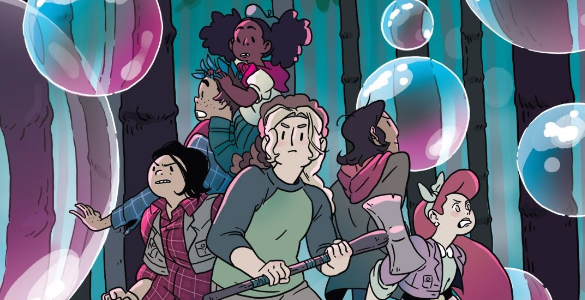
Lumberjanes is ostensibly a comic geared towards a younger audience. The young protagonists, the summer camp setting, and the the fantasy elements all suggest a title that is purposely trying to engage young comic readers. There’s nothing wrong with that and in fact it’s vitally important to foster a love of comics in young people by making titles expressly for their consumption. However, as with all art, Lumberjanes frequently isn’t heralded as much a titles written for older audiences. But as issue 44 shows, there’s no reason why that should be the case.

Continue reading

Father and Son Bonding Time in East of West 35

by Taylor Anderson

This article contains SPOILERS. If you haven’t read the issue yet, read on at your own risk!

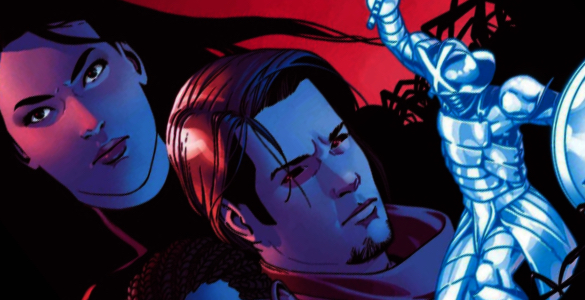
Father and son stories have been written since the beginning of time, literally. Many myths focus on this relationship and still today there are movies, books, tv shows, and comics written about this foundational familial connection. It’s obvious to see why. The father-son relationship is…complicated…so it promises an endless well of commentary and creative ideas. And while this is true, I can’t recall ever seeing a father and son story where one member is a horseman of the Apocalypse and the other is promised to destroy the world, but in East of West this is what we have. Even though this may seem bizarre, Jonathan Hickman still finds a way to make Death and Babylon’s relationship meaningful.

Continue reading

Magna Tolvan is Lovable, to a Distracting Degree, in Doctor Aphra 14

by Taylor Anderson

Doctor Aphra 14

This article contains SPOILERS. If you haven’t read the issue yet, proceed at your own risk!

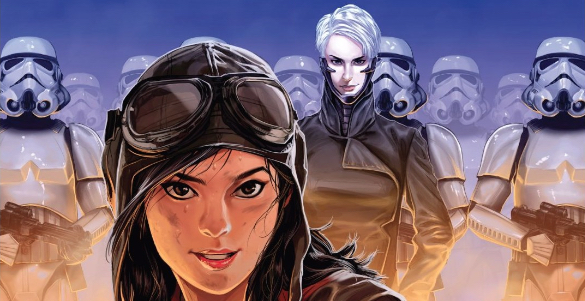
The great thing about Star Wars comics is that we’re introduced to characters from the extended universe we would never meet otherwise. I mean, Han, Luke, Leia, and Darth are all pretty compelling characters, but forty years worth of stories surrounding them means there isn’t a whole lot left to say about them. Dr. Aphra, then, is a great series in this regard. Aphra herself is a compelling character, but the title is made so much better by the rich cast of characters that surrounds her. However, if these characters lose their charm or act in ways that don’t make sense then there’s not a whole lot for an issue to fall back on save for space battles and explosions.

Continue reading

Doctor Strange 381: Discussion

By Taylor Anderson and Patrick Ehlers

Doctor Strange 381

This article contains SPOILERS. If you haven’t read the issue yet, proceed at your own risk!

Taylor: There’s a scene in the excellent new Thor movie where the titular character comes face to face with Dr. Stephen Strange. At the time, the scene struck me as kind of weird, even if I enjoyed it greatly. What seemed odd to me at the time was the idea of Norse gods meeting a sorcerer who seemingly hails from a completely different mythology. But as the rest of the movie showed me with its zany and fun plot, there’s no reason why the two mythologies shouldn’t meet. At the end of the day, both Thor and Dr. Strange have super powers, and whether one is or isn’t magic doesn’t seem to really matter. Once I crossed the cognitive divide that these two characters shouldn’t interact, I was totally hooked. The same is true of Doctor Strange 381, because it operates in much the same way. Continue reading

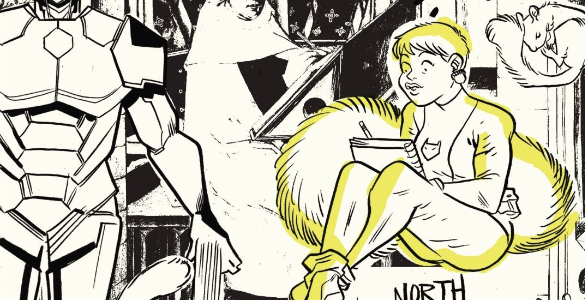
Epistolary Irreverence in The Unbeatable Squirrel Girl 26

by Drew Baumgartner

Unbeatable Squirrel Girl 26

This article contains SPOILERS. If you haven’t read the issue yet, proceed at your own risk!

The provenance of epistolary texts are always weird. Actually, it’s probably less weird than traditional narratives, where we might somehow be privy to the private thoughts of the protagonist or even the perspective of an omniscient narrator, but epistolary texts necessarily draw our attention to the weirdness in a way that more traditional narratives don’t. Because we’re reading documents composed within the diegesis of the epistolary narrative, the ostensible writer of those documents are a character, even as the actual writer attempts to become invisible. That tension, between our hyperawareness of the fictional author, and purported obliviousness of the actual author, puts epistolary narratives in this weird netherworld of headspace, embracing the self-awareness of postmodernism in an attempt to produce an entirely un-self-aware story. It’s a concept that already folds in on itself, but writer Ryan North adds a few more wrinkles, confusing the notion of self-awareness enough that the confusion starts to be to point. Continue reading

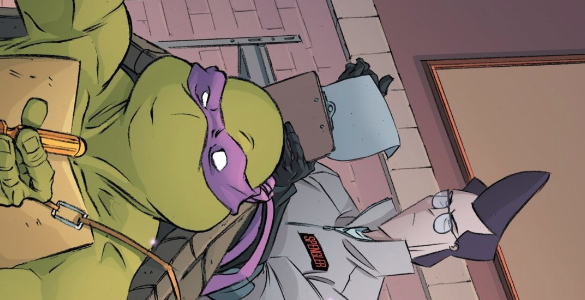
Teenage Mutant Ninja Turtles/Ghostbusters II 2 is Like Childhood Fun

by Taylor Anderson

This article contains SPOILERS. If you haven’t read the issue yet, proceed at your own risk!

As a kid, I had a lot of action figures. Ninja Turtles, Ghostbusters, G.I. Joe, Star Wars — you name the franchise, I probably had at least one figurine from it. Part of the fun of having such a large collection was that I could mix and match the toys in any way that made sense to my imagination (which means it required little sense at all). This meant that sometimes Donatello would drive the Millennium Falcon or Peter Venkman might drive the Pizza-Cycle. This spirit of boundless play has been all but beaten down in me by society, but luckily it lives on in TMNT/Ghostbuster II 2. Continue reading

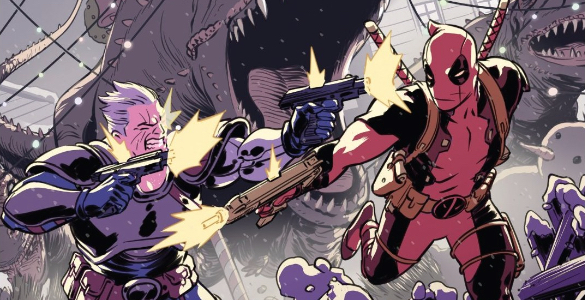
Time Travel Mulligans in Despicable Deadpool 288

by Taylor Anderson

This article contains SPOILERS. If you haven’t read the issue yet, proceed at your own risk!

slim-banner

Everyone knows there are paradoxes when it comes to time travel, but the very idea of time travel in a story comes with its own set of paradoxes as well. Chief among these paradoxes is the fact that any story being told is somewhat meaningless. Why? Well, if characters have the ability to time travel then they probably have the ability to go back in time and alter the story line they just took part in. This is the case in Despicable Deadpool 288 where all sorts of crazy shit happens, but none of it may matter at all. Continue reading

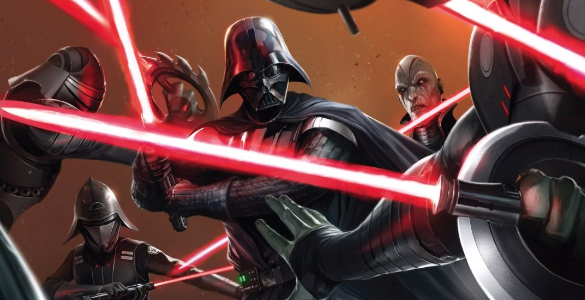
There Are No Absolutes in Darth Vader 7

by Taylor Anderson

This article contains SPOILERS. If you haven’t read the issue yet, read on at your own risk!

When I generally think about the causes of the fall of the Republic in Star Wars, my mind usually focuses on Palpatine and his meddling in senate affairs in such a way that he was gradually able to secure political power. While that certainly plays a part in the fall, I think we also have to wonder why the Republic was so weak that a single madman could gain solitary control of it in the first place. Certainly, I could point my finger at the Trade Federation or the Techno Union as sowers of unrest in the Republic which led to Palpatine’s rise, but that isn’t it, exactly. No, the reason the Republic fell was due to its crumbling institutions, namely the Jedi Order, which failed to protect and delegate the way it was designed to do. Continue reading

The Frustration of ‘Almost’ in Astonishing X-Men 5

by Taylor Anderson

This article contains SPOILERS. If you haven’t read the issue yet, proceed at your own risk!

I’ve recently been playing a lot of Zelda: Breath of the Wild, and while I love the game, there are times it frustrates the hell out of me. Usually, this frustration comes in the form of puzzles located in shrines scattered throughout Hyrule. While a lot of the shrines are solved using logic, there are some that just require skill and a lot of patience to complete. I can’t count the number of times I’ve come close to solving one of the skill shrines only to have something get bungled up at the last minute. This sense of frustration in the face of near victory is familiar to me now, and it’s why I recognize it so readily in Astonishing X-Men 5. Continue reading

Teenage Mutant Ninja Turtles/Ghostbusters II 1

by Taylor Anderson and Patrick Ehlers

This article contains SPOILERS. If you haven’t read the issue yet, proceed at your own risk!

Taylor: There’s something about a Teenage Mutant Ninja Turtles and Ghostbusters crossover that just works. There are the obvious reasons why, like both groups being made up of four dudes with similar personalities, or the fact that they both live in New York. While that explains why the crossover is convenient, it’s not why it works. No, the reason that the Turtles and ‘Busters can merge stories so well is that both groups routinely deal with strange shit. That, and that alone, might just be why there is a second crossover event for these two franchises, and if the first issue is any indication, it is also reason enough for it existing. Continue reading