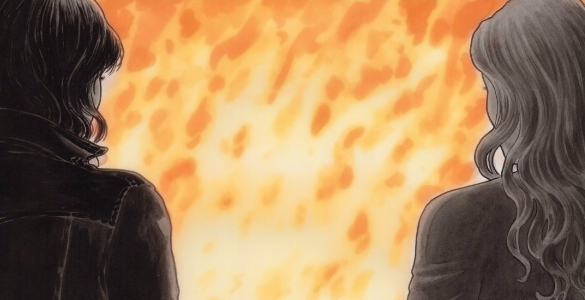
Rowan’s Defenses May be Lacking in Black Magick 7

by Drew Baumgartner

Black Magick 7

This article contains SPOILERS. If you haven’t read the issue yet, proceed at your own risk!

We don’t often talk about procedurals in terms of “putting the pieces in place” — there’s too much directionality to all of the clue finding for the endgame to feel anything other than inevitable. Of course, for all of the procedural elements in Black Magick, it isn’t strictly a procedural. This issue is full of procedural scenes — all showing some degree of cause and effect — from Rowan’s “investigation” into Bruce Dunridge to her (and Alex’s separate) spellcasting, to Stepan Hahn’s own detective work. He’s the noose we’re consciously aware of (especially as the end of the issue puts him on a collision course with Ro), but it’s the procedures we don’t quite see the fallout of that intrigue me most. Continue reading
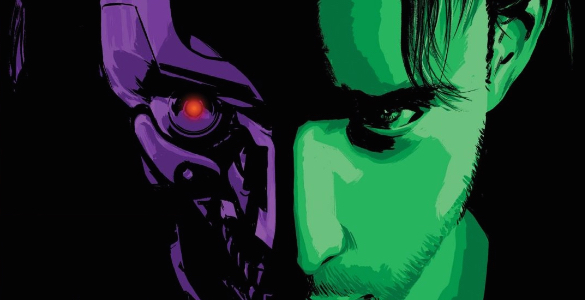
Lazarus X+66 2 Presents a Cyborg as a Rorschach Test

by Drew Baumgartner

Lazarus X+66 2

This article contains SPOILERS. If you haven’t read the issue yet, proceed at your own risk!

People see what they want to see. It’s a fact that’s fundamental to our perception of the world, but also the thing that prevents us from agreeing on anything. Rorschach tests represent the most fundamental expression of this notion, asking subjects to project their own meaning onto meaningless inkblots, but it’s something we see every day, from our simplest hopes and fears to the way we evaluate political candidates. That’s not to say there aren’t objective truths, just that, individually, we’re terrible at recognizing (and respecting) them, so their existence is almost incidental to our attitudes about the world. This is enervating enough when discussing climate change or which way toilet paper rolls should be oriented, but becomes all the more heartbreaking when the debate questions your very humanity, as it does for Joacquim Morray in Lazarus X+66 2. Continue reading

Descender 23: Discussion

by Ryan Desaulniers and Spencer Irwin

This article contains SPOILERS. If you haven’t read the issue yet, proceed at your own risk!

Ryan D: After last issue‘s cliffhanger, the audience wondered whether or not the self-serving Quon would risk his neck by leaving the relative safety of the ship into the deep waters in which Captain Telsa currently languished, lifelessly. Well, he did, and the sequence of Quon retrieving Telsa looks beautiful. Continue reading

Accepting or Rejecting our Personal Identities in Godshaper 5

by Spencer Irwin

This article will contain SPOILERS. If you haven’t read the issue yet, proceed at your own risk!

Our race, sexuality, or gender are usually major parts of our personal identities, but because of the prejudiced society we live in, they can also end up as impediments in life if we’re non-white, queer, or non-cis/non-male — essentially, if we don’t meet the status quo. In Simon Spurrier and Jonas Goonface’s Godshaper, being a shaper has always worked as a metaphor for all these “other” identities, which makes Ennay’s reaction to an offer of a god of his own — which would free him from the stigma of being a shaper — all the more interesting. Continue reading

A Toxic Relationship Smorgasbord in The Wicked + The Divine 30

by Spencer Irwin

This article contains SPOILERS. If you haven’t read the issue yet, proceed at your own risk!

My best friend has a particularly notorious habit of falling for the absolute worst women. The poorer of a match they are for him, the more he’s attracted to them. He’s shrugged off our warnings with “well, you can’t help who you’re attracted to,” to which I would inevitably respond “Just because you’re attracted to someone doesn’t mean you need to always go for them!” It’s a statement that wouldn’t stop going through my head as I read Kieron Gillen and Jamie McKelvie’s The Wicked + The Divine 30, an issue chock full of dysfunctional, toxic relationships and characters who know how screwed up their love lives are, yet leap head-first into them anyway, as if they never had a choice. Continue reading

When the Threats Get Personal, So Does The Violence in Kill Or Be Killed 11

By Ryan Desaulniers

This article contains SPOILERS. If you haven’t read the issue yet, proceed at your own risk!

There are different levels of violence in murder, right? I mean, there’s a different intensity to pressing a button and a bomb dropping on a target versus bayonetting someone in the ribs. The first allows one to remain detached, while the other forces the attacker to be up close and personal. While the result is effectively the same — the death of another human being — the latter’s level of “personal” really makes a difference. In Kill or be Killed, we’ve seen Dylan murder, but it’s been clumsy, almost accidental, in spite his intentions; however, we see in issue eleven a new level to Dylan’s commitment to violence, one which honestly took me aback. Continue reading

Elsewhere 1: Discussion

by Mark Mitchell and Ryan Desaulniers 

This article contains SPOILERS. If you haven’t read the issue yet, proceed at your own risk!

Mark: I’m unsure how exactly to begin unpacking Jay Faerber and Sumeyye Kesgin’s Elsewhere 1. It’s an issue that’s pregnant with ideas, yet surprisingly without depth. It moves incredibly fast, but when it ends there’s the feeling that nothing has happened. Like buying cotton candy at a carnival, it looks like there’s a lot of substance, but once you’ve consumed it all, you’re still left feeling unsatisfied. But if Elsewhere 1’s ideas are interesting, how come the issue never really takes off? Continue reading

You Need Wings in East of West 34

by Taylor Anderson

This article contains SPOILERS. If you haven’t read the issue yet, read on at your own risk!

The bullshit piled up so fast in Vietnam you needed wings to stay above it.

Captain Benjamin Willard, Apocalypse Now

War is a messy business. Aside from the needless death it causes, war destroys communities and families, wrecks economies, and has a way of dragging people and countries down into its bloody maw. Those who try to keep their hands clean often find, despite their best efforts, that war has a particular talent for drawing the unwilling into its embrace as well. Xiaolian Mao has tried, for 34 issues, to keep her hands out of not just war, but the apocalypse, but with attempts on her life and a final attack against her people, she finds that even she can’t avoid her part in ending the world.
Continue reading

Silence at the Crossroads in Sex Criminals 20

by Ryan Desaulniers

Sex Criminals 20

This article contains SPOILERS. If you haven’t read the issue yet, proceed at your own risk!

At the risk of sounding dramatic, cliche, or platitudinous: sometimes love is not enough to save a relationship. So many things go into successfully balancing the scale of a happy, healthy long-term romantic relationship, and while love is certainly important, it is certainly not the only factor. This is were we see Jon and Suzie in Sex Criminals 20 — at a crossroads, loving each other dearly, but unable to continue as a couple. Continue reading

Emphasizing Theme in Injection 14

by Drew Baumgartner

Injection 14

This article contains SPOILERS. If you haven’t read the issue yet, proceed at your own risk!

Sandwiches are important.

Brigid Roth

When do you know something in a given narrative is important? Is it someone in the story saying as much? Is it that that element keeps coming back? Or is it some subtler means of emphasis that can make even the first appearance of an idea feel meaningful? Ultimately, these methods aren’t mutually exclusive, but I do see them as existing on a kind of continuum of obviousness, with someone stating the importance of something as “impossible to miss,” and those subtler methods covering a wide range from “clear” to “ambiguous” (the scale theoretically continues into “unclear” and “impossible to detect,” though those will obviously be difficult to notice from a reader’s perspective). Then again, those elements can be used in ways beyond their perceived meaning. That is, a character could say something was important in order to mislead the audience, or, in the case of Injection 14, to draw our attention to what really matters. Continue reading