An Early Start Sets Crude 1 on an Unusual Course

by Drew Baumgartner

Crude 1

This article contains SPOILERS. If you haven’t read the issue yet, proceed at your own risk!

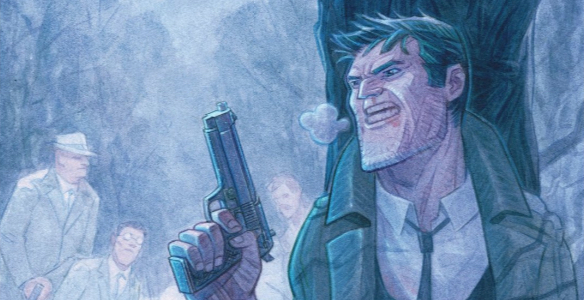
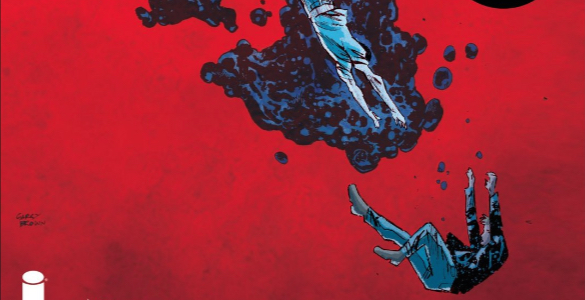
Every story is a mystery at its start. Themes, settings, characters, and their motivations are all unknown to us at the outset, so the opening chapters of stories are often defined by which of these questions they answer, and which they leave open. In that way, a story ultimately defines what its hanging questions are by where it begins. Does it open generations before the protagonist is born or on the day of the inciting incident? Does its scope start wide and zoom in, or does it start in tight and zoom out? Or, more to the point in many mainstream comics, do we meet the protagonist before or after their loved one is murdered, propelling them on some kind of quest for justice/vengeance? With Crude 1, Steve Orlando and Garry Brown’s choices on where and when to start their narrative reveal a great deal about what they think is interesting about their narrative, but in doing so, may have buried the lede. Continue reading

Authenticity in Sex Criminals 23

by Ryan Desaulniers

Sex Criminals 23

This article contains SPOILERS. If you haven’t read the issue yet, proceed at your own risk!

[He] felt he had to choose between being a failure and being a fake

Because going against our natural inclinations can make us feel like impostors, we tend to latch on to authenticity as an excuse for sticking with what’s comfortable.

Herminia Ibarra, The Authenticity Paradox

“Authenticity” is a big, nebulous word. I normally encounter the concept in the realm of art — whether it be performance or otherwise — as an indicator of a work’s sincerity or the artist’s commitment to an original, unique vision, but there’s no rubric or scale to truly measure these values. The same can be said about authenticity in one’s personal life. How can one accurately and honestly gauge whether their actions or behaviors come from one’s natural, earnest inclinations when any given person, on their journey through life, undergoes so much change due to a litany of reasons? At what point can the quest for authenticity become a detriment to further development instead of being a welcome pillar of deeply-held tenants? Matt Fraction and Chip Zdarsky’s Sex Criminals 23 reads as a very busy issue, featuring an array of close-ups on the characters of the series, and these moments succeed in showing the struggle for authenticity, though these moments occur within a messy-feeling broader plot. Continue reading

Secrets as a Weapon in The Wicked + The Divine 35

by Spencer Irwin

This article contains SPOILERS. If you haven’t read the issue yet, proceed at your own risk!

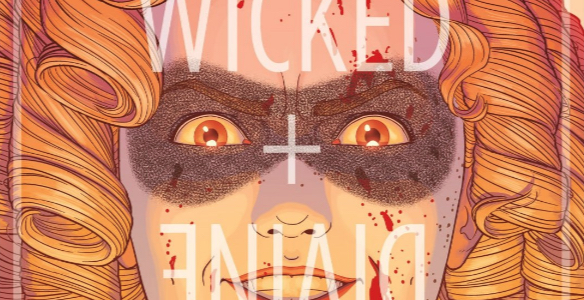
It should be no surprise that almost every character in Kieron Gillen and Jamie McKelvie’s The Wicked + The Divine are hiding major secrets, nor that, as the series enters its final year, more and more of those secrets are coming to light. What might be a bit surprising, though, is how well the cast leverages these secrets — both their own and others’ — in order to get what they want. Secrets can be a liability, but in the world of WicDiv, they’re just as often an asset, a weapon just waiting to be fired. Continue reading

Isola 1: Discussion

By Spencer Irwin and Michael DeLaney

This article contains SPOILERS. If you haven’t read the issue yet, proceed at your own risk!

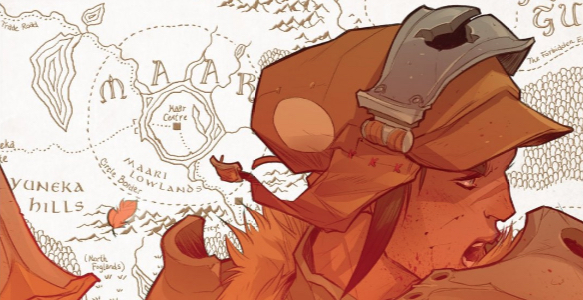
Spencer: The older I get, the more I realize how vital communication is to just about every single facet of life. So many problems and conflicts, be they in business or our personal lives, are caused by simple miscommunications, and the inability to communicate with someone makes it almost impossible to do anything with them or have any sort of meaningful relationship. Communication is a central theme of Isola, the new Image series from former Gotham Academy collaborators Brenden Fletcher, Karl Kerschl, and Msassyk. Not only does Isola 1 explore the difficulties that arise when two parties are unable to communicate, but the methods the creative team use to communicate information with the readers are second-to-none. This is one smartly-told comic book. Continue reading

Analog 1: Discussion

By Patrick Ehlers and Drew Baumgartner

This article contains SPOILERS. If you haven’t read the issue yet, proceed at your own risk!

Patrick: I listen to a lot of Slate’s Trumpcast. Y’know, because the president has me in a nearly constant state of low-key panic, and I feel utterly powerless to stop our democracy from crumbling, so like, might as well listen to a podcast about it. One of the things that comes up on the show pretty often is the idea that we need to let go of the idea that there is one smoking gun that will implicate the administration and the president himself in collusion with the Russian government. There is no evidence so ironclad that it would force impeachment. Further, impeachment and removal from office would not address the systemic problems with corruption, bigotry, and foreign interference. There’s no “one solution” because there is no “one problem.” Gerry Duggan and David O’Sullivan’s Analog 1 takes a very specific speculative high-concept pitch, and gradually reminds the reader of everything else that is intriguing and terrifying about their world — there is no “one problem.” Continue reading

A Glass Half-Full of Pessimism in Days of Hate 3

by Drew Baumgartner

Days of Hate 3

This article contains SPOILERS. If you haven’t read the issue yet, proceed at your own risk!

Drew: The heuristic we use for optimism and pessimism — whether a glass is seen as half full or half empty — focuses on the language we use to frame a description. But that’s not necessarily the difference between an optimist and a pessimist. If we could construct some kind of neutral description of an amount of water in a glass, you could still have disagreement about whether that is good or bad, whether it will improve or get worse, and what exactly caused this state in the first place. Moreover, in this day and age, you might have people disagreeing about the facts of how much water is in the glass at all. These are the distinctions Aleš Kot and Danijel Žeželj make between Amanda and Xing’s accounts of their relationship in Days of Hate 3. Continue reading

Kill or be Killed 17: Discussion

By Drew Baumgartner and Ryan Desaulniers

Kill or be Killed 17

This article contains SPOILERS. If you haven’t read the issue yet, proceed at your own risk!

Don’t bury the lede.

Journalism, Traditional

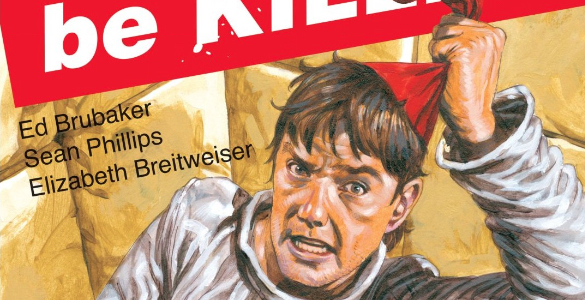
Drew: Is journalism the opposite of storytelling? Maybe these terms are too sticky to parse, but it’s interesting to me that one of the cardinal rules of journalism — putting the most dramatic part of the story at the start of the article — is essentially the opposite of the basic narrative structure, where the climax arrives very close to the end of a story. Actually, the difference may lie less in where the “climax” (for lack of a better word) occurs as where it’s allowed to occur. While narratives tend to have the climax in their final act, it is by no means as hard-and-fast a rule as “don’t bury the lede,” and precisely where the climax fits in that final act is decidedly more flexible than absolutely, positively occurring in the first paragraph. It’s a simple matter of the purposes of these art forms — the kinds of tricks storytellers use to surprise us or keep us in suspense are totally inappropriate in a newspaper article designed to inform us of what happened where. And it’s those wrinkles in form, unique to storytelling, that make Ed Brubaker and Sean Phillips’s Kill or be Killed 17 such a delight. Continue reading

Saga 50: Discussion

by Taylor Anderson and Ryan Mogge

This article containers SPOILERS. If you have not read the issue yet, proceed at your own risk!

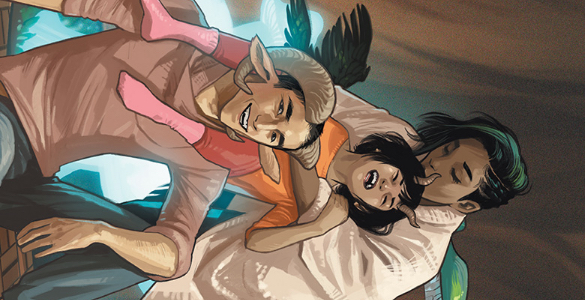
Taylor: Back in August, my wife and I packed up all of our worldly belongings and moved from Chicago to Denver. We’ve greatly enjoyed our new digs for the most part, but this doesn’t mean the transition was without its trials. I had lived in Chicago for nearly ten years, so moving to a new city meant saying goodbye to a lot of things and people I knew. I feel lucky to have undergone this momentous change with my wife, who has been a rock through it all. Point is, when you go through a big change, it’s always nice to have someone by your side, as Saga 50 illustrates. Continue reading

There’s Power Hidden in the Style of Black Magick 11

by Drew Baumgartner

Black Magick 11

This article contains SPOILERS. If you haven’t read the issue yet, proceed at your own risk!

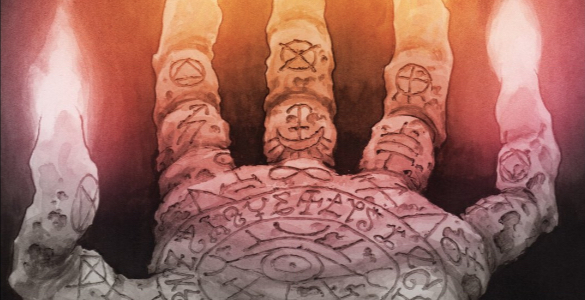
As a medium, comics are limited to two dimensions and single moments in time, but those are really the only limitations. Even so, it can be easy to forget that comics art can be anything but representational, as so many mainstream comics tend to default to some much more restrictive rules. This is particularly strange given the popularity of supernatural or superhuman powers in comics. In a medium with infinite possibilities, these powers tend to be depicted in the same ways, again and again; a hard punch (like, a really hard punch), a big explosion (like, a really big explosion, a massive spaceship (like, a really massive spaceship), etc. It takes a much more thoughtful, much more subtle hand to actually take advantage of the medium’s possibilities to represent the otherworldly, which is exactly what Nicola Scott does in Black Magick 11, cashing in some of the stylistic choices she’s made from the beginning of the series to really sell the magic at hand. Continue reading

High School Memories in The Further Adventures of Nick Wilson 3

By Spencer Irwin

This article contains SPOILERS. If you haven’t read the issue yet, proceed at your own risk!

Whether they romanticize it or want to forget about it altogether, most people have pretty strong feelings about the time they spent in high school — or, at least, that’s how most popular media likes to portray things. In truth, I’m guessing far more people think about high school the way Nick Wilson does: with hazy indifference. In The Further Adventures of Nick Wilson 3, Eddie Gorodetsky, Marc Andreyko, and Stephen Sadowski send Nick to his high school reunion, which is probably the lamest — and, thus, the most realistic — high school reunion in the history of pop culture.  Continue reading