The Multiversity 2

Alternating Currents: The Multiversity 2, Drew and Michael

Today, Drew and Michael are discussing The Multiversity 2, originally released April 29th, 2015.

You’re missing stuff by reading too fast.

Mercury Man, The Multiversity 2

Drew: There’s a specific type of confusion that comes when reading certain Grant Morrison comics — the kind that comes when you have absolutely no idea what’s going on, but you have faith that it will all make sense in the end. Or, at least, you’ll be able to draw conclusions from it in the end. Mercury Man suggests that it all makes sense if we just slow down to make all of the connections, but Morrison books tend to require reading at a pace several orders of magnitude slower than the average comic. That Morrison doesn’t write “the average comic” is exactly why his works are so worth that effort, but I’ll be damned if it doesn’t make them incredibly difficult to talk about. Continue reading

Nameless 3

Alternating Currents: Nameless 3, Drew and Patrick

Today, Drew and Patrick are discussing Nameless 3, originally released April 8th, 2015.

It’s like the goddamn “Exorcist” meets “Apollo 13”!

Grant Morrison, Nameless

Drew: One day, I’d like to write an essay defending allusions as the defining artistic device of our time. That’s not to say allusions haven’t been used well throughout history, or that allusions are ubiquitous in all contemporary art, but it’s hard to deny the prevalence of allusions in modern pop-culture, from sampling in hip-hop to the naked homages of Quentin Tarantino. It makes sense; allusions are the natural, artistic extension of the hyperlinks we’ve come to expect throughout our daily reading. In that way, remixes and pastiches are the distillation of our time, simulating the experience of living in an overstimulating world, combining countless inputs into one meta-narrative we might call our lives. Nobody does this kind of remix better than Grant Morrison, whose career is as much defined by his ability to reconcile unwieldy continuity as it is by his affinity for impenetrable density. Nameless 3 showcases both of those sides, meditating on a whole host of sci-fi inspirations before spinning into a wickedly self-aware web of confusion. Continue reading

Batman and Robin Annual 3

Alternating Currents: Batman and Robin Annual 3, Michael and Shane

Today, Michael and Shane are discussing Batman and Robin Annual 3, originally released April 1, 2015.

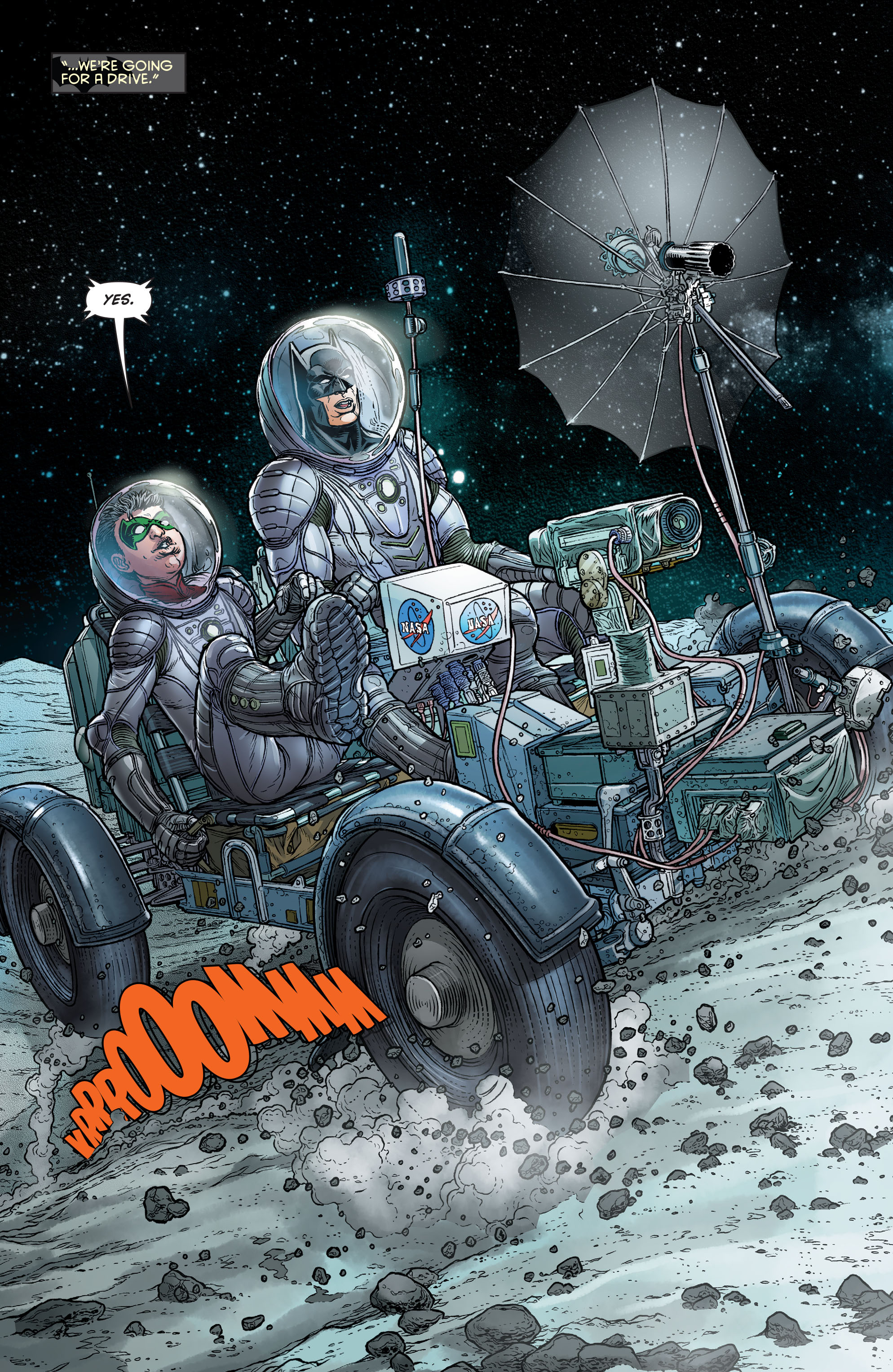
Michael: Convergence has already begun, whose end will signify the sort-of-new direction for DC’s entire line. While Batman and Robin 40 was Patrick Gleason’s final issue on the series, Batman and Robin Annual 3 marks the quiet death of the Batman and Robin series that Gleason and Pete Tomasi re-launched back in 2011. So prepare yourselves for Batman and Robin IN SPAAAAAAACE!

Batman and Robin Annual 03-008 Continue reading

The Multiversity: Ultra Comics 1

Alternating Currents: Multiversity: Ultra Comics 1, Michael and DrewToday, Michael and Drew are discussing The Multiversity: Ultra Comics 1, originally released March 25th, 2015.

“We believe in Ultra Comics. And we demand a happy ending!”

Red Riding Hood

Michael: “The Tinkerbell effect,” born from the stage play of Peter Pan, where Pan encourages the audience to clap their hands if they believe in fairies to save the dying Tinkerbell. That is, if you believe in something, it exists. Grant Morrison thrives on the philosophy of this idea and the power that we as an audience/society give to it. The Multiversity: Ultra Comics 1 takes this theme and runs with it, transforming the act of reading a comic book into an interactive, cross-reality adventure. Continue reading

Nameless 2

Alternating Currents: Nameless 2, Drew and MichaelToday, Drew and Michael are discussing Nameless 2, originally released March 4th, 2015.

Dave Bowman: Open the pod bay doors, HAL.
HAL 9000: I’m sorry, Dave. I’m afraid I can’t do that

2001: A Space Odyssey

Drew: Arthur Miller called betrayal “the only truth that sticks,” and it’s hard to deny the visceral power of a betrayal. Betrayals are at the center of every great tragedy, from Euripides to Shakespeare, and are still very much a driver of drama today. In it’s simplest form, a betrayal is simply someone acting differently than we expect, but “acting differently” can have dire consequences in a life-or-death situation. That’s what makes HAL 9000’s turn in 2001 so compelling — a computer with a sense of self-preservation is shocking enough, but because the story is set in outer space, there’s a lot more at stake than when your laptop decides to auto-update. Grant Morrison and Chris Burnham’s Nameless 2 clearly draws a lot of inspiration from that betrayal, as the crew remains unaware of a mutiny brewing back at the base. Continue reading

The Multiversity: Mastermen 1

mastermen 1

Today, Mark and Michael are discussing The Multiversity: Mastermen 1, originally released February 18th, 2015.

Mark: As far as I know, Grant Morrison has no plans to retire from comics anytime soon, but it’s hard for me to not view The Multiversity as the culmination of Morrison’s work at DC. Maybe comic books in general. It’s an opportunity to play in all of the sandboxes he’s ever wanted to play in. If The Multiversity: Pax Americana 1 was Morrison doing Watchmen, The Multiversity: Mastermen 1 reads like Morrison’s take on Mark Millar’s famous Superman: Red Son. Where that book imagined a universe in which Kal-El’s escape ship crashes in the USSR instead of America’s heartland, Mastermen takes place on Earth-10 where events unfold much like on our Earth until an alien spacecraft lands in Nazi Germany in 1939. Inside that spacecraft is a small child who grows to become Overman, a Superman analog and the key to the Nazi’s world domination. Continue reading

Nameless 1

nameless 1

Today, Michael and Drew are discussing Nameless 1, originally released February 4th, 2015.

Michael: Back to the Future, The Wizard of Oz, Wife Swap: popular pieces of film, literature and even reality TV. Besides being engaging pieces of fiction (reality TV burn!) they all have an essential plot element that draws us in as an audience: they are all “fish-out-of-water” stories. Marty McFly isn’t familiar with the culture of the ’50s, Dorothy doesn’t understand the strange land of Oz, and one wife doesn’t know how to live in a drastically different home. Since Nameless is a Grant Morrison story, it is over-the-top bonkers and full of heady ideas. At its core though, it is also a story about a fish out of water. Continue reading

The Multiversity Guidebook

multiversity guidebook 1

Today, Michael and Mark are discussing The Multiversity Guidebook, originally released January 28th, 2015.

Michael: Currently I’m re-watching Animaniacs, a children’s show which often wore the disguise of an educational tool pretending to be a cartoon. Sure, the characters are goofy and zany, but they still teach you the names of all of the countries of the world in a catchy tune. With that in mind, The Multiversity Guidebook is a story disguised as a “history book.” There’s a lot of information thrown at you about the multiple earths of the DC Universe, but it is clearly the connective tissue of every chapter of The Multiversity thus far. It’s the history of the same story: The DC Universe story. Continue reading

Best of 2014: Best Issue

Best of 2014: Best IssueEpisodic storytelling is the name of the game in monthly comics. Month- or even multi-year-long arcs are fine, but a series lives and dies by its individual chapters. From self-contained one-offs to issues that recontextualize their respective series, this year had a ton of great issues. Whittling down those issues to a list was no easy task (and we look forward to hearing how your lists differ in the comments), but we would gladly recommend any (and all) of these issues without hesitation. These are our top 14 issues of 2014.
Continue reading

The Multiversity: Thunderworld Adventures 1

multiversity thunderworld 1Today, Mark and Drew are discussing The Multiversity: Thunderworld Adventures 1, originally released December 17th, 2014.
Mark: The Multiversity: Thunderworld Adventures 1 is a story out of time. On Earth-5, Billy Batson and friends exist in a pre-New 52 (and pre-Crisis on Infinite Earths?) continuity. Shazam is the name of a wizard, not the name of our superhero. The Rock of Eternity is attacked and the wizard Shazam taken prisoner by the evil Dr. Sivana. Working in tandem with the Sivanas across the multiverse, Dr. Sivana has mined enough Suspendium to build his own Rock of Eternity and create his own day on the cosmic calendar: Sivanaday, a day where everything goes his way. Continue reading