We Stand On Guard 3

we stand on guard 3

Today, Ryan D and Taylor are discussing We Stand On Guard 3, originally released September 2nd, 2015.

Ryan: Canada and America at war. Total war. At first glance, this seems highly unlikely, almost unimaginable. But at issue three of a six-part miniseries, We Stand on Guard is far past first glance. Brian K. Vaughn and Steve Skroce keep pulling back the curtains, and every reveal in this issue fits perfectly into the universe created. The real hook, aside from the soaring tension and slick action, is that the fiction is not incredibly far from the truth.

Continue reading

Hawkeye 22


Today, Drew and Jack are discussing Hawkeye 22, originally released July 15th, 2015.

Drew: Endings are hard. Whether they break our hearts or leave us wanting more, even the most satisfying ending must face the bittersweet truth of being the end. “The End” takes on a peculiar meaning in the world of month-to-month comics (especially where the next volume may already be a few issues in), but whatever we’re saying goodbye to — whether its a paradigm or a creative team — can still have an almost hallowed air of significance. This makes talking about comic book endings in a issue-by-issue format particularly difficult, as its tempting to use the final issue as a platform for talking about the series as a whole. I absolutely want to talk about Matt Fraction’s Hawkeye run as a whole, but I want to first give issue 22 its due respect as perhaps the perfect distillation of what made his run so remarkable. Continue reading

We Stand On Guard 1

we stand on guard

Today, Taylor and Ryan are discussing We Stand On Guard 1, originally released July 1st, 2015.

Taylor: You don’t have to sort through many comics, movies, or books before you find a story about a war, on earth, set in the relatively near future. A lot of the time, these stories are a good way of capturing the zeitgeist of time in which it was written. Take, for example, much of the sci-fi written during the Cold War. What percentage of that writing focuses on a then-likely war with the Soviet Union and/or nuclear holocaust? Keeping that in mind, some might find it surprising that Brian K. Vaughan’s new series We Stand On Guard is about a future war between the USA and… Canada? Yes, the country known for its benign nature is now the centerpiece for a story about war. But why? As it turns out there are plenty of reasons which make this a promising series premier.

Continue reading

Chrononauts 2

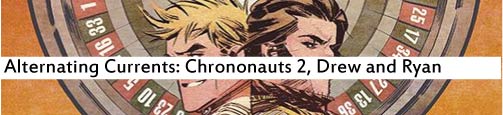
Alternating Currents, Chrononauts 2, Drew and Ryan

Today, Drew and Ryan are discussing Chrononauts 2, originally released April 15th, 2015.

Homer: Sorry but this is a highly sophistimacated doo-whackey. If you don’t use it responsibly… Kablammo!
Lisa: Ow! Someone just punched me in the face!
Homer: It was your mother!

The Simpsons, “Treehouse of Horror VIII”

Drew: I’m endlessly amused by the notion of using sci-fi technology for mundane personal uses. Homer using his teleporter to grab a beer without getting up, or to avoid having to climb the stairs feels like an abuse of the technology, but it’s also a compelling estimation of how it would be used in the hands of an everyday person. As much as we might claim to want to use a time-machine to avert a world war or warn people of impending disaster, we’re probably more likely to use it to ace a history presentation, meddle with the affairs of our family, or just bring the younger versions of our friend group to the present in hopes of winning an argument. Doctors Corbin Quinn and Danny Reilly find even less noble uses for their chronosuits in Mark Millar and Sean Gordon Murphy’s Chrononauts 2, and it proves to be an absolute blast. Continue reading

Chrononauts 1

Alternating Currents: Chrononauts 1, Ryan and Drew

Today, Ryan and Drew are discussing Chrononauts 1, originally released March 18th, 2015.

Ryan: On September 13th, 1959, the Soviet Union made history by landing the first man-made object — the Luna 2 — on the moon.  The Soviet success allowed their premiere, Nikita Khruschev, a scientific triumph to laud over President Eisenhower demonstrating the virtues of Communism. After a decade of dominating the Space Race, the USSR lost the ultimate prize to the USA and its space program, which had been kicked into high gear under the watch of President John F. Kennedy, when the first feet to touch the surface of the moon belonged to American astronauts on July 20, 1969. Despite the years of rivalry and the mires of the Cold War, when Apollo 11 touched down, the Russians cheered. As Soviet astronaut Alexei Leonov wrote, “Everyone forgot that we were all citizens of different countries on Earth. That moment really united the human race.” Mark Millar and Sean Gordon Murphy’s new title, Chrononauts, seeks to recapture the magic of families across the world crowding around their televisions and radios as science catches up to imagination. Continue reading

Suiciders 1

suiciders 1

Today, Patrick and Drew are discussing Suiciders 1, originally released February 25th, 2015.

Patrick: I usually resist pulling in creator’s comments about their own material when discussing a comic book — especially a first issue. But I’ve heard Lee Bermejo pitch this series twice now, once at NYCC in 2013 and again at C2E2 in 2014. Both times, he lead with a joke about the premise: “It takes place in post-apocalyptic Los Angeles… which is to say: Los Angeles.” It’s a good line, and far be it for me call someone out for re-using a clever turn of phrase. What interests me about his repeated use of the joke is that there’s really no point in any post-apocalyptic storytelling unless it can tell us about life in the pre-apocalypse. In a manner reflecting his detail-heavy drawing style, Bermejo writes about many specific societal ills that plagues LA, blowing everything out to grotesque proportions. The remarkable thing — and the thing that makes me most uneasy as a reader and resident of the City of Angels — is just how recognizable it all is. Continue reading

Hawkeye 21

Alternating Currents: Hawkeye 21, Drew and Spencer

Today, Drew and Spencer are discussing Hawkeye 21, originally released February 4th, 2015.

I shall not today attempt further to define the kinds of material I understand to be embraced within that shorthand description; and perhaps I could never succeed in intelligibly doing so. But I know it when I see it…

Justice Potter Stewart

Drew: I’ve never been a fan of classifications in art. I could go on at length about how sub-subgenres eventually become too specific to have any utility, while broader classifications face the opposite problem of being to general, but my real issue is that our definitions fall apart under scrutiny. We tend to accept the kind of “I know it when I see it” definition of basically every category we have, from gender to genre, but most working definitions have to allow for so many exceptions that they lose all meaning. Take “superhero” for example. We all have a lose idea of who a superhero is, what they do, how they act, but to try and pin down the definition reveals that none of those things are fixed. Are they heroic (courageous, noble, selfless)? Many are, sure, but there are plenty of antiheroes muddying up any moral definition. What about superpowers? Again, lots do, but with so many non-powered superheroes, it’s hardly a criteria. The closest I can come up with is based on our relationship to superheroes — namely, that we expect their actions to lead to their success. In that way, I’d like to posit Clint Barton — particularly as depicted in Matt Fraction and David Aja’s Hawkeye — as an antisuperhero. Continue reading

Best of 2014: Best Issue

Best of 2014: Best IssueEpisodic storytelling is the name of the game in monthly comics. Month- or even multi-year-long arcs are fine, but a series lives and dies by its individual chapters. From self-contained one-offs to issues that recontextualize their respective series, this year had a ton of great issues. Whittling down those issues to a list was no easy task (and we look forward to hearing how your lists differ in the comments), but we would gladly recommend any (and all) of these issues without hesitation. These are our top 14 issues of 2014.
Continue reading

Best of 2014: Best Colorist

Best of 2014: Best Colorist
From lines at conventions to the internet petitions every time an assignment changes, its clear comic fans put a lot of stock in who writes and draws their comics, often to the exclusion of the rest of the creative team. While colorists have slowly been gaining more recognition, they are still largely the unsung heroes of the comics world, adding depth and meaning to the storytelling in ways so subtle as to be almost invisible. As we started preparing our year-end lists, we realized that we, too, had been overlooking the contributions of these indispensable artists, and decided it was high time to offer the best the praise they so rightly deserve. These are our top 14 colorists of 2014.
Continue reading

Swamp Thing 37

Alternating Currents: Swamp Thing 37, Drew and SpencerToday, Drew and Spencer are discussing Swamp Thing 37, originally released December 3rd, 2014.

Men have become the tools of their tools.

Henry David Thoreau

Drew: I think it’s safe to say that technophobia has always been a thing. From fire to electricity, somebody was always more concerned over what we were losing than what we were gaining. Stories of people fearing electrical vapors or locomotives seem quaint to us now, but it wasn’t so long ago that buying things through this new internet thing seemed like an absurdly risky endeavor. In fact, I think consumers were so scared of online shopping that we were kind of oblivious to the impacts it could have in offline shopping. If anyone should have been scared of online shopping, it was brick-and-mortar establishments like Blockbuster and Borders (and, you know, countless small businesses) that couldn’t compete with the convenience and selection. The comics industry is still recovering from its most recent bout of technophobia, having only recently fully embraced same-day digital releases and content designed specifically for screens. Those growing pains are very much at the heart of Swamp Thing 37, which checks in on how the various avatars are reacting to the space technology is carving out for itself. Continue reading