Heroes We Can All Relate To in Green Lanterns 47

By Mark Mitchell

This article contains SPOILERS. If you haven’t read the issue yet, proceed at your own risk!

I really misjudged Green Lanterns 45. In my write up of that issue I figured Tim Seeley’s story to be primarily interested in teasing out the mystery surrounding the indentity of the murderers who killed Jessica Cruz’s friends, but in truth, the larger “Ghosts of the Past” arc has much more on its mind.
Continue reading

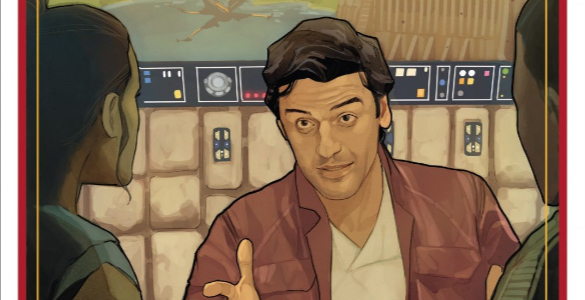
Torture Buddies are the Best Buddies in Poe Dameron 27

by Taylor Anderson

This article containers SPOILERS. If you have not read the issue yet, proceed at your own risk!

It’s easy to overlook throughout the Force Awakens and the Last Jedi, but Poe Dameron and Rey (does she have a last?) have spent virtually no time together by the time the latter film ends. That’s kind of odd when you think about how Poe, Rey, and Finn are touted as the next iteration of Luke, Leia, and Han. This being the state of things, however, it makes sense the three of them would have a lot to catch up on. Still, the last issue of “Story Time with Poe and Friends” wasn’t all that great despite it’s apparent need. So does the second issue featuring the same premise fare any better?

Continue reading

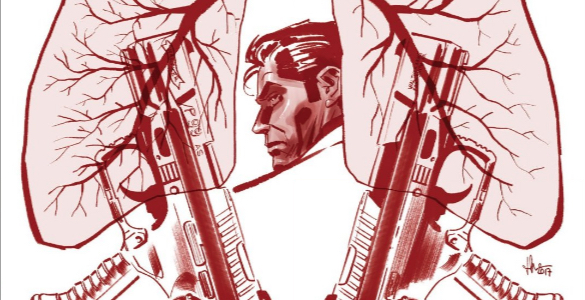
James Bond: The Body 5 Discussion

by Michael DeLaney and Drew Baumgartner 

This article contains SPOILERS. If you haven’t read the issue yet, proceed at your own risk!

slim-banner

Michael: “Realism” can be a dirty word in the realm of comic books and its movie franchise offspring. Making comic book superheroes “more realistic” often makes them lose their larger-than-life qualities. James Bond, on the other hand, is a character who could probably use a little more realism. The Daniel Craig series of James Bond films have been hailed as “more realistic” than their predecessors, but he’s still an uncrackable murder machine. The beauty of James Bond: The Body 5 is that Aleš Kot provides us with a rare opportunity: to get inside Bond’s head. Continue reading

Setting a Mood in Venom 1

by Spencer Irwin

This article contains SPOILERS. If you haven’t read the issue yet, proceed at your own risk!

slim-banner

First issues have a lot to do, and Venom 1 checks off many of those requirements with subtle aplomb. It establishes its hero’s goals, modus operandi, and morality in a casual, understated way, and spends plenty of time looking towards the future, expanding Venom’s world in intriguing new directions. Despite all that, though, more than anything Venom 1 is interested in creating an atmosphere, setting a mood. It’s an issue that’s bleak and relentless, and for once, I mean that as a compliment. Continue reading

Loving the Dimension You’re With in Oblivion Song 3

by Drew Baumgartner

Oblivion Song 3

This article contains SPOILERS. If you haven’t read the issue yet, proceed at your own risk!

Hey, can you get Stockholm syndrome for a place? For a set of circumstances? When generalized in this way, Stockholm syndrome seems less like a pathology and more like a testament to human resilience. We can come to love whatever hand life deals us, even when we initially wanted something completely different. Maybe that’s a coping mechanism to keep us from dwelling on what could have been, but it’s potent, either way. Anywhere you look, from crumbling cities to evacuated war zones, you’ll find people who refuse to leave because this is their home. Or, more precisely, this is their life — they can’t just chuck it all away for something they might have preferred a decade ago. It’s not an attitude that makes a whole lot of sense from the outside looking in, but that may be exactly what the remaining survivors in Oblivion are feeling. Continue reading

A Journey Through Color in Isola 2

By Spencer Irwin

This article contains SPOILERS. If you haven’t read the issue yet, proceed at your own risk!

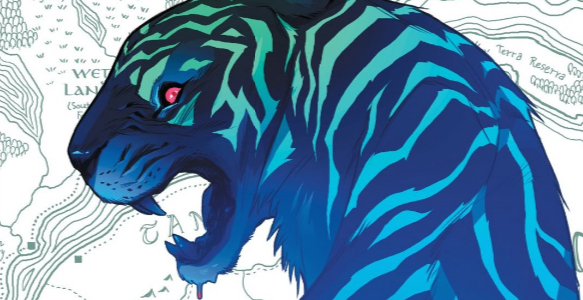
Using color to differentiate settings and characters is not new — even television shows such as Heroes or The Defenders have done it — but I’m still amazed by how well Isola uses the technique. It helps that Msassyk’s colors (combined with Karl Kerschl’s crisp, animation-worthy artwork) are so jaw-droppingly gorgeous — they’d take readers on an immersive journey by that merit alone — yet Msassyk takes things to the next level by constantly varying palettes throughout the issue, shifting his color schemes to indicate new locations, introduce new characters (or bring back old ones), and even just show the passing of time. By the end of the issue things look completely different from the outset, making readers feel like they’ve truly taken a journey with Rook and Olwyn, truly spent a night making their way through this lush fantasy world with them. Continue reading

How Not to Communicate in Runaways 9

By Spencer Irwin

This article contains SPOILERS. If you haven’t read the issue yet, proceed at your own risk!

Miscommunication has always been a major threat in superhero comics: after all, one of the most famous tropes of the medium is the idea of pitting heroes against each other simply because they didn’t take the time to talk and explain themselves first. Of course, the Runaways have never really been superheroes, so the miscommunication that plagues their team is a more subdued, realistic one. Don’t let that fool you, though: it’s easily the greatest threat the team faces right now. Continue reading

The Timelines Dissociate in Eternity Girl 3

By Drew Baumgartner

Eternity Girl 3

This article contains SPOILERS. If you haven’t read the issue yet, proceed at your own risk!

Spoiler alert for season one of Westworld, but I’m now deeply suspicions of non-explicit linearity in sci-fi. Fiction has long featured flashbacks and achronological storytelling, but usually by being up-front about when and where those things are happening. Westworld reminded us that stories don’t have to be transparent about when things are happening in relation to one another, and with characters that are impervious to age, we might make bad assumptions (or be intentionally misled). It’s unclear to me how much this applies to Eternity Girl, but that’s exactly why I’m so wary of jumping to any conclusions. Continue reading

Defeat and Retaliation in Analog 2

by Patrick Ehlers

This article contains SPOILERS. If you haven’t read the issue yet, proceed at your own risk!

slim-banner

Normal Person + Anonymity + Audience = Total Fuckwad

Penny Arcade, 2004

Back in 2004, the Penny Arcade guys were disgusted by the behavior of some people playing Unreal Tournament online, leading to them publishing the strip referenced above. Fourteen years later, and we know better than to ever be shocked by a faceless teenager hiding behind the gamertag “6ftcock” using hate speech in PU:BG. Vile behavior begets other vile behavior, and as long as the bullies never have to meet their victims, that fuckwadery is as make-believe as the game they’re playing. At least, that’s what John Gabriel’s Greater Internet Fuckwad Theory postulates. But what if those hateful impulses, those destructive anti-social tendencies are just part of who we are, with or without the internet? Gerry Duggan and David O’Sullivan’s Analog 2 dutifully moves the series’ plot mechanics forward, while continuing to mine this thematically rich vein. Continue reading

“What Ifs” in Peter Parker: the Spectacular Spider-Man 304

by Taylor Anderson

This article contains SPOILERS. If you haven’t read the issue yet, proceed at your own risk!

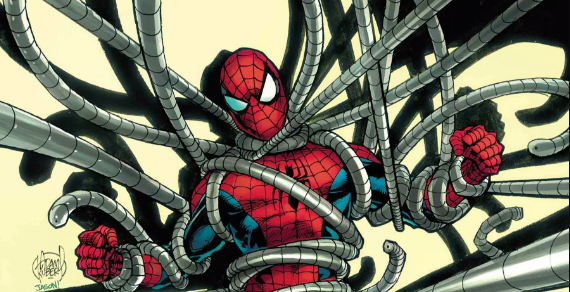
One of my favorite episodes of Star Trek: the Next Generation involves Worf and parallel dimensions. In it, Worf is returning to the Enterprise from a Bat’leth tournament and through a bizarre set of circumstances finds himself transporting to different versions of his universe. In one, he’s married to Deanna Troi. In another he goes from placing first in the Bat’leth tournament to ninth. In yet another, he’s responsible for the inadvertent death of Goerdi La Forge. It’s a fun episode because it sets familiar characters and settings against an unfamiliar backdrop. This “what if” is a favorite of every Star Trek show and the same goes for comics. That being the case, you think I would be tired of the conceit, but the very opposite is true — I love it.

Continue reading