Reconciling with the Past in Black Bolt 12

By Drew Baumgartner

Black Bolt 12

This article contains SPOILERS. If you haven’t read the issue yet, proceed at your own risk!

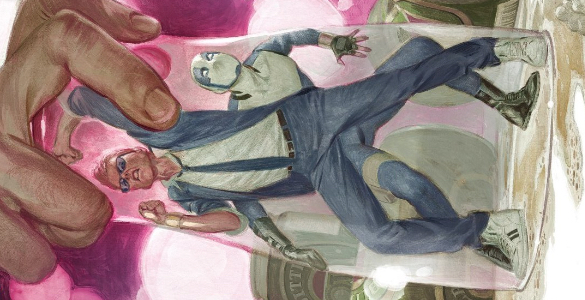
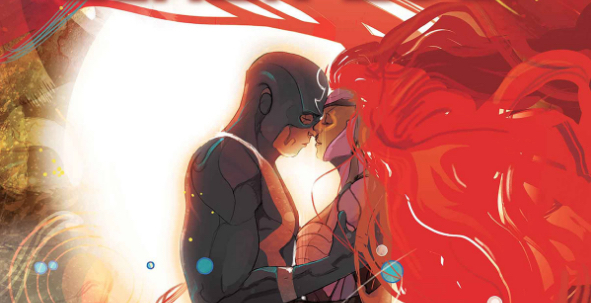
The superhero genre is littered with emotionally scarred men. Whether it’s a murdered loved one or a superpower-generating freak accident, trauma of one kind or another is a ubiquitous motivator for superheroes. Indeed, for most characters, that tragic backstory is so central to who they are and why they fight that it’s all but impossible to truly confront it — remove the psychological pain, and you “solve” the character’s motivating problem, effectively ending their story. So most of these characters are doomed to never resolve their issues. But what if why they fight has little to do with their trauma? What if that emotional baggage isn’t their motivating force? What if a superhero could confront their problems without destroying the conflicts that make them a hero in the first place? These are questions posed by discerning fans for decades, but rarely have those questions been answered as effectively as they are in Saladin Ahmed and Christian Ward’s Black Bolt 12. Continue reading
Peter’s Problems Outpace His Growth in Amazing Spider-Man 798

by Drew Baumgartner

Amazing Spider-Man 798

This article contains SPOILERS. If you haven’t read the issue yet, proceed at your own risk!

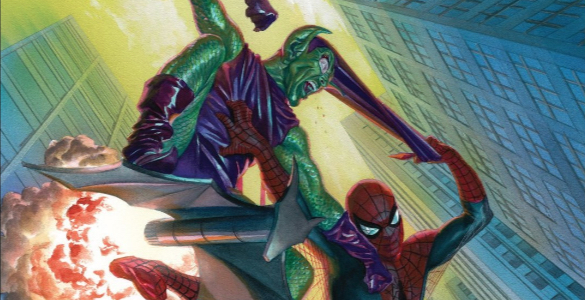
I had a college professor who liked to talk about “the ascending spiral groove thang” — the notion that we tend to cycle through the same problems, but always with our previous experience informing each new iteration, turning that cycle into a kind of spiral staircase. It’s an elegant idea that helps turn the hopelessness of facing down the same issues again and again feel like an opportunity for improvement. It’s an idea that Peter Parker embodies almost perfectly, vowing to improve (if never quite perfect) the decisions that led to the deaths of his loved ones. But what if those problems have an ascending spiral groove thang of their own? What if Peter’s problems are getting smarter and more mature along with him? That’s exactly what he’s up against in Amazing Spider-Man 798, as Norman Osborn returns with the Carnage symbiote. Continue reading

A Glass Half-Full of Pessimism in Days of Hate 3

by Drew Baumgartner

Days of Hate 3

This article contains SPOILERS. If you haven’t read the issue yet, proceed at your own risk!

Drew: The heuristic we use for optimism and pessimism — whether a glass is seen as half full or half empty — focuses on the language we use to frame a description. But that’s not necessarily the difference between an optimist and a pessimist. If we could construct some kind of neutral description of an amount of water in a glass, you could still have disagreement about whether that is good or bad, whether it will improve or get worse, and what exactly caused this state in the first place. Moreover, in this day and age, you might have people disagreeing about the facts of how much water is in the glass at all. These are the distinctions Aleš Kot and Danijel Žeželj make between Amanda and Xing’s accounts of their relationship in Days of Hate 3. Continue reading

The Gordons Investigate Together in Batgirl 21

By Drew Baumgartner

Batgirl 21

This article contains SPOILERS. If you haven’t read the issue yet, proceed at your own risk!

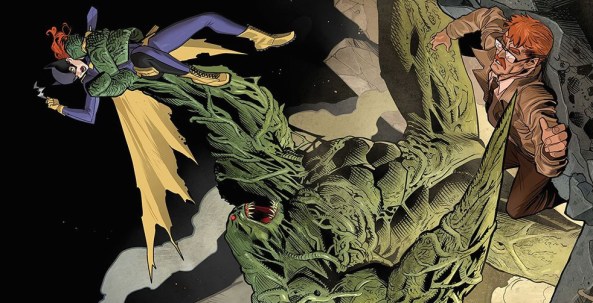
One of my favorite anecdotes (not mine), involves some confusion at an Arby’s drive-thru — a woman orders orange juice and drives away with a cup full of au jus. Of course, the entire premise of that story requires us to accept that anyone would order orange juice at an Arby’s, but I like the punchline enough to justify that minor suspension of disbelief. And that really is how I think about suspension of disbelief: if it’s justified — even retroactively — I’ll happily go along for the ride; if not, then the very odd detail of the orange juice at the Arby’s drive-thru probably shouldn’t be there. Such is the case with Batgirl 21, which finds both Babs and Jim independently investigating the same supernatural phenomenon, but never quite justifies their choices. Continue reading

Kill or be Killed 17: Discussion

By Drew Baumgartner and Ryan Desaulniers

Kill or be Killed 17

This article contains SPOILERS. If you haven’t read the issue yet, proceed at your own risk!

Don’t bury the lede.

Journalism, Traditional

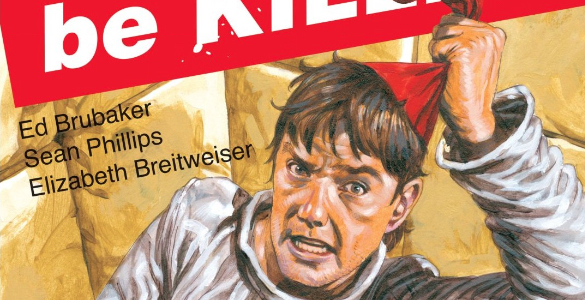
Drew: Is journalism the opposite of storytelling? Maybe these terms are too sticky to parse, but it’s interesting to me that one of the cardinal rules of journalism — putting the most dramatic part of the story at the start of the article — is essentially the opposite of the basic narrative structure, where the climax arrives very close to the end of a story. Actually, the difference may lie less in where the “climax” (for lack of a better word) occurs as where it’s allowed to occur. While narratives tend to have the climax in their final act, it is by no means as hard-and-fast a rule as “don’t bury the lede,” and precisely where the climax fits in that final act is decidedly more flexible than absolutely, positively occurring in the first paragraph. It’s a simple matter of the purposes of these art forms — the kinds of tricks storytellers use to surprise us or keep us in suspense are totally inappropriate in a newspaper article designed to inform us of what happened where. And it’s those wrinkles in form, unique to storytelling, that make Ed Brubaker and Sean Phillips’s Kill or be Killed 17 such a delight. Continue reading

There’s Power Hidden in the Style of Black Magick 11

by Drew Baumgartner

Black Magick 11

This article contains SPOILERS. If you haven’t read the issue yet, proceed at your own risk!

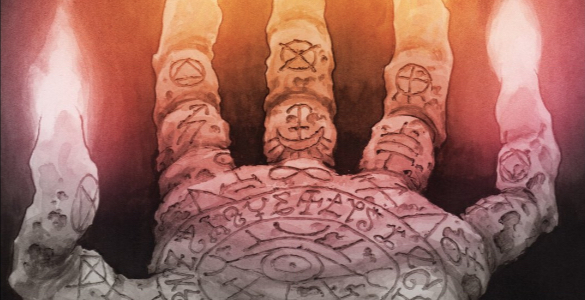
As a medium, comics are limited to two dimensions and single moments in time, but those are really the only limitations. Even so, it can be easy to forget that comics art can be anything but representational, as so many mainstream comics tend to default to some much more restrictive rules. This is particularly strange given the popularity of supernatural or superhuman powers in comics. In a medium with infinite possibilities, these powers tend to be depicted in the same ways, again and again; a hard punch (like, a really hard punch), a big explosion (like, a really big explosion, a massive spaceship (like, a really massive spaceship), etc. It takes a much more thoughtful, much more subtle hand to actually take advantage of the medium’s possibilities to represent the otherworldly, which is exactly what Nicola Scott does in Black Magick 11, cashing in some of the stylistic choices she’s made from the beginning of the series to really sell the magic at hand. Continue reading

Burying the Message in Infinity 8 1

by Drew Baumgartner

Infinity 8 1

This article contains SPOILERS. If you haven’t read the issue yet, proceed at your own risk!

Are science fiction and heart mutually exclusive? One word: Cocoon.

Steve Guttenberg, Party Down

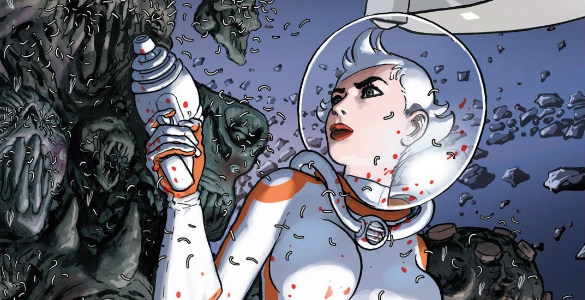
Like any sci-fi fan, I love a good high-concept premise. Those premises give us something to latch onto in the uncertain settings of science fiction, but are ultimately just the hook that draws us into the narrative. For any story — sci-fi or otherwise — to work, it needs to meaningfully comment on the human condition (even if, you know, the characters are aliens or robots or whatever). The story needs to connect on some deeper human level in order to be anything other than a series of things that happen. Unfortunately, Infinity 8 1 is too invested in its own competing high-concept premises to ever make that kind of connection. Continue reading

Quantum and Woody 4 Aims for the Audience

by Drew Baumgartner

Quantum and Woody 4

This article contains SPOILERS. If you haven’t read the issue yet, proceed at your own risk!

We live in a world torn between postmodernism and romanticism. We’re just as likely to encounter arguments based on The Death of the Author as we are those based in auteur theory. That we have different critical lenses at our disposal may not seem all that remarkable, but I’d argue that these two aesthetics have completely different opinions on what art is and how we consume it. Does art facilitate some kind of transfer of ideas between the creator and the audience, or is it simply a mirror that audiences use to reflect themselves? As mutually exclusive as those options appear, Quantum and Woody 4 seems to exist in a space between, riffing on classic tropes and even explicit references while still crafting a character all its own. Continue reading

Strength in Teamwork in Batman 43

By Drew Baumgartner

Batman 43

This article contains SPOILERS. If you haven’t read the issue yet, proceed at your own risk!

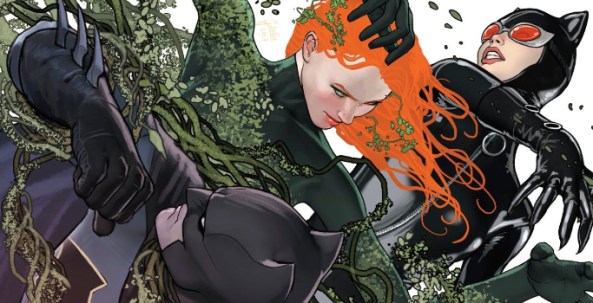
On the surface, grief and regret may not seem all that similar; one deals with an inescapable force of nature, the other is preoccupied with (potentially avoidable) personal failures. I might argue that regret is a kind of grief, albeit over the death of an idea or an opportunity, as opposed to a loved one, but there’s a more fundamental commonality between these two: how personal they feel. This can make both grief and regret feel very lonely, potentially driving us away from the friends and family who might want to support us through those difficult times. It’s a trap Ivy falls into, trying to go it alone in the face of her own grief and regrets, but Batman and Catwoman (and the entire creative team behind Batman 43) have a better way. Continue reading

Moonshine 8: Discussion

by Drew Baumgartner and Patrick Ehlers

Moonshine 8

This article contains SPOILERS. If you haven’t read the issue yet, proceed at your own risk!

Dyin’? Boy, he can have this little life any time he wants to. Do ya hear that? Are ya hearin’ it? Come on. You’re welcome to it, ol’ timer. Let me know you’re up there. Come on. Love me, hate me, kill me, anything. Just let me know it.

Luke, Cool Hand Luke

Drew: It’s hard for me to read genre fiction through anything other than a deconstructionist lens. I mean, it’s hard for me to read anything through anything other than a deconstructionist lens, but this is especially true of genre fiction, where by definition conventions must be explicitly followed. Fortunately for me, that postmodern generic awareness is just as prevalent in creators as it is in audiences, so I’m never struggling to find multidimensional, self-aware, fully postmodern genre fictions. But the good ones, the ones that actually force me to reexamine the genres they’re deconstructing (rather than just having fun with some winking references), are few and far between. But Brian Azzarello and Eduardo Risso’s collaborations have always gone a step further. Beyond cute self-awareness or even symphonic use of references, Azzarello and Risso’s work offer new perspectives on the foundational genre pieces they take on. That is to say, their comics don’t just gain meaning from their references — their references gain meaning from the comics. They’re almost a purer form of postmodernism, digesting entire genres in a few issues, offering new readings to even the most familiar works of art. Continue reading